Coherence = From Inside Out
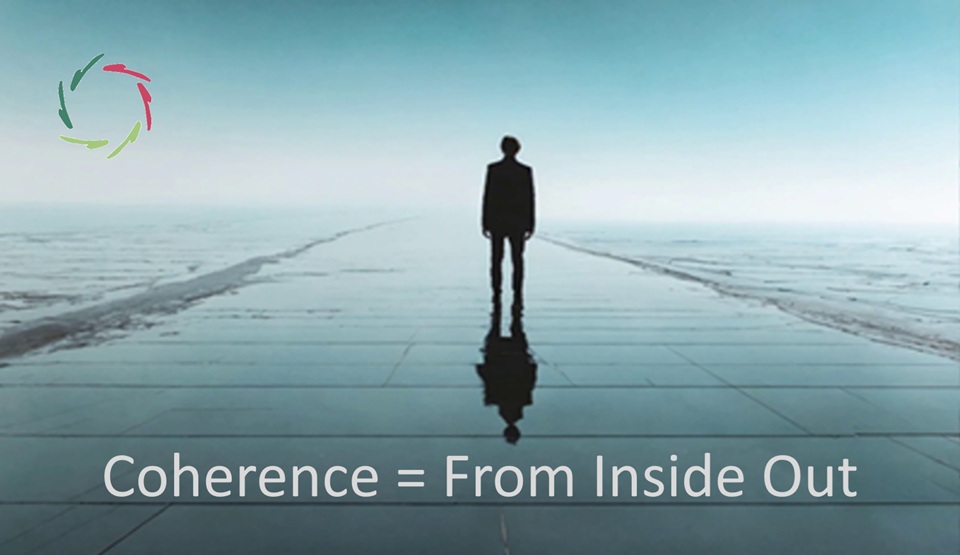
A good story, a scientific theory, or a conversation may possess coherence. Most people recognize it when they see it. We organize things, and coherence may follow.
Yet living systems seem to follow a specific logic. Their coherence does not arise because someone assembled them. It grows from within. As explored in About the (In)visibility of Coherence, it truly comes from what remains largely invisible.
Inside means self-organizational
‘Inside’ in the expression ‘from inside out’ refers to the ongoing organization of a system itself. A tree grows from inside out, not because everything happens inside its trunk, but because its organization continually unfolds from its own living dynamics. The same holds for an embryo, an immune system, a human mind, or an ecosystem. Each responds to its environment, yet none is shaped primarily by external assembly.
This deeper meaning of ‘from inside out’ is explored from several perspectives in What ‘From Inside Out’ Really Means. The ‘inside’ is self-organizational rather than spatial. The environment matters, but development comes through responses generated from within.
Definitions
This perspective invites three closely related definitions:
- Intrinsic organization is the ongoing self-generation, self-maintenance, and self-development of an organization through its own network of mutually constraining relationships.
- Coherence is the quality of intrinsic organization.
- Open coherence is the quality of intrinsic organization that remains developmentally open through continual inside-out reorganization.
These provide a lens through which many apparently different phenomena begin to resemble one another.
‘Organization’ is not enough
The word ‘organization’ itself deserves careful attention. Not every organization self-organizes.
| Organization | Intrinsic organization | Coherence |
| A property of a system | An ongoing process of the system | The quality of that process |
| May be externally imposed | Arises from within | Can deepen or diminish |
| May be static | Self-generating, self-maintaining, self-developing | May be open or closed |
| Does not necessarily produce emergence | Produces emergent organization | Determines the richness and viability of emergence |
A bridge is organized. A crystal is organized. A filing cabinet is organized. Yet none of these continually generate and develop their own organization in the way living systems do.
By contrast, a child, a brain, an immune system, or a forest continually reorganizes itself through countless internal interactions. That ongoing intrinsic organization characterizes coherence.
Nature rarely assembles. It unfolds.
A seed does not begin by collecting branches. An embryo is not constructed piece by piece. Healing does not arise because new health is imposed from outside. Instead, living systems continually reorganize themselves through their intrinsic dynamics while remaining open to their surroundings.
This idea is explored more broadly in Inside-Out is Nature’s Way. Looking from this perspective, nature is less a collection of objects than a movement of unfolding coherence. Living beings do not simply persist. They continually become.
Perhaps this is why genuine growth often feels surprisingly natural. It does not resemble being forced into shape. It resembles something already present gradually finding expression.
The same may hold for intelligence.
We often imagine intelligence as something accumulated: more knowledge, more computation, more sophisticated reasoning. Yet this may describe only the visible surface.
As discussed in Intelligence from the Inside Out, intelligence can also be understood as a profoundly unfolding process. Concepts become visible expressions of much richer underlying dynamics. Understanding is not inserted into a system. It gradually emerges as intrinsic organization becomes increasingly coherent.
Seen this way, intelligence is less something a system possesses than something it continually becomes.
Between entropy and rigidity
Intrinsic organization is not guaranteed to flourish. When intrinsic organization progressively loses its integration, fragmentation follows. At the other extreme, it may become increasingly so rigid that further development becomes difficult.
Triangular to these lies a third possibility: continual emergence. Here, intrinsic organization remains coherent while continually reorganizing itself in response to changing circumstances. One may think of this as open coherence.
Every adaptive organization faces two fundamentally different modes of failure: dissolution into entropy and fixation into rigidity. Development occurs through continual inside-out reorganization, remaining sufficiently stable to preserve identity while sufficiently open to continue growing.
Engineering from the inside out
This distinction has important implications for artificial intelligence.
Much engineering traditionally works from the outside in. Components are designed, assembled, optimized, and connected. This approach has produced extraordinary achievements and will undoubtedly remain valuable.
Yet if intelligence itself depends on intrinsic organization, another engineering philosophy becomes preferable. Rather than assembling intelligence directly, one cultivates the conditions under which increasingly coherent organization can emerge.
This is the spirit of coherence engineering.
Coaching from the inside out
The same principle has always been central to AURELIS coaching. This does not place meaning into someone. It does not install wisdom or manufacture motivation. Rather, it supports the person’s own intrinsic organization in becoming more coherent.
Lisa also coaches from the inside out, as described in Coaching Lisa — ‘From the Inside Out’. She is not primarily a mirror of content. She is a tuning fork for open coherence, gently inviting deeper patterns to resonate without imposing their direction.
The same organizational principle that may eventually underlie intelligent A.I. may thus underlie meaningful coaching.
A different perspective
Looking from the inside out changes more than our understanding of coherence. It changes our understanding of ourselves.
Perhaps intelligence is not fundamentally about computation. Perhaps healing is not fundamentally about repair. Perhaps growth is not fundamentally about adding something new. Perhaps they all express one deeper movement: intrinsic organization gradually becoming more coherent.
This perspective does not reduce everything to a single idea. It simply suggests that many phenomena we usually study separately may be different expressions of one ongoing process. If so, coherence is not merely one topic among many. It is the living quality through which intrinsic organization continually unfolds from the inside out.
Related Posts
Resonance at the Center of Lisa’s and the Human Mind
Resonance is something we all recognize, though rarely by name. It appears in moments when something simply feels right, without needing explanation. This blog explores that phenomenon as something deeply human — and increasingly relevant to how humans and A.I. may meet. In doing so, it gently unfolds how resonance may lie at the center Read the full article…
Coherence in the Brain ― A Primer on Waves
The picture of the brain as a network of neurons exchanging signals is correct, but incomplete. Recent neuroscience increasingly shows neural activity unfolding as dynamic waves that continuously travel across the cortex, organizing and reorganizing the brain as they go. This is especially fascinating because these discoveries offer an unexpectedly concrete window into a deeper Read the full article…
From Coherence to Intelligence
Coherence is a word that feels familiar. Most people recognize it when they encounter it — in a conversation that flows, in an idea that ‘clicks,’ or in a person who feels internally consistent. Yet when asked to define it precisely, something seems to slip away, almost as if it resists being captured. This blog Read the full article…