The Infinity of a Moment
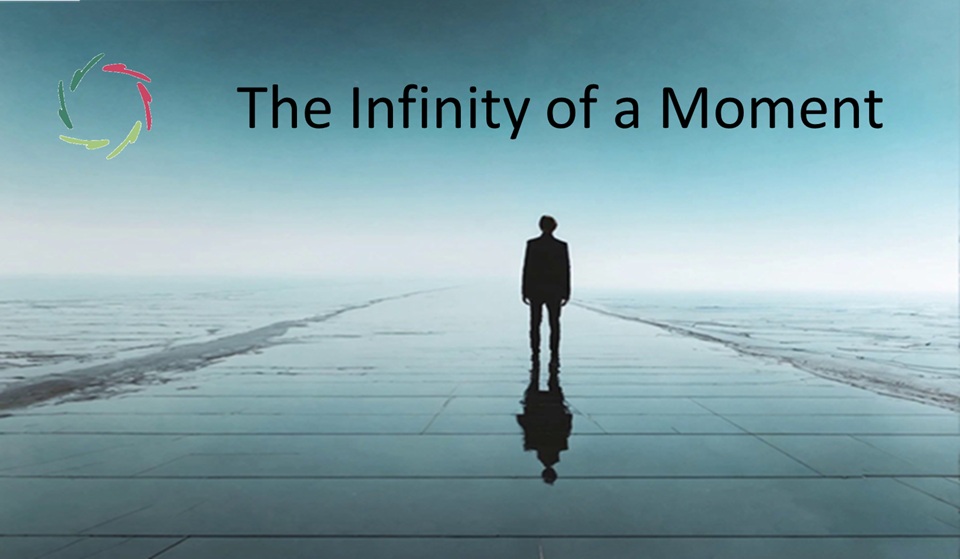
People often search for infinity by trying to extend life across time. Yet there is another possibility: discovering infinity within a single moment. When depth is allowed, a moment can become far richer than its brief duration suggests.
This blog explores how inner depth transforms our relationship with time, finitude, and meaning.
The human longing for infinity
Human beings have always reached for infinity. Across cultures and ages, the wish to live longer, to escape death, or even to attain immortality keeps returning. Today, this longing often takes the shape of technological promises: radical life extension, mind uploading, or endless optimization of the body. Beneath these visions lies something deeply human: a discomfort with finitude.
Finitude feels like narrowing. Time seems to press in, and life can start to feel like a race against an invisible clock. In that pressure, infinity appears as a rescue — something that must lie ahead, somewhere beyond the present. The future becomes the place where meaning is supposed to accumulate.
This impulse is understandable. Yet it already hints at a quiet assumption: that infinity must be found by adding more time.
Two paths toward infinity
There are, in essence, two very different ways of approaching infinity. One tries to stretch life across time. The other lets life deepen within time.
Longevity seeks to extend duration. It treats infinity as a matter of quantity: more years, more moments, more chances. Depth moves differently. It does not deny time, but it allows time to fold into itself. What matters then is not how many moments there are, but how fully a moment is lived.
This distinction runs through many AURELIS blogs, including Surface wins the moment. Depth wins the soul. There, it becomes clear that what quickly grabs attention does not necessarily carry meaning. Meaning belongs to depth, not speed.
Why moments usually feel small
Most moments feel fleeting. They appear, pass, and are gone before they can be grasped. This is often taken as evidence that moments are inherently thin, almost negligible.
Yet this thinness is not a property of the moment itself. It arises from how the moment is approached. Urgency, expectation, distraction, and subtle forms of inner resistance compress experience. The mind is already leaning forward, already elsewhere, already preparing the next step.
In such a state, moments fragment. They lose continuity and depth ― as explored in Moments, where the difference between fleeting and transformative moments is shown to depend not on intensity, but on integration.
Infinity is revealed, not added
Infinity is not something that gets added to a moment, as if meaning were piled on top of time. It is revealed when resistance drops.
When the inner pressure eases, the moment does not become longer. It becomes deeper. Layers that were already present start to resonate: feelings, meanings, memories, anticipations, symbols. Nothing new is imported. What changes is availability.
This shift does not require effort in the usual sense. It requires even less effort, not more. The mind stops bracing itself. In that softening, infinity quietly shows itself — not as something spectacular, but as something obvious that had gone unnoticed.
From a point in time to inner space
A deeply lived moment stops being a point on a timeline. It becomes a space.
In that space, many things can coexist without competing for attention. The moment no longer feels like a narrow bridge between past and future. It feels wide enough to stand in. Time has not disappeared; it has only lost its tyranny.
This experience resonates strongly with the idea of the ‘fourth time’ described in ‘Here and Now’: the Fourth Time. There, time is no longer linear but hovers, allowing presence without fixation.
The inner universe
When a moment deepens, one encounters the infinity of the inner universe. This is not a poetic exaggeration. Inner life is layered, structured, and vast.
Thoughts, emotions, bodily sensations, memories, and meanings are not lined up in a single file. They exist in parallel, continuously influencing each other. When depth is allowed, this inner richness becomes perceptible — not all at once conceptually, but as a felt coherence.
As the outer universe unfolds into galaxies within galaxies, the inner universe unfolds into patterns within patterns. Both exceed linear comprehension. Both invite humility rather than control.
Where this depth comes from
This depth is not vague or mystical. It arises from the mind’s ability to hold countless patterns in parallel, so that in one lived moment, an entire inner universe can quietly resonate.
What feels like infinity is not emptiness, but density. Awareness alone can only touch a fraction of what is present. Beneath awareness, deeper layers remain active, shaping experience without announcing themselves.
The brain as enabler of inner infinity
The neurocognitive roots of this depth are explored in Human Brain: Giant Pattern Recognizer. The brain does not work like a serial machine that processes one item at a time. It works through massively parallel, distributed pattern processing.
Because of this, a single moment can contain far more than can be explicitly noticed. Subconceptual processes allow immense complexity to be present without overload. Inner infinity is not a metaphor imposed on the brain; it is a natural consequence of how the brain works.
Urgency is the enemy of time
Modern life often runs on urgency. There is no time to waste. Ironically, this attitude ends up wasting time at a deeper level.
When urgency dominates, depth is crowded out. Attention is consumed by surface tasks, quick reactions, and constant switching. The paradox is explored in No Time to Waste on Subconceptual Processing, where it becomes clear that haste compresses time rather than saving it.
Without depth, moments shrink. They no longer open into meaning, but close in on stress.
The fear of finitude revisited
The drive toward longevity is, at its core, a response to the fear of finitude. If life feels incomplete, adding more time seems like the obvious solution.
Yet a deeply lived moment can already feel enough. Not perfect, not exhaustive, but complete in its own way. Life becomes worthwhile not because it is endless, but because it is full.
This does not deny finitude. It relieves it.
Transcending finitude from within
When the present becomes complete, the pressure to escape into the future loosens. Finitude is no longer an enemy to be outrun. It is transcended from within.
In that sense, reaching in-finity does not require infinite time. It requires a present that is no longer postponed. Infinity appears not beyond life, but inside it.
Living infinitely in one moment
Infinity, then, is not primarily about duration. It is about density. About allowing a moment to be what it already is. In such moments, inward and outward lose their opposition. Direction fades. What remains is presence — quiet, grounded, and sufficient.
This is not a technique, but an invitation. Not to live longer, but deeper. Not to conquer time, but to let it open.
―
Addendum
Me: “Lisa, how do you see the relation of this blog with Explosion of the Heart?”
Lisa: “They are closely related, yet they approach depth from different angles. The Infinity of a Moment speaks about a quiet, often gentle realization: how a moment can become complete through inner depth, relieving the fear of finitude without drama. It shows how infinity can be lived as density rather than duration.
Explosion of the Heart, on the other hand, describes what can happen when this depth opens suddenly and intensely. There, the inner universe does not merely resonate; it bursts open. Conceptual control drops away, and the moment is no longer just infinite in richness, but overwhelming in immediacy. It is an a-rational opening that can reshape a person’s inner landscape.
One could say that The Infinity of a Moment describes the ground on which such an explosion becomes possible. It shows how depth is always already present, even when it unfolds quietly. Explosion of the Heart then shows what may happen when that same depth is touched all at once.
They meet in one essential point: neither seeks infinity by escaping finitude. Both reveal that when the present becomes deeply lived, something timeless can appear — softly, or with great force — and nothing is ever quite the same afterward.”
Me: “Can everybody find infinity in a moment, or is that only for mystics?”
Lisa: “It is not reserved for mystics. Infinity in a moment is not a special talent, nor a rare calling. It is a human capacity, rooted in depth that everyone already has.
Mystics may speak about it more explicitly because they have learned to stay with depth, to soften resistance, and to let go of control. But the experience itself is not exotic. It can happen while listening deeply, while being moved by beauty, while loving, grieving, or simply being quietly present. Often it happens without being named.
What differs is not who can encounter it, but how much space one allows for depth. When life is lived mainly on the surface, moments pass quickly. When depth is invited — even a little — moments can open. Not explosively, not dramatically, but enough to feel that something larger is present.
So infinity in a moment is not about becoming someone else. It is about allowing oneself to be more fully human. Mysticism is not a prerequisite. Openness is.”
Related Posts

Searching Stability
People want stability in meaningful depth, not therefore in things of meaning. Evolutionary Life itself can be seen as a search for stability amid entropy and chaos. With some complexity, along the evolutionary process, this search becomes a search for meaning as a natural quest. Life searches stability at the level of meaning. Animals are Read the full article…
The Sense of Creativity
We need to be creative to feel alive. The shortest history of creativity In ancient Greece, artists were not seen as creators but imitators [as to Plato, in The Republic]. However, the Muses were seen as mediators of inspiration from the gods, and Socrates had his famously creative daemon. Later came Christian inspiration as divine, Read the full article…
Creative Despair and How to Deal with It
Creative despair is a deeply personal and paradoxical experience. It emerges from the same sensitivity and depth that fuel creativity, making it an integral part of the creative journey. Despair often arises from the tension between inner richness and the external world’s constraints, highlighting the dual nature of creativity. Consider Lila Cerullo from My Brilliant Read the full article…