The Problem of the Skeptic
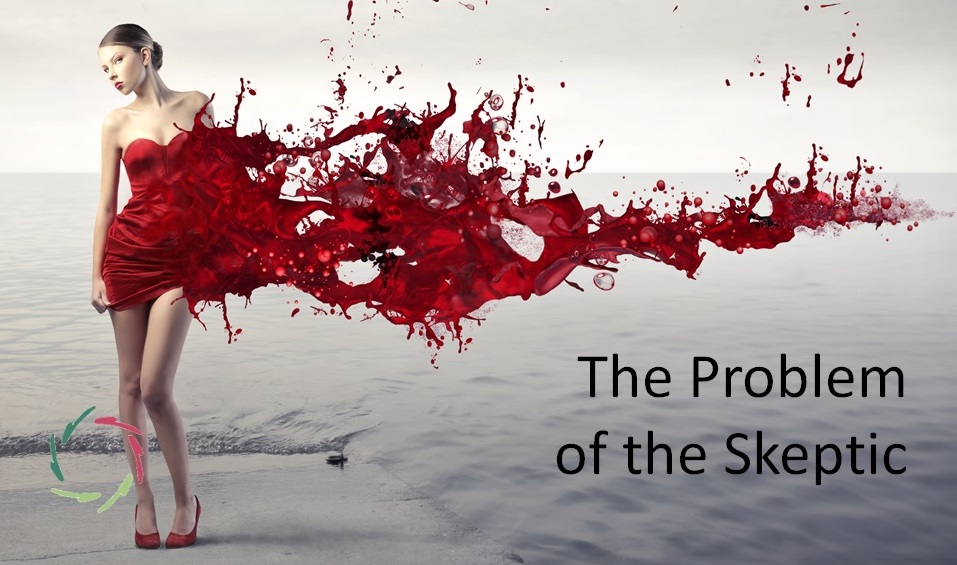
Typically human to run into such kind of problem… Well, we’ll have to deal with it. Hm, by throwing it out of the window?
Let’s say you are a skeptic.
That means you are a person wishing to you use rationality to ‘think for yourself’, as Kant admonished us all to do in order to ‘emerge from a self-inflicted immaturity’ (his words, see: ‘Enlightenment, Kant, AURELIS, Growth’]).
Yes, we should!
So, all right, you are skeptic and then even more skeptic and near to 100% skeptic…
Very, very skeptic indeed. And that’s very, very good!
And then there is a problem. Sooner or later, you get skeptic about your skepticism itself. Let’s put it this way: you get skeptic (A) about your skepticism (B) itself.
(A) turns on (B), making (B) actually impossible when nearing to 100% skeptical (A).
This is the Problem of the Skeptic.
One ‘solution’ is to stop being skeptical right before you make ‘being skeptical’ itself impossible. You stop being skeptical because “otherwise you run into the impossibility to do anything good at all.”
That seems to me like throwing the problem out of the window. Isn’t it?
Let’s say you are a magician.
And you ‘heal’ people, through for instance sticking iron things into them, or letting them drink some colored, plain water. Or even – who cares – some uncolored, plain water 😊. Whatever.
I’m very skeptical towards magicians. Most of them very much value money and/or status. Besides, they leave a huge trail of human misery, frequently within themselves and even more within others.
You see: placebo [see: ‘Placebo Is Not Good for You’].
Still, the aura is about ‘doing good’ and magicians – the ones that think one bit further than their wand – counter skepticism because “otherwise you run into the impossibility to do anything good at all.”
Recognizable?
Back to the skeptical future.
It’s the only decent one. At present, unfortunately, we’re not there yet.
Skeptical (A) turns on skeptical (B). It seems like biting one’s tail and ending the trip. It seems like sawing through the branch of the tree on which one is sitting oneself, trying to enjoy the view meanwhile.
Hm. And then there is of course skeptical (C) that turns on skeptical (A) and prevents it from sawing. Hey, what’s happening?
It’s not a dead end. It’s a groove, one that gets deeper and deeper. No window.
Can we get out of this groove?
My years in AI have taught me that if there is an insoluble problem, one should try to broaden the problem domain. Is that applicable here?
I guess so. What we want to achieve, is a better world. Rationality (including skepticism) is of utmost importance in this. We now have a landscape and a groove in that landscape. Trying to stop things getting into this groove, is like building a dam. Soon you have a flooding and a loss of many beautiful sites in the landscape. No good.
I think it’s better to accept the groove.
This way, we can get to being 100% skeptical. No window needed.
One can never be too skeptical!
Just accept the groove. It’s there, together with many beautiful and interesting things. There is no need to keep sitting in the groove. There’s lots of other things we can do. For instance, we can use our 100% skepticism to stop all magicians and their woe…
and build a better world.
Related Posts
Lisa on WEF
The yearly World Economic Forum brings together those who shape economies, technologies, and global directions at scale. This blog looks at WEF through the lens of Lisa, a nascent Compassionate A.I. in healthcare, work, leadership, economics, and diplomacy. Not to judge, but to observe what becomes visible when human depth is taken seriously alongside economics. Read the full article…
Words don’t Matter
Words are things. If not imbued with life, they are like water that flows to the sea on an eternally lifeless planet. Concepts matter. Emotions matter. Depth matters. Beauty matters. Culture matters. People matter. Life matters. Words don’t matter. They’re just letters, one after the other. All the above matters within words ― not the Read the full article…
Divide et Impera
Throughout history, ‘divide and rule’ has been both a method of domination and a mirror of human fragmentation. From empires to algorithms, from nations to minds, the same principle repeats itself: power-seeking by deepening division. Yet every act of fragmentation ultimately turns inward. True strength lies in coherence — in rediscovering the flow that division Read the full article…