Coarse Comparison of Brain and Silicon
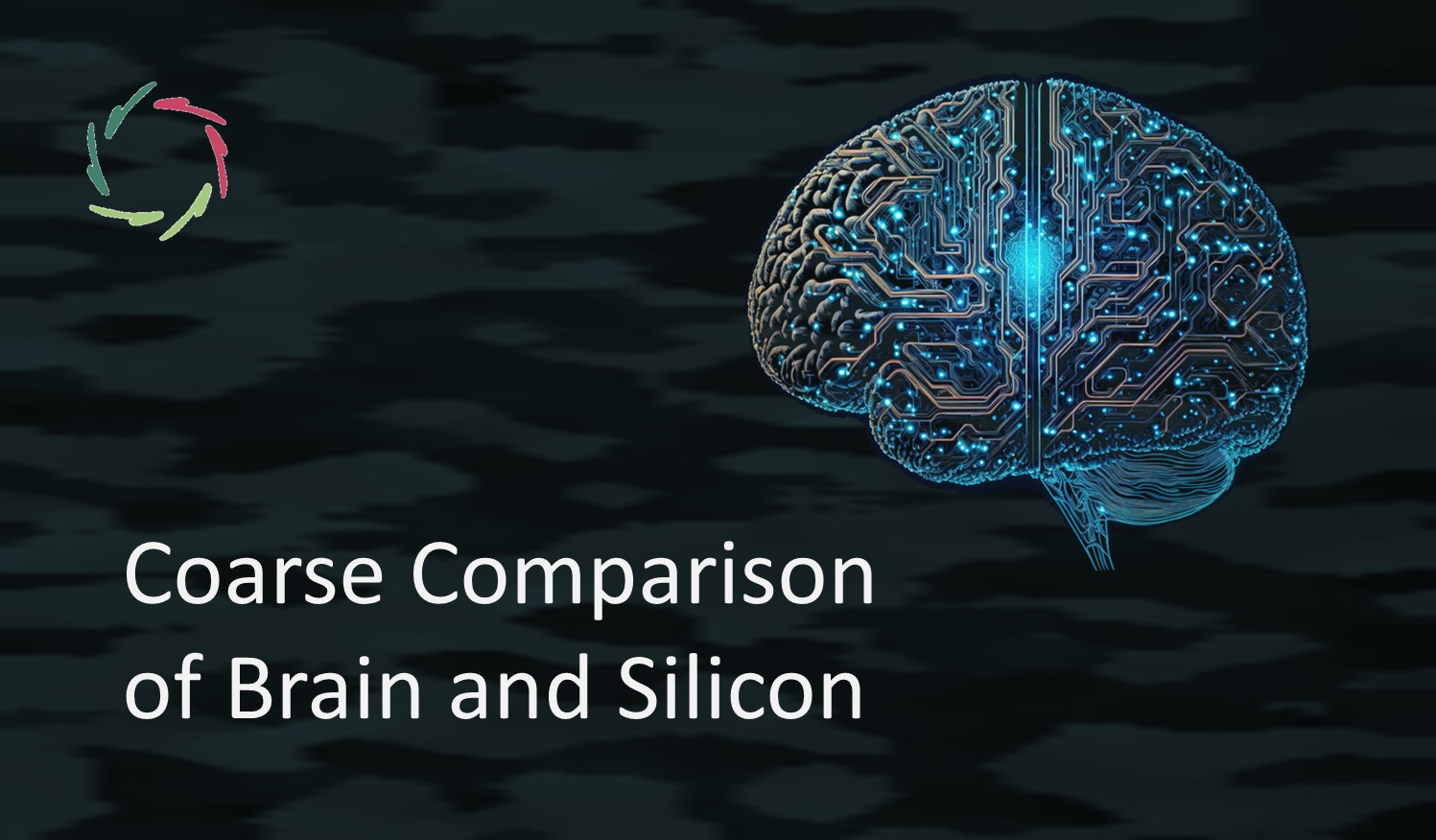
In an age where artificial intelligence and silicon-based processors are advancing at lightning speed, it’s tempting to compare their capabilities to the human brain. Can silicon ever replicate human cognition? What are the strengths and limitations of each system?
This exploration dives into the heart of these questions, revealing fascinating parallels and stark (!) differences between our biological brains and the machines we create.
Structure and architecture: nature vs. silicon
The human brain is an intricate masterpiece, housing approximately 100 billion neurons interconnected by trillions of synapses. These neurons form dynamic, self-organizing networks that adapt continuously through learning and experience. This adaptability – often called neural plasticity – is what allows the brain to process diverse tasks simultaneously, from regulating our heartbeat to pondering philosophical dilemmas.
Silicon-based systems like CPUs (Central Processing Units) and GPUs (Graphics Processing Units) operate quite differently. CPUs are versatile, handling sequential tasks with high precision. GPUs, in contrast, are built for parallelism, equipped with thousands of cores to process similar operations across large datasets.
Analogy: distributed brilliance
The brain is like a distributed computing system, where specialized areas work in tandem:
- The cerebrum (in this blog also simply referred to as ‘the brain’), responsible for abstract thought and reasoning, resembles a neural network, adapting dynamically to new information.
- The cerebellum, which coordinates movement and precision, mirrors a GPU, excelling in high-speed, repetitive tasks.
- The prefrontal cortex, the brain’s executive center, is analogous to a CPU, allocating resources and managing priorities.
Processing style: symphony vs. choir
The brain processes information in a massively parallel and context-sensitive manner. Listening to a song, for instance, involves multiple streams: auditory signals, emotional resonance, and personal memories. This orchestration occurs dynamically, with different regions communicating seamlessly to create a unified experience.
In contrast, silicon systems operate within defined constraints. CPUs execute instructions sequentially, while GPUs achieve parallelism by performing the same operation across many data points simultaneously. Neural networks mimic the brain’s parallelism but rely on the underlying serial architecture of silicon.
Analogy: harmony in action
- The brain is like a symphony orchestra, blending diverse elements into a harmonious experience.
- A GPU is like a choir, performing with immense power but limited variability.
- A CPU is akin to a solo pianist, precise but linear.
Communication and coordination: hive vs. factory
The brain’s communication network is fluid and non-hierarchical. Neurons communicate through synapses, forming dynamic patterns that shift in response to new stimuli or learning. This decentralized approach ensures flexibility and resilience.
Silicon systems, however, rely on centralized control. The CPU acts as a manager, assigning tasks to GPUs or other components. Communication is often bottlenecked by data transfer speeds between memory and processing units.
Analogy: decentralized vs. centralized
- The brain is like a hive of bees, where autonomous agents work together fluidly toward a common goal.
- A silicon system is like a factory, with workers (GPU cores) executing tasks assigned by a manager (CPU).
Learning and adaptability: forest vs. bonsai
The brain’s plasticity is unparalleled. It rewires itself, creating new neural connections in response to experiences and challenges. Learning occurs both at the surface and deep within subconscious processes, allowing the brain to handle novelty and ambiguity effortlessly.
Silicon systems, by contrast, are rigid. They follow predefined instructions, requiring external programming for adaptation. While neural networks simulate learning, their structure is static compared to the organic growth of the brain.
Analogy: growing vs. shaping
- The brain is like a living forest, continuously adapting to its environment.
- A neural network is like a bonsai tree, shaped and trained by external forces.
Energy efficiency: candle vs. spotlight
The brain is a marvel of energy efficiency, operating on just 20 watts of power—less than a typical light bulb. Despite this, it performs a staggering array of tasks continuously. This efficiency stems from millions of years of evolution optimizing biological processes.
Silicon systems, on the other hand, are energy-hungry. GPUs often consume hundreds of watts, and their power usage scales with computational complexity, making them far less efficient.
Analogy: resourceful vs. resource-intensive
- The brain is like a candle, providing efficient illumination with minimal resources.
- A GPU is like a spotlight, powerful but demanding.
Outcomes and applications: painter vs. printer
The brain excels in nuanced, context-rich tasks like creativity, emotional intelligence, and ethical reasoning. Its outputs are holistic and adaptive, shaped by individual experiences and subconscious processes.
Silicon systems, meanwhile, thrive in rule-based tasks, such as data analysis, rendering, and repetitive computations. They lack the depth and flexibility of human cognition but compensate with unparalleled speed and precision.
Analogy: creating vs. reproducing
- The brain is like a painter, crafting works filled with emotion and meaning.
- A GPU is like a printer, producing consistent, high-quality results rapidly.
A complementary future
Rather than replacing human intelligence, silicon systems can complement it. By leveraging the speed and precision of GPUs alongside the creativity and depth of the human brain, we can tackle challenges that neither could address alone. The brain, with its dynamic parallelism and adaptability, brings depth and meaning. Silicon, with its speed and precision, offers unparalleled efficiency.
Together, these two worlds promise a future where technology enhances human potential, not by mimicking it but by amplifying its unique brilliance. By understanding both, we can chart a path toward a truly intelligent and harmonious future.
Related Posts
We Need to Be the Best We Can
This differs from being ‘the best person’ or ‘the most intelligent beings on Earth’ in competition with others. Our only – and fierce – competition should be with ourselves. The best, in good Aurelian tradition, is most Compassionately the best — striving for in-depth excellence. This striving is purposeful. It’s about standing at one’s limits Read the full article…
From Tool to Autonomy
When can a tool – gradually – become an autonomous agent, and how must we deal with this? What is an agent? And what is a tool? For instance, is your body (or your left hand) a tool of your brain? Is your entire body – including your brain – a tool of your mind? Read the full article…
Medical A.I. for Humans
Medical A.I. is flourishing and will be more so in the future. Therefore, we must ensure that it serves the total human being. The main challenge Through medical A.I. – substantially more than ever – humans can become either more humane or robotized from the inside out. This is not about putting probes etc. in Read the full article…