How can Suggestion be Powerful?
Suggestion offers a non-coercive way of influencing, providing the receiver the freedom to follow or not. Auto-suggestion extends this freedom even further. How can this be powerful?
Autosuggestion
In this blog, I use the term ‘suggestion,’ but mostly mean ‘auto-suggestion.’
Autosuggestion rarely involves directly indicating the intended direction but instead operates through deeper, pattern-like associations. This allows the invitation to be received more easily when the individual is ready. It involves a search of how this readiness can be obtained.
Suggestion then communicates with the non-conscious mind, facilitating changes from within. This process subtly promotes natural and deeply rooted growth rather than superficial change. Eventually, a significant transformation may result in your life and mindset that accords with who you profoundly are, and thus can happen as by itself.
Suggestion as a gentle influence
This respects the autonomy, personal growth, and inner strength of the individual. Precisely this combination makes it a powerful tool when used correctly.
The essence of suggestion is its ability to gently influence the non-conscious mind, planting seeds of thought and action that can flourish naturally. Like watering a garden, with time and care, these seeds can grow into a lush and vibrant reality, making nature a powerful ally rather than a daunting adversary.
Alignment
Effective suggestion involves communicating with the non-conscious parts of the mind in a language that resonates deeply ― more akin to poetry than prose. It thus aligns the non-conscious mind with conscious goals, promoting changes that are both effective and ethical.
By repeatedly suggesting positive outcomes or behaviors to oneself – preferably in indirect, pattern-like ways – the mind can start paving the way for actual change. In this, autosuggestion encourages inner strength without the need for coercion because it respects the natural complexity of the human mind. Change happens spontaneously like water flowing through a river.
The dance of the mind
In many ways, the process of suggestion can be likened to a dance. When we suggest something to ourselves or others, we engage in a delicate dance with the non-conscious. Just as dancers move in harmony, suggestion harmonizes with the mind’s natural rhythms.
This dance is about leading and following, inviting and responding, rather than control. It creates a space where new possibilities can naturally emerge.
Using suggestion effectively is an art.
The best suggestions feel like a natural extension of one’s own thoughts and desires. They do not feel imposed but are rather discovered. This artful approach to suggestion requires a keen understanding of timing, tone, and context.
When done artfully, it is a powerful tool in personal development, coaching, and everyday interactions.
Related Posts
Subconceptual – Conceptual: a Dynamic Continuum?
In humans, the subconceptual layer – the deeper, intuitive, and often non-conscious level – feeds into the conceptual layer, which organizes thoughts into more structured, conscious forms. Their working together as a dynamic continuum is key to understanding complex phenomena while making meaningful decisions. Concepts can never perfectly capture the messiness of the physical world, Read the full article…
Whence Aggression?
Ultimately, unresolved inner tensions are central to the origins of aggression, whether these stem from unmet needs, misunderstood emotions, or external influences. Understanding this complexity is essential to addressing the root of aggression. Three origins of human aggression Human aggression arises from a combination of biological, psychological, and social factors. Biologically, aggression is linked to Read the full article…
If You Fake, Do It for Real
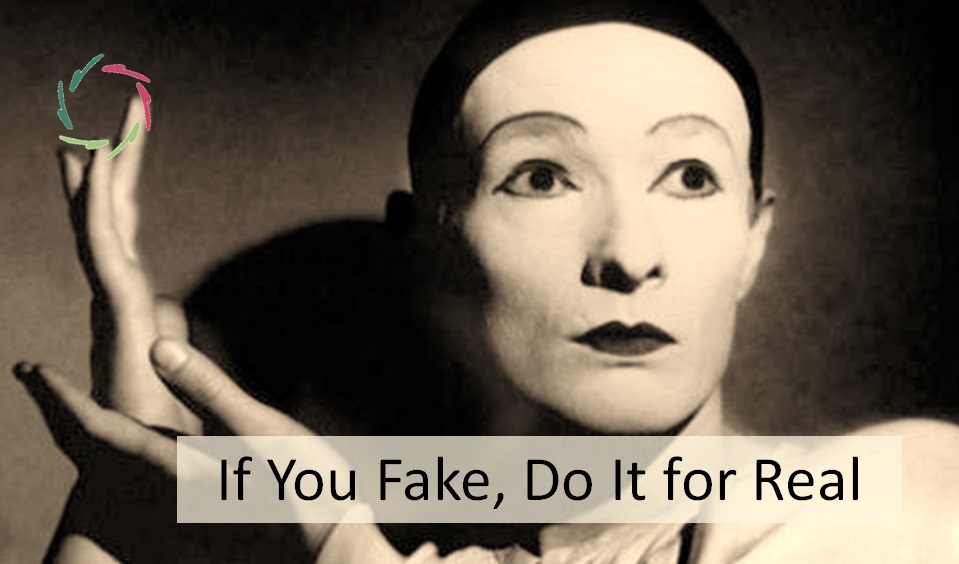
‘For real’ is like a very good mime, for instance. It’s fake and at the same time, it may be more real than reality itself. ‘Reality inside’ is more important than ‘reality outside.’ Then who is the faker? While faking, you may get closer and closer to full reality. Faking is in such case a Read the full article…