To be Free is to be Meaningful
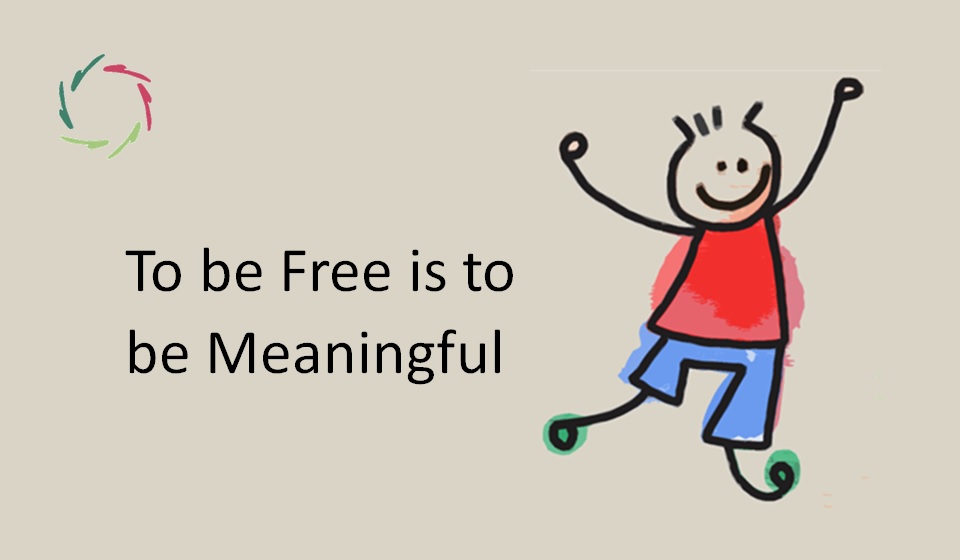
Freedom may be a feeling or a being. It’s about being able to do what one wants to do ― this is, what one finds meaningful, one way or another.
Being compelled to act
For instance, out of patriotism, one may feel compelled to risk one’s life in battle. This ultimate sacrifice is given in freedom.
Actually, one may feel most free if one acts out of some urge that comes from deep inside so strongly that there is no choice but to follow one’s inner urge to act.
Where does this urge come from?
It is not a purely conscious decision, which would be the logical act of an automaton ― no deep feeling involved that this is a personal decision.
One can only freely decide about any meaningful stuff by feeling deep inside that one or the other is the direction to take. At the same time, one doesn’t need to consciously know which elements contribute to this feeling ― let alone what meaningfully influences or has influenced these elements.
On the opposite: meaningless consumerism
In a broad sense, one may consume products or services, whether material or non-material. Anything that can be marketed can be consumed: beverages, the news, vacations, etc.
It is possible – being an understatement – to consume many things in a meaningless way. This way, consumption becomes an addiction, an urge to find meaningfulness by heaping up a lot of surface-level experiences. In this, the freedom to buy what one pleases out of a bazillion options remains a superficial sense of freedom.
Source of stress
Stress results from an imbalance between what one wants to achieve and what one can achieve. This may clarify that the coercion to produce and consume are both sources of stress. Present-day stressed-out individuals are generally the result of not only much deeply meaningless work, but also much deeply meaningful consumption.
If the result is a stress-related disease, one should not look for causality in stress-as-a-blob, but in the lack of meaningfulness that causes the divide between wanting and being-able, which causes the feeling of stress in the first place.
Deep wanting, deep being-able
It mainly plays in-depth, which is also the realm of – yes, deep – meaningfulness and – yes, a deep – sense of freedom.
One cannot just decide to feel free. It is not a conscious decision. It is an in-depth happening that surfaces as such in the presence of the right circumstances. If in-depth meaningfulness is attained and can be acted upon, what surfaces is a feeling of freedom.
Politics of freedom
Politically, people want freedom because they want to be meaningful. If you take away (their perception of) their freedom, it’s like making them meaningless. Of course, they defend (their perception of) their freedom ― if need be, with violence.
So in politics, too, looking for what people feel as their precious freedom, one should look for what they find deeply meaningful.
Eventually, this has the potential to unite people within one country and – as should be – over the whole world in the foreseeable future.
Will this be the world of the free and the brave?
Related Posts
In Ego against Ego, Egos Win and People Lose
The battles between egos – whether they unfold between two people, political figures, or nations – often seem inevitable. Yet, these conflicts are distractions from a more dangerous confrontation: the ego’s relentless struggle against the total self. This ‘battle of the future’ poses an existential threat, as the ego fights to maintain its fragile inner Read the full article…
In Defense of Free Will
Free will as generally conceived, appears to be an illusion. This doesn’t mean that we ‘have no free will’. [see also: ‘You Are Free Even while Freedom Is an Illusion’] The notion of personal ‘free will’ is probably as old as humanity. Only God or some devil – or a witch – might interfere and Read the full article…
Why Induction Works
We all rely on induction, often without realizing it. Every expectation about tomorrow, every lesson learned from experience, and much of modern science and artificial intelligence depend on it. Yet a surprisingly simple question has puzzled philosophers for centuries: why does induction work at all? Perhaps the answer is not found in induction itself, but Read the full article…