The 999 + 1 Doors Principle
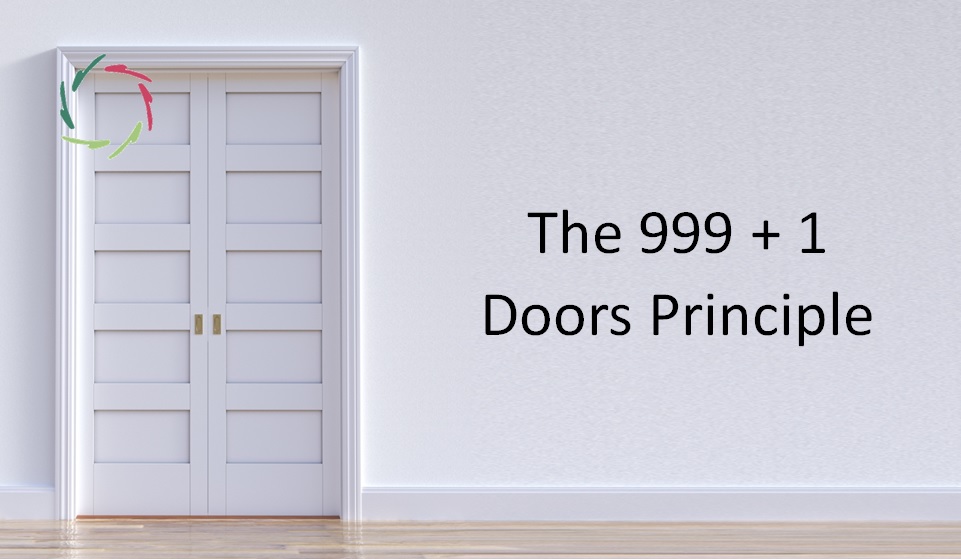
If all doors are closed to a beautiful space behind the wall, yours is most important. You should not look at the others to keep yours closed ― easier said than done.
It’s innate to the human being to be one of the 1000.
Historical herd mentality
It’s probably a survival reflex ― therefore, Darwinian. Until quite recently, excommunication meant to the individual human a probably soon death from physical causes. Psychologically, it was/is even more crucial. ‘Being alone’ isn’t easy for many. ‘Feeling expulsed’ is much harder still.
Social media may give one the un-real feeling of being together while being alone in reality. Therefore, ‘canceling’ someone should be the very last thing to do. It’s horrific.
So, if 999 doors are closed, it’s not obvious to open yours.
Please be brave.
The first step toward this is acknowledging that it’s not obvious ― as said. You may not only encounter the 999, but also yourself and your innate wish to conform. You may not be very much consciously aware of this.
‘Know thyself’ is an ancient wisdom that is also applicable in this setting. Know your humanity. Don’t try to ignore it.
Then and only then, you can really be brave.
Present necessity
It’s no secret that the present era poses specific problems that may, soon enough, grow into existential challenges for humankind. Undoubtedly, A.I. will play a central role in this positively or negatively.
Probably more than ever before, the near future depends on what we do now. There are many doors to the challenging space behind them – also A.I.-related – in which bad actors can do their very bad things to very many people. You see, opening a catastrophical door is easier than ever.
Therefore, the 999 + 1 doors principle is also in the positive more crucial than ever.
In short, this is a time of unprecedented challenges and opportunities. While genetically, we’re still the same herd-followers, there is also more than ever that enables you to open your door, nevertheless.
Most important now is the door toward yourself ― getting to know the profundity of your inner self, ‘awakening,’ if you like, inner mental growth in a universe of subconceptual mental-neuronal patterns. This starts with seeing that there is and always will be a long road ahead, which is perfectly fine!
The ‘beautiful space behind the wall’ is you ― better said, You.
This is the most pivotal point one can imagine. Historically, we had the advantage – although gradually diminishing – of being unable to do much harm at the broadest scale. In the future, we will have the disadvantage of being able to do so.
That future is being prepared now.
It’s being prepared DEEP inside each one of us.
Related Posts
Why is Compassion Important in the Future of A.I.?
Compassionate A.I. is poised to revolutionize personal well-being across many domains, such as mental health, content curation, and customer service, turning technology into a true partner in emotional and mental growth. I’ve been down with COVID for a few days now, for the first time. Mainly very tired in a weird way. One shouldn’t even Read the full article…
Subconceptual – Conceptual: a Dynamic Continuum?
In humans, the subconceptual layer – the deeper, intuitive, and often non-conscious level – feeds into the conceptual layer, which organizes thoughts into more structured, conscious forms. Their working together as a dynamic continuum is key to understanding complex phenomena while making meaningful decisions. Concepts can never perfectly capture the messiness of the physical world, Read the full article…
Human Meditation and Artificial Intelligence
At first glance, meditation and A.I. seem worlds apart — one is deeply human and introspective, the other fast and computational. Yet both revolve around pattern recognition. Meditation reveals how thoughts arise within a vast web of neuronal activity, while A.I. detects and predicts patterns through deep learning. If meditation uncovers the emergence of thoughts Read the full article…