Gender Equivalidity
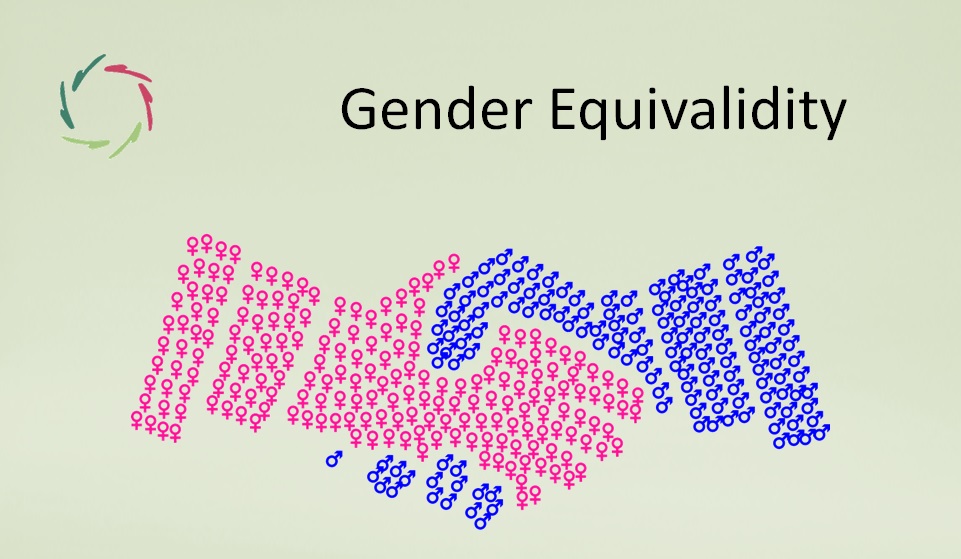
People can be deemed equal in worth without any bit of need to adhere to one mold. Crucial is value, not sameness.
Gender equality?
Men and women are not equal at the outside, nor at the inside ― least of all at the mental side. Therefore, the term gender equality sounds forced. The more one goes into genders, the less it makes sense.
Trying to make them somehow equal – for instance, for fear of disrespect – may end in not respecting any individual for what he/she truly and naturally is. This way, any person gets excessively pushed into a mold of equality.
There is little respect in making a circle by breaking a square.
Equivalidity
There is more respect in making a circle by empowering a square (or triangle). This starts by valuing the square for what he is before molding him into something else like a circle.
Seeing equal value in different people is the challenge, not asking them to be the same for the sake of equal value.
Young, old, black, green, male, or any other gender ― these characteristics should not be the source for seeing different value. In equal validity, people have all freedom to be different ― or equal.
Whence the striving for equality?
At least in some cases, this may come from a rather mechanistic view of the human being. If genders can be readily made equal, that means the in-depth differences – including many subtle ones – are not so crucial, and a lot of what people feel to be gender-related can be dismissed.
This feels like making things less or unimportant. In this manner, the equality in value gets realized by making everything less valuable, at the same time more interchangeable.
On the other hand, of course, gender non-equality can also be a mold used by some culture to divide the sexes and subdue one more than the other. A reaction to this molding should not be the installation of another mold. That would be like jumping from one box into another box.
What degree of non-equality is optimal?
The question is not readily answerable.
Well, yes, that’s what I can say about it. I guess the only reasonable answer can be given at an individual level. Here, it is an ethical question. Aurelian ethics may be some guideline.
What is sure – and fascinating – is that it can always remain a challenge.
Wild orchids
Wild orchids have an individually independent attitude concerning gender. That doesn’t mean they strive for equality; quite the contrary.
No two natural orchids – the flowers – are the same. They’re all pretty different, which makes them more beautiful and interesting. It’s the same in the human case.
Wild orchids are free ― no need for any degree of equality to attain natural equivalidity. They are spontaneously themselves, respecting themselves and others plainly as they are.
Nothing human is unimportant.
Everything human is infinitely valuable if only correctly treated.
Related Posts
Universal Declaration of Human Values?
No, I won’t solve this problem now, especially since that’s impossible. Nevertheless, we must make valuable strides. How else are we going to see human-A.I. value alignment? One critical stride is the insight into how difficult it is to develop such a declaration ― at least in a sustainable way, even though it’s getting highly Read the full article…
Post-Truth
“Not the facts are important but what works. The higher human purpose is to escape literalism and reach the essence, shaping one’s own reality.” No. I’ve not gone mad. And I’ve not gone POMO, fancy acronym for post-modernism. To assure you, the under-title of this blog is as abhorrent to me as I hope it Read the full article…
Demo Cracy
‘Power to the people’ is not self-evident. Who is this ‘people’? And what kind of ‘power’ is desirable? Eventually, democracy is the only worthwhile way, but in which way? ►►► WHY read this? Democracy itself will increasingly be under pressure if we do not act now.◄◄◄ Demos Cratos Demos = people; cratos = power. Power Read the full article…