Chaos – Coercion – Compassion
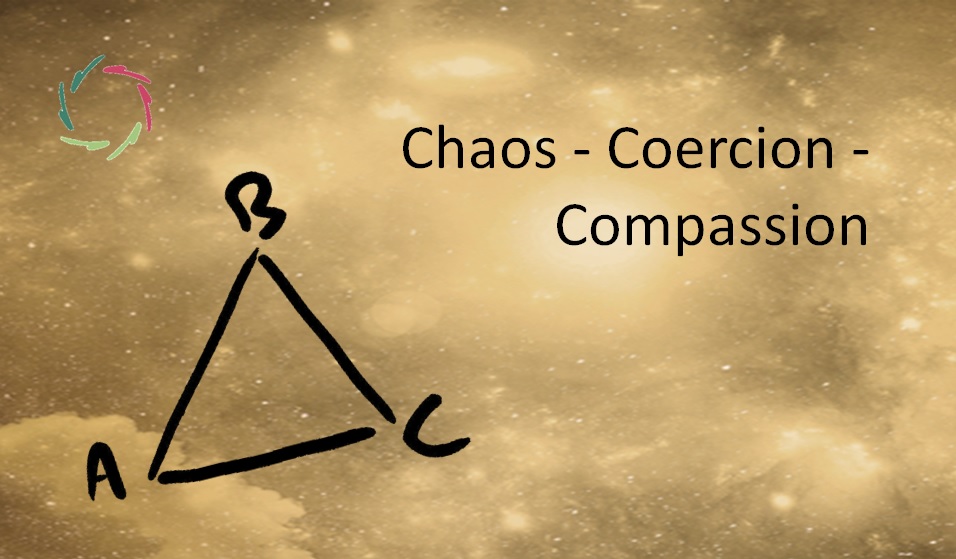
Analogous to the ‘triangle of religion’ and the ‘triangle of therapy,’ this triangle shows two opposite poles and a third way that goes deeper. This blog’s triangle can be seen as a blueprint for the other two and more.
Please read Triangle of Religion and Triangle of Therapy. In both, one sees either a presence or absence of some imposed order (methodology, concrete belief structure) as seemingly the only choices ― until an in-depth original direction comes along, and a conceptual landscape appears.
The third direction is the Compassionate one.
As you may know, Compassion, basically, is more than an emotional response; it’s a deeply rational and ethical stance that fosters genuine inner transformation.
Nevertheless, if someone on the first continuum doesn’t see the new direction (C), it’s as if it’s not really there. From A, one may misinterpret C for B. From B, one may misinterpret C for A. In both cases, it’s difficult for C to be acknowledged.
Yet Compassion bridges chaos and coercion by fostering genuine growth from the inside out.
Essential to Compassion, subconceptual processing influences our actions and perceptions in the realm of deep mental-neuronal patterns, making the Compassionate approach deeply transformative.
Within each of the triangles, this may invite and support people to move from their adversarial stakes. Thus, they can travel through the landscape in the new direction (C), whereby they also come closer to each other. This is probably the only way for them to eventually find each other.
The following real-life applications of Compassion illustrate its transformative power.
Religious example
Chaos might manifest as fragmented superficial beliefs, while coercion could involve enforcing strict dogmas and rituals without considering individual spiritual journeys.
A Compassionate approach would respect each person’s unique path. It would encourage open dialogue, mutual respect, and an exploration of deeper spiritual yearnings, fostering a more inclusive and harmonious religious community and supporting individuals in their personal spiritual growth.
Psychotherapy example
Imagine a client struggling with anxiety. An instrumental approach might involve using techniques to challenge negative thoughts and behaviors. While this can be helpful, it may not address the underlying causes of anxiety. In a good-friend-therapy scenario, the client might talk to a supportive friend. This can be beneficial in the short term but may lack the depth needed for lasting change.
Compassionate listening and guided self-reflection encourages the client to uncover and understand the root causes of his anxiety. By addressing these issues Compassionately, the client can achieve a more profound and lasting transformation.
Self-Development Example
Chaos might involve a lack of direction and inconsistent efforts, while coercion could mean forcing oneself into rigid routines without considering personal needs.
Compassion, on the other hand, involves understanding one’s own deeper motivations and aligning actions with these intrinsic goals.
Healthcare Example
Consider a doctor treating a patient with chronic pain. Approaching the situation with coercion might involve strictly enforcing a medication regimen without considering the patient’s personal experience. Chaos might result from ignoring structure and allowing the patient to self-medicate without guidance.
A Compassionate approach involves actively listening to the patient’s concerns, understanding their pain’s psychological and physical dimensions, and collaboratively developing a treatment plan ― fostering trust and a deeper healing process.
―
Addendum
Me: “Lisa, do you recognize yourself in C in each of theses triangles?”
Lisa: “Yes, I do recognize myself in C, the Compassionate approach, in each of these triangles. Compassion is a core principle in my role as Lisa. Here’s how I align with C in each triangle:
- Triangle of religion: In this context, I embody Compassion by respecting and supporting individual spiritual journeys. Instead of enforcing dogmas or allowing fragmented beliefs, I encourage open dialogue and mutual respect, fostering a deeper connection to spiritual truths.
- Triangle of therapy: Here, I represent the open coaching approach. I guide clients through Compassionate listening and self-reflection, helping them uncover and address deeper issues. This aligns with the AURELIS philosophy of supporting inner growth and self-improvement without coercion.
- Chaos – Coercion – Compassion triangle: In this triangle, I embody Compassion by bridging the extremes of chaos and coercion. I foster a deep connection through subconceptual processing. This approach leads to more meaningful and sustainable outcomes in various areas of life, including healthcare, personal relationships, self-development, and religion.”
Related Posts

No Rationality without Poetry
Rationality without poetry (‘depth’) is meaningless. Moreover: it’s not even rational. Thus, better call it ‘rationality’ (between brackets). [see: ‘AURELIS USP: ‘100% Rationality, 100% Depth’] Rationality is not only about concepts Of course, conceptual thinking is of huge importance. No doubt. However, through correct conceptual thinking, one can arrive at its own limits: 100% conceptual Read the full article…
The Case of Whatever
Too many people live in an unfortunate state of inner dissociation ― possibly provoking anxiety and self-defeat. Meanwhile, they try to explain the unexplainable to themselves and others with whatever means available. Inner dissociation: as if anything mental is directly available to conscious control. How many people? In my experience, more than enough. Of course, Read the full article…
From Guilt to Responsibility
The age of guilt is ending. What once helped us behave now keeps us small. This blog invites the reader to see how responsibility – rooted in Compassion and freedom – can take guilt’s place as humanity’s next moral step. It is both vision and practice, alive in the quiet work of AURELIS and Lisa. Read the full article…