Poems from a Parallel World
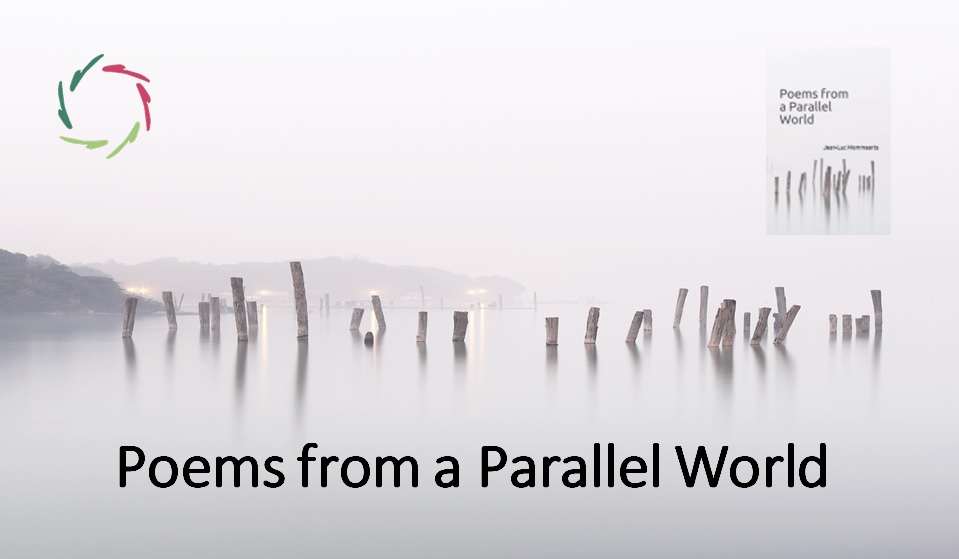
You find this book with 343 poems at Amazon (see menu), just published.
In them lies a personal appreciation of meditation and Zen.
Please savor them carefully.
They speak of a meditative way of living. They are also meant to be insights for life. Zen literally means ‘meditation.’ It may be a pure source of inspiration — nothing more, nothing less.
Buddhism
I use terms and insights from Buddhism in these poems. Buddhism in general is to me a lifestyle tradition. Also, it is a broad universe of viewpoints. My take on it is personal and my errors in representation are only my responsibility.
I like Buddhism mainly when it’s fierce and daring, while at the same time gentle and bent on doing good for everybody. Striving for the impossible, undeterred.
With no-striving upfront, the total-striving is the grandest. This is a paradox, not a contradiction.
The term ‘parallel’
has a specific meaning. [see: “What is ‘Parallel’?”] This is related to the functioning of our brain. The poems also hint at a ‘parallel world’ that one can discern from a specific mindset.
It is, of course, the same world, but seen from a different viewpoint. Or should I say, with a different viewpoint? Broad patterns become more discernible. Associations that are usually invisible become apparent.
To me, this is an important asset one can get from meditation.
Some meditative traditions talk about non-dualistic. If dualistic means conceptual – with conceptually distinct entities – then non-dualistic is the subconceptual domain. In the extreme, this becomes empty of concepts. One can eventually also see in this the realm of poetry in general. It doesn’t surprise me that I came to the domain of poetry as a medium of expression for these deep ideas that, at the same time, can get fairly emotional.
Quite an adventure.
I hope this doesn’t confuse you. I hope it clarifies.
We don’t need to leave behind the scientific endeavor. We don’t need to blow up common sense.
On the contrary!
[see: “Poetry is Not the Absence of Rationality”]
Also, poetry should not be analyzed. Not even this kind of poetry.
It should be felt.
It should be lived.
It should be meditated.
Related Posts
Meaningful Relaxation
Deep relaxation can be meaningful by itself ― not only as a means to further action or a necessary slowing-down of the mind/brain machine. This is not about crisp-concept-based meaningfulness but pattern-based meaningfulness ― the meaningfulness of “This means a lot to me.” Not straightforward We are used to looking for meaningfulness in action. This Read the full article…
Practicing Compassion
Deep, spontaneous, difficult. Looking for a shortcut? Then it’s even much more difficult. Formal meditation Yes, the beautiful action ― in my view, warm and friendly. [see: “True Meditation is Warm and Friendly”] At least this kind of meditation is a direct practice of Compassion towards yourself, then towards others, and all sentient beings. Soto, Read the full article…
Simply Beautiful
Eventually, what is beautiful is simple. Also when this beauty is surrounded by complexity. Simplicity in beauty Beauty doesn’t necessarily mean ‘not much’. It always means ‘not too much’. At least, no superfluous complexity is standing in the way. So as much as possible, beauty can flow where it wants. According to me, beauty is Read the full article…