Being Kind
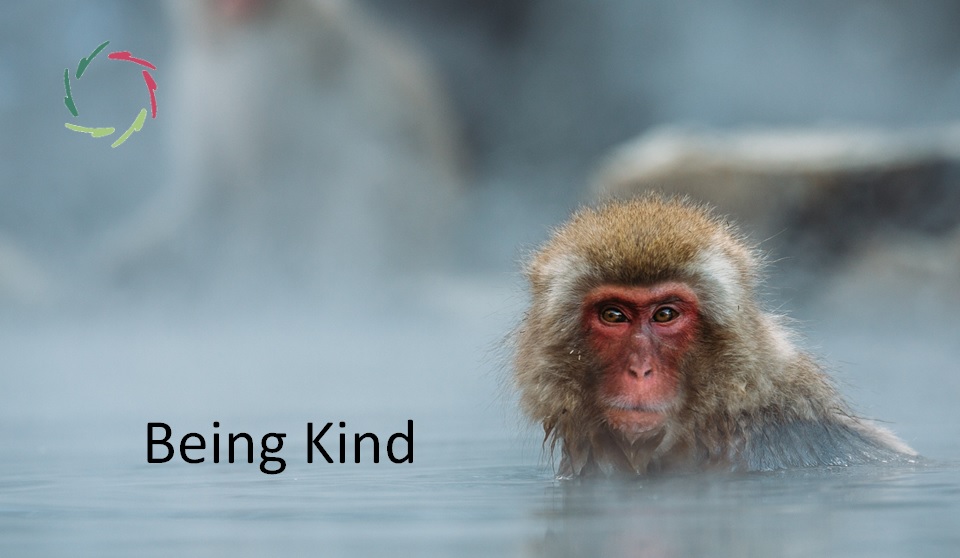
You are kind. You make people feel good. OK. This way they may have more opportunity to be kind to themselves.
Why not?
Pay attention though. And of course, pay attention to the attention itself because too much attention may stop all kinds of things that can only be themselves when allowed to flow freely.
When you are kind to others in their ego
then you possibly are at the same time very unkind to them as total person. Something like: you may be kind to a dictator who uses your kindness to take tougher action in his region. That leads to war. Kind? I don’t think so.
A good principle: everything is allowed in depth and respect.
In other words: everything is allowed if it is not standing in the way of what, by itself, is much more important.
Being kind to the total person. Yes!
Being kind to a mere-ego… no.
A direct question: is there a chance that as a reaction to this (call it ‘resistance’), one might enfold an ego even more into itself? That is possible. And that is certainly also less good in the sense that it should better not happen. It would also be better if all kinds of psychosomatic symptoms would not occur. Yet nature chooses for them to occur in certain circumstances. At that time, it’s the least unfriendly response.
It’s not the intention to cover something up.
At the same time, it is important to look at the long term. If the doors are closing – ‘resistance’ – you better find other doors. Perhaps the space behind these other doors is even more beautiful than the space behind the first ones. Furthermore: maybe talking about ‘space’ only starts becoming relevant at that time. Always remaining kind. Always open, except to closedness. Sooner or later, that is the most efficient way, for always.
Nobody says that it has to be easy.
If kindness should only be gentle, it is not strong and also not friendly. And it may quickly become weak. And after a while it becomes hard. This hardness serves to protect the weakness but meanwhile it is hard to the outside world. That’s not so good.
Therefore, real kindness is gentle and strong at the same time.
Gentle enough to feel. Strong enough to continue. Even if it might look to some as if it were ‘hard’. That may be due to ignorance or to own weakness. Do not lose your kindness and stay strong. And if necessary you may spread a layer of gentleness over it. It would be appropriate then to make this clear.
In a coaching session for example:
“Good. Let’s keep assuming that you are responsible for what happens to you. You should find the strength to take this responsibility and I can help you with that. To achieve this, I will ask you all kinds of things that you should comply with. Are you OK with that? “.
When people see your firmness they know that your kindness is no pseudo which arises from weakness. That is reassuring. Feel free to clearly show this if you wish. Moreover, it is also a characteristic of leadership. Practice makes perfect, so if this is your ambition: surely do so.
During meditation you can practice on being kind towards yourself
and from there also to others. Seated, strong and gentle, kind to body and mind. It’s an interesting exercise for your whole life.
Imagine then a whole world full of very friendly people.
Is there anything nicer than that?
Related Posts

How do People Generalize?
Generalization is one of the most familiar and yet most mysterious abilities of the human mind. We do it constantly, usually without noticing: when learning language, navigating emotions, forming expectations, or making sense of life. This blog looks at how people generalize, not from a narrow technical angle, but from the inside out. It follows Read the full article…
Being Certain
Certainty can arise in two fundamental ways: through a mental journey (gaining inner certainty) or through a lack thereof (outer certainty). Inner certainty is often more resilient and enriching because it is grounded in personal insight and growth, unlike outer certainty which can be brittle and superficial. Unfortunately, many people don’t put much of an Read the full article…
Deep Dynamics of Confirmation Bias
Confirmation bias is a living process rooted in the way human beings think and feel. Beneath its surface simplicity lies a complex interplay between clarity and depth, between the patterns of early life and the challenges of today. To understand this bias deeply is to see not only its dangers but also its hidden potential Read the full article…