Compassion is not Pity
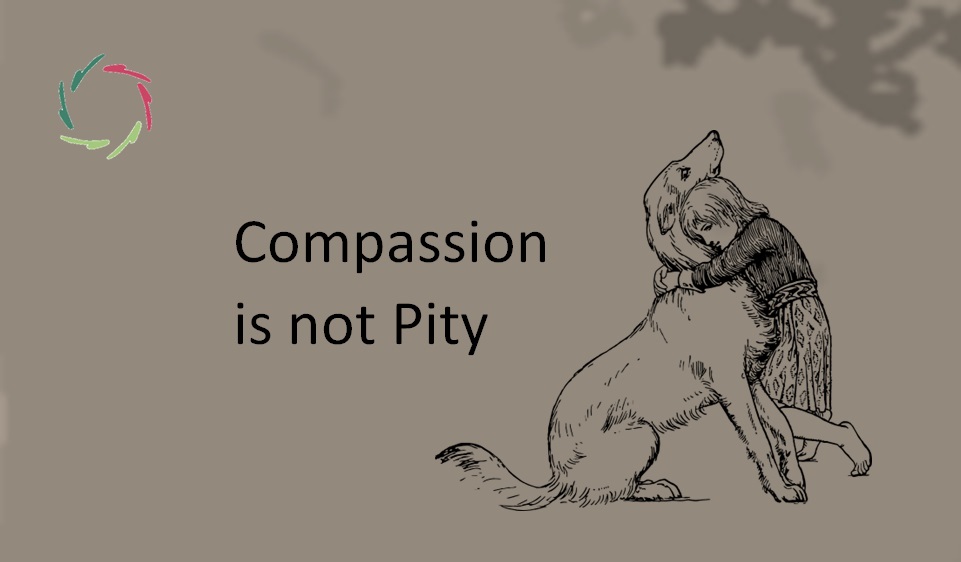
Compassion can be seen as Eastern Enlightenment in action. The term can also be used for ‘pity,’ which is very different, giving additional insight into Compassion.
Compassion with a capital C ― see Compassion, basically.
Pity can be excellent.
In that case, it resembles Compassion.
Being touched by suffering is human. Compassion is not meant to be super-human. An emotional pity can even accompany Compassion. They are not incompatible.
Pity without Compassion
This quickly turns into emotional contagion — see Landscape of Empathy. In that case, it can have the opposite effect from Compassion.
Out of such pity, one can, for instance, give a child the surface-level attention it doesn’t need or even loathes. The child may fare worse for it. Pitiful indeed.
Bringing Compassion to this brings depth, deep attention, and a different picture.
Compassion does not mean the absence of any kind of emotion.
In Buddhism, this is not always clear. One may find descriptions of the path to Enlightenment that specifically urge for dropping emotions in a ‘higher stage.’ Emotions are supposed to block the entrance to the so-called Nirvana (Buddhist kind of heaven).
If following that symbolism, I don’t think any emotion needs to be dropped. What needs to be carefully dropped is oneself — into the emotion — toward depth.
In more modern parlance, Compassion can be pretty emotional, but it doesn’t need to be. It’s nice when it is. Sometimes, not being very emotional can be more efficient. A hallmark of Enlightened Compassion is to have the choice, at least more than usual.
This choice is special.
Mere-ego may jump up now. Please put it to rest again. We’re not talking about its kind of choosing. Seen from the ego, it’s even rather a kind of being chosen.
Compassion gives a choice that more openly comes from the total person — this is, from where it always spontaneously comes from.
This way, emotions are doors toward Compassion.
But only if they are open in-depth. This is not only about pity but any emotion. Going through such a door is adventurous.
The adventure may be frightening. This is why, in Buddhism, a teacher is recommended on the Enlightenment path. Unforeseen challenges may be encountered with huge opportunities and some threats. One huge threat is related to the big mistake between mere-ego and total self.
Still, the adventure is worth it for oneself, others, and humanity’s sake.
Indeed, it deserves all the support one can get.
Related Posts
Compassion as ‘Soft’ Power
Compassion is often seen as soft, rarely as strong. In a world caught between force and persuasion, this blog explores a third path — one that transforms rather than convinces. Not merely a feeling, Compassion can become a resilient form of power that reaches further and lasts longer than any army ever could. This is Read the full article…
Compassion = Total-Person Empathy
The first (but not exclusive) dictionary meaning of compassion in the West is pity. I use Compassion to mean Total-Person Empathy, a far more accurate interpretation. — In Eastern traditions, Compassion similarly aligns with Total-Person Empathy. I capitalize Compassion consistently to emphasize the inherent worth of the whole person. See also Compassion, Basically. Total person Read the full article…

Compassion Lives in Details
Compassion is often imagined as something grand — a sweeping force of kindness. But it lives in the smallest things ― a fleeting glance, a gentle pause, the weight of silence in the right moment. Strip away the details, and Compassion becomes an abstraction without depth. If we want to find real Compassion, we must Read the full article…