Nirvana, What about Feelings?
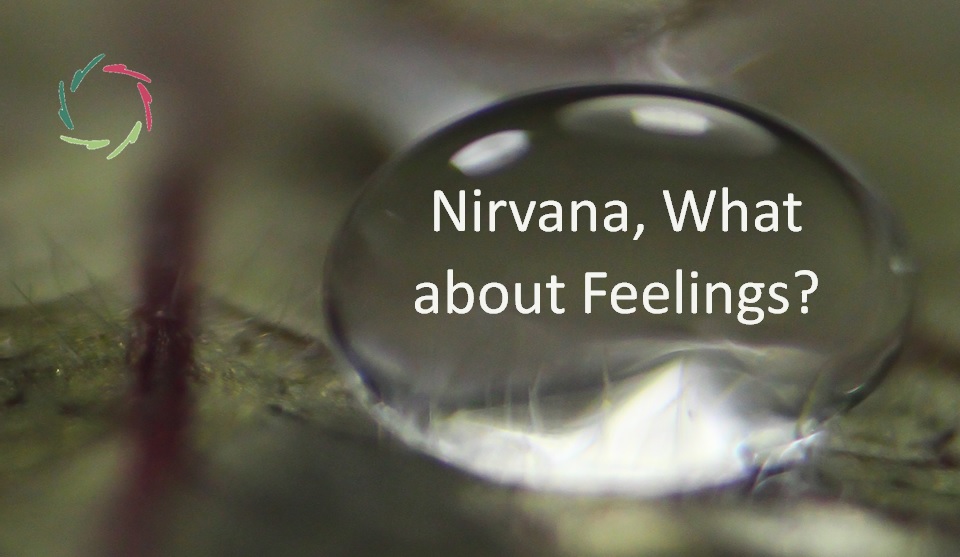
Nirvana, Buddhist ‘heaven’ where the candle has stopped burning. What about feelings? What can this teach us about feelings in general?
This is symbolism.
It’s not about what might happen in another, magical world.
It’s also not about what might happen in this world with just a few minor changes. Symbolism readily touches the heart of the matter and may demand change — not just asking for it at the sideline. As such, this is eventually important for everyone in every circumstance.
Extinction of conscious thoughts and feelings?
Nirvana in Buddhism literally means the extinction of the candlelight, symbolizing the extinction of all thoughts and feelings — everything that is supposed to stand in the way of pure Enlightenment.
More broadly, this symbolizes not letting ‘distracting’ thoughts and feelings (the ‘bonnõ’) stand in the way of the striving towards a detached life (and next lives for real Buddhists) in the service of Insight and Compassion.
Insight and Compassion
To me, these are thoughts and feelings, be them of a special kind.
This ‘special’ lies in nothing special: depth. Therefore, not human depth is called for extinction by original Buddhism and certainly not by me — quite the contrary.
So, what about Nirvana?
Eventually, I see ‘pure consciousness‘ as no consciousness.
Nirvana stays relevant as a direction. It is our human privilege to be able to follow this direction and encounter many mental adventures ― called ‘life.’
Distracting thoughts and feelings are those that may rather incarcerate than liberate. They are those that lack depth, being instead quick and cheap and heavily superficial. Unfortunately, many of these are continually flooding social media.
Distracting thoughts are not small steps in the right direction, although they may sometimes appear so. Nevertheless, they can be stepping stones.
By extinguishing these in their form of obstacles, a new mindscape becomes visible.
As said, this is not Nirvana. It is the path toward Nirvana.
Feelings are of utmost importance on this path — if they are liberating. For instance, those of young children or otherwise uncomplicated people can be very much so. Of course, more complexity is no problem, just more challenging.
Kind of feelings
The feelings that liberate are not categorized or easily categorizable as distinct entities that accord to groups of people.
This is about feeling without feelings.
This is about a feeler who encounters his feelings intimately. Each time again, it’s a different feeling because each time again, it grows from the inside.
Going deeper into this doesn’t mean getting rid of feelings but encountering them in a conceptual emptiness ― without putting them in little boxes and, one way or another, putting labels on these.
This is about warm and friendly meditation.
You can go very near to Nirvana as ‘ultimate extinction’ this way.
Please don’t enter it as long as, by doing so, you might feel that you would lose something essential.
Related Posts
Zen: Moving Beyond Western Mindfulness
In the Zen tradition, meditation goes beyond the realm of conceptual observation and awareness into something deeper and more profound. Zen teaches us to let go of the need to control, moving into the non-conceptual layers of the mind. Please first read Beyond Mindfulness: The Deeper Layers of Meditation. The present blog explores how Zen Read the full article…
Wu Wei in Leadership
Traditionally a characteristic of the idealized Chinese leader, ‘effortless action’ doesn’t always appeal to Western-style leadership. With a twist in-depth, it may appeal to any leadership worldwide. Hopefully, this contributes to [see: “One Future, One World”]. In any case, recognizable leadership everywhere is a good start. Open Leadership [see this category on the blog-wiki] This Read the full article…
The Tao of Chan and AURELIS
Chan Buddhism, or Zen as it is known in Japan, stands as a profound synthesis of two great traditions: Taoism and Buddhism, reflecting the universal truths that underlie human spirituality. AURELIS, as a modern path to inner growth, resonates with this perennial tradition. AURELIS weaves the essence of Eastern and Western wisdom into a contemporary Read the full article…