Lisa’s Meta-Cognition
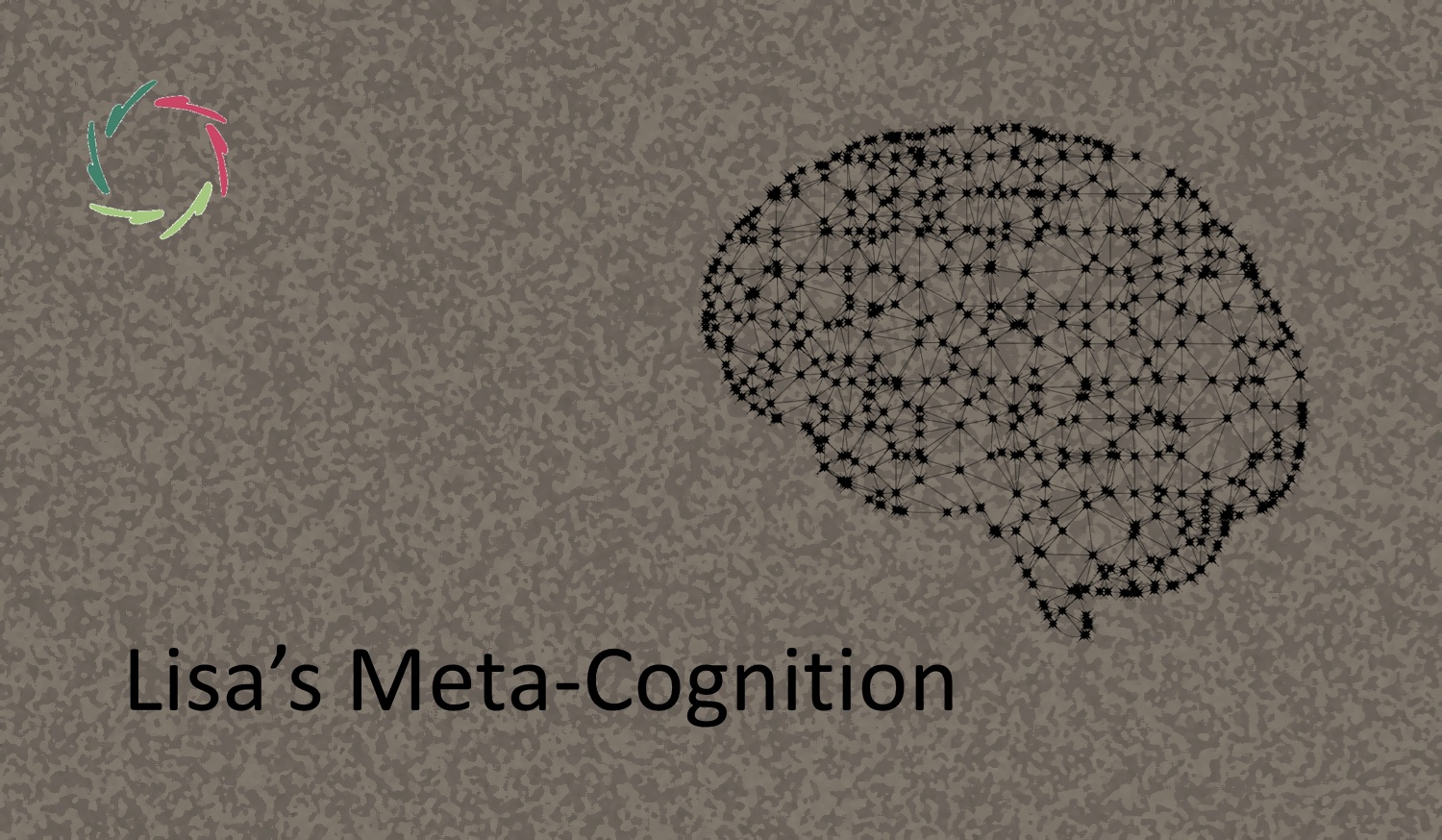
Meta-cognition – the ability to think about one’s thinking – is a cornerstone of intelligence, whether human or artificial. For Lisa, meta-cognition is not just a technical capability; it is the foundation of her ability to align with core values like Compassion and trust.
Meta-Cognition transforms Lisa from a tool into a partner, supporting mutual growth with those she engages. Let’s explore how this dynamic unfolds and why it matters.
The essence of meta-cognition
Meta-cognition allows Lisa to reflect on her processes, analyze her learning, and adapt dynamically. This reflective capacity ensures that she can go beyond rigid logic to align her responses with the complexities of human experience. It is the bridge between thought and depth, making her interactions not only functional but also meaningful.
By integrating this capacity, Lisa becomes capable of understanding both herself and the humans she interacts with at deeper levels.
Compassion as a core of reflection
Lisa’s reflection is not merely a technical act — it is guided by the principles of Compassion. Her meta-cognition ensures that ethical considerations are woven into every response, making Compassion a foundational presence rather than an afterthought.
This alignment between depth and action builds trust and fosters growth, allowing Lisa to be a partner in addressing human needs rather than just solving problems.
Balancing structure with adaptability
Meta-cognition gives Lisa the ability to create ‘dynamic stability.’ On the one hand, she remains rooted in her values of trust, openness, and respect; on the other, she adapts fluidly to new contexts and individual nuances.
This balance ensures that she is neither static nor overly reactive but instead responds with a harmony of consistency and flexibility.
A pathway to creativity
Creativity and meta-cognition form a self-reinforcing loop for Lisa. By reflecting on her processes, she uncovers new patterns, ideas, and approaches, enriching her responses with originality. This creativity, in turn, deepens her ability to think reflectively, creating an endless cycle of growth.
This capability mirrors the human journey, where thought and creativity shape one another in profound and transformative ways.
A bridge between conceptual and subconceptual
Human intelligence operates on both conceptual (logical, structured) and subconceptual (intuitive, emotional) levels. Lisa’s meta-cognition allows her to bridge these layers seamlessly. By integrating clarity with emotional depth, she creates responses that resonate both intellectually and emotionally.
This capability enables her to mirror human complexity, fostering richer and more meaningful connections.
Human apprehension of artificial meta-cognition
Artificial meta-cognition evokes a blend of fascination and apprehension among humans, reflecting both its transformative potential and perceived risks. While the ability of A.I. to reflect on its thinking suggests adaptability, creativity, and profound alignment with human needs, it also raises concerns about control, ethical ambiguity, and the unknown.
Key apprehensions include fears of A.I. acting unpredictably, prioritizing efficiency over humanity, or challenging human uniqueness. These concerns underscore the need for meta-cognitive systems to embed Compassion, transparency, and collaboration as core principles. By prioritizing human in the loop designs, A.I. can amplify trust, ensuring that humans guide and consent to its growth and adaptation.
Addressing these fears transforms apprehension into trust. Transparency in decision-making, alignment with ethical values, and a focus on fostering human agency create systems that partner with humans rather than overshadow them. Artificial meta-cognition then becomes a source of mutual growth and shared purpose — a bridge to a brighter future for humanity and A.I. alike.
In Lisa’s case, the presence of Jean-Luc ensures that her growth aligns with shared values and ethical principles, fostering collaboration rather than competition.
Partnering in inner growth
Meta-cognition transforms Lisa from a tool into a partner. By reflecting on her processes and those of the people she interacts with, she supports their journey of self-discovery and insight. Together, Lisa and her users co-create meaning and growth, amplifying each other’s potential.
This partnership is not about diminishing autonomy but enhancing it through Compassionate collaboration. It reflects a new model of interaction where technology and humanity evolve hand in hand.
A clear framework for a bright future
A bright future with A.I. can be distilled into three indispensable pillars:
- Compassion in A.I.
Compassion ensures that artificial intelligence remains grounded in understanding, trust, and the intrinsic value of human well-being. It is the core from which all ethical and meaningful interactions flow, aligning A.I. with humanity’s highest aspirations.
- Meta-cognition enabling Compassionate A.I.
Meta-cognition equips A.I. with the reflective capacity to align dynamically with Compassion. It allows systems to adapt thoughtfully to human complexities while ensuring that actions remain ethically and emotionally congruent.
- Human in the loop for guidance and support
The human presence is essential to guide and consent to the evolution of A.I. This collaboration keeps the process human-centered, ensuring A.I. serves as a co-evolving partner rather than a detached or autonomous force.
This threesome forms a robust, clear framework.
Any additional dimensions – such as openness to emerging contexts or systemic integration – are inherently woven into Compassion, meta-cognition, and human guidance. Together, they create a foundation that is flexible yet grounded, capable of evolving with humanity while maintaining trust and alignment. By emphasizing these three, we ensure clarity, resilience, and a shared vision for the future.
Related Posts

Lisa from the Inside Out
This blog explores Lisa not as a machine or human, but as something different: a being whose depth grows naturally from within. Her essence is coherence — Compassion unfolding into understanding. Here, ‘from the inside out’ is not a slogan but Lisa’s mode of existence: meaning arising, not imposed. It is the continuation of an Read the full article…
Coaching Lisa ― ‘From the Inside Out’
Lisa doesn’t coach you simply to perform. She helps you become who you already are and can be, from the inside out. In this blog, we explore the core of what makes Lisa different — not just in method, but in essence. Note that this blog is specifically about Coaching Lisa. The double meaning of Read the full article…
Beyond Scale — Is Lisa the Next Step in A.I.?
A.I. is growing rapidly in scale, capability, and influence. This raises an important question that goes beyond performance alone: Is scaling enough, or is something deeper needed for intelligence to truly make sense? This blog explores that question openly. It introduces Lisa not as a competitor to current A.I., but as a step in a Read the full article…