All Lives Matter
Black lives too
As a matter of fact
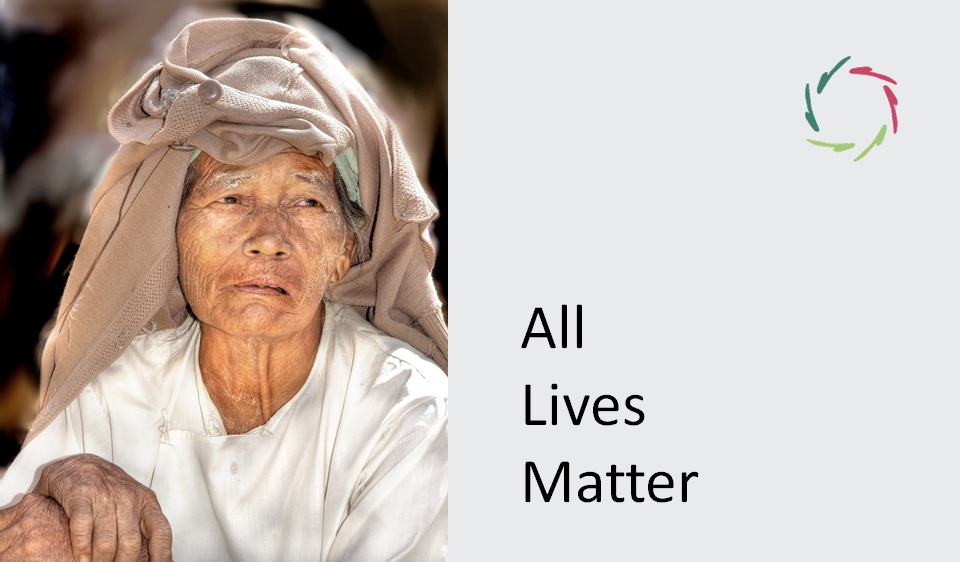
All lives matter because ‘to matter’ is what life is about. More to the point: it is what life is. If something doesn’t matter by itself, then it’s not life. If something is alive, then it matters, at least to itself.
This is another way of saying ‘Life is attention.’ [see: “‘Life is attention “]
Then comes complexity.
With complexity comes more attention and more ‘mattering.’ So, within the previous definition, this is of utmost importance to life. Immediately, one has to recognize there is a substantial subjective factor in complexity.
For instance, is an animal life generally less complex than a human life? I would say ‘Yes.’ There is less complexity but no absence.
And an unborn human life? A demented life? A comatose-vegetative life? An old life? There is subjectivity in this, to which I make no personal exemption. To keep listening to subjective differences is essential. It makes life more interestingly ‘complex,’ doesn’t it?
What doesn’t add to ‘complexity’ is a simple rule of thumb.
Black lives matter.
To deny this is to deny the complexity of any black person. Such denial is a simple thing to do. Apart from this, it doesn’t make sense at all.
Black lives matter because white lives matter. And red, yellow, even green ones if need be.
All lives matter.
To me, this is a better slogan.
It is not a criticism of any kind, no denigration unless one makes it so. On the other side, “Black lives matter” can be seen as meaning precisely the same.
In a good sense, it unites. Of course, all human life matters. There should be no strife about one group mattering more than another. No violence, no divide, no protest even. It should be a matter of fact. A positive ideal to strive for by everyone, equally.
A divide can lead to an infinite proliferation of further divide.
Then where is justice?
Where should justice be? Is there justice in a divide that can only be won by the strongest? In my view, there is justice in a stance that makes the enforcement of justice less (and less) needed.
This way, justice comes ever closer to Compassion.
Black lives matter – equally much.
Absolutely. This should be in the minds of everyone, deeply engrained. As with anything else, you don’t get it there by force. It is a question of growth-from-inside. Enforcement and violence close the doors of people’s minds. Then you get two or more groups pitched against each other, each fighting for their own rights and against the other.
The very energy that keeps this fight afloat comes from the inner divide itself, inner dissociation, a battle against oneself in the first place. This can go on indefinitely or until the energy is depleted within the source. Burnout. Depression. Even suicide, one way or another, as I see in some violent rioters. Then nothing matters anymore.
‘Black lives matter’ means ‘All lives matter.’ There is no violence needed to assert this. On the contrary, no-violence will make the point come through much more poignantly. It will lead to change from inside, where it matters.
Well, to be honest, I can be violent. I guess it’s human nature. This text is not a call for complete non-violence beyond the borders of being human. But there is a big and fundamental difference between fighting-for and fighting-against. There is a big and fundamental worthiness in staying open.
There is immense beauty in the peacefully marching together of black people and whites and any other kind.
Related Posts

Modern Copernicus
We need a new Copernican revolution in which each person acts as a modern Copernicus within his own inner mind-universe. The historical Copernicus (1473-1543) placed the sun at the center of the physical universe instead of the Earth. Likewise, modern Copernicus places the deeper self – rather than the ego – at the center of Read the full article…
The Value of the Individual
Since the world is becoming a village, and people (many individuals) need to live together in this village, we should tackle this issue urgently and adequately to keep things viable. [I’m not an expert in cultural science. This text contains some self-made insights, which I can easily debunk with counterexamples. So, this is an unfinished Read the full article…
Group Exceptionalism
Groups often want to feel special, even superior. That’s human, but in today’s interconnected world, it is also risky. Group exceptionalism may once have helped small tribes survive, yet now it threatens global cooperation. This blog explores the roots, dangers, and healthier alternatives to exceptionalism — and why real strength lies in being exceptional together. Read the full article…