Consciousness & Communication
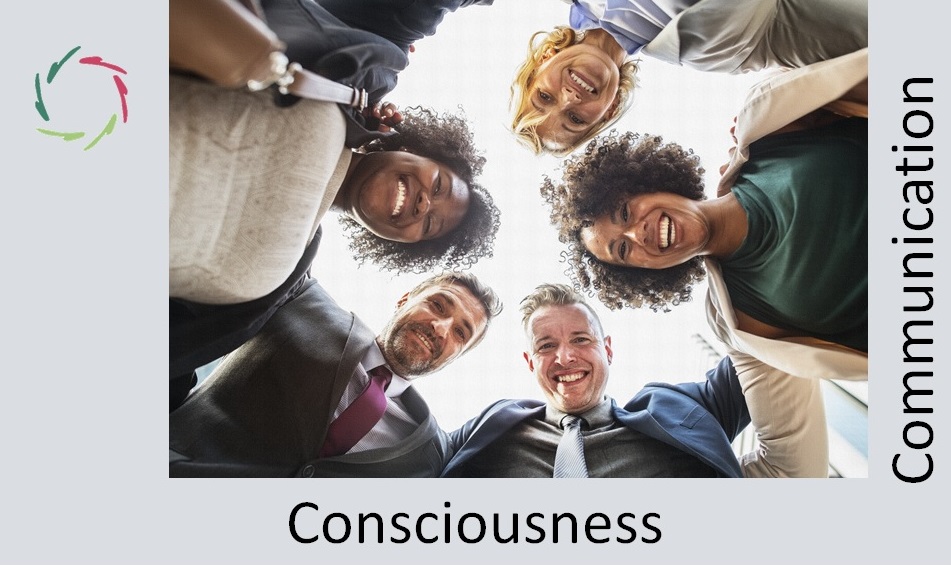
Why and how has consciousness emerged? One take on this: intra- as well as extracranial communication.
Why = how
Organic life is not the product of an engineer who starts with the question of why he should build something, then proceeds with how he can achieve his goals.
Organic life evolves from instance to instance, each time taking the road to optimization of self-replication. Part of this lies in keeping alive long enough.
Thus, there is only one why, and that is: how can things be optimized? The only ‘intelligence’ behind it is trial and error. Then again, this may be more sophisticated than just playing dice. Anyway, in such circumstance: why = how. This also means that
evolution is always gradual.
There is no need for an end goal – such as developing consciousness – in the long run, to be achieved over many generations.
As well, in hindsight, there is no one point of emergence of something as complex as consciousness. A long and winding road is mandatory. In other words: animals are conscious too, be it to lesser degrees. Where in evolution one may start talking about the big c-word, is arbitrary. Your dog? A mouse? The angry bee that stung you when you were a child? You decide.
Let’s look at one case now, knowing where it comes from. This case is you.
Intracranial communication
You have a lot of different brain parts, each more or less specialized, be it in sometimes amazingly flexible ways. One functionality – for instance, deciding whether to read on – may be realized through different parts in your brain versus that of the next reader.
This kind of flexibility is especially high for consciousness. Nevertheless, one characteristic seems to be ubiquitous:
active connections between many brain parts.
For instance: your cerebellum (back of your brain) contains most of your brainy neurons, but there is little connection between the parts, so: little contribution to consciousness. Vice versa in your cortex. In situations where these connections are made inactive (coma, deep sleep, anesthesia…), you lose consciousness.
Bring back the connections and you regain consciousness.
You are – relatively, but more than enough – special within the animal kingdom in that you at the same time have a quite big brain and you have a lot of communication – back and forth – between your brain parts. It could be better. It could be worse.
This communication is what you experience as ‘being conscious.’
Thus, consciousness is an experience, not some ‘special kind of stuff in the universe.’ Sorry. No dualism.
Nevertheless, it’s more than special enough. Consciousness brings you a lot of advantages and self-perpetuating patterns such as a very enhanced ability to conceptualize, to memorize, to plan, to compare options… Wow!
This is extremely relative. Even a fridge may ‘experience’ – to a very, very little degree – being a fridge, but it will never be able to conceptualize its experience. It’s not conscious.
A good question: will A.I.?
Extracranial communication
You are also social. Your intracranial communication comes in handy to immensely heighten your social capabilities. And vice versa: through being social, you can also develop your intracranial complexity to a huge degree.
In other words, you are conscious of a whole culture. You even have access to the Internet.
Evolutionarily
this intra- and extracranial communication have probably very much bootstrapped each other. This made possible, towards the human species, a rut towards consciousness as part of our habitat and evolutionary niche in which we became more and more advantageous.
One way or another, we dispersed of close competitors – more and more of these are found by archaeologists – heightening the gap between quite conscious and very much less conscious species.
Consciousness through and for communication
So, we now have consciousness much more than any other kind of animal. Let’s use it to good ends. To the latter, communication is key. Also in depth.
Listening this way is so very important. [see: “Deep Listening”]
Related Posts
Mind as an Emergent Potential
Inspired by biological insights and deeply rooted in human meaning, this blog explores how what we call ‘mind’ emerges from the body as a coherent movement shaped by inner resonance. There is no dualism here. Instead, we find a unity that evolves, heals, and expresses itself in profound ways. Intelligence without brains? Recent biological insights Read the full article…

About Dukkha (Suffering)
Central to Buddhism, from early on – and even somewhat earlier – is that dukkha (suffering, stress, fundamental unsatisfactoriness, dis-ease) exists and can be alleviated. Buddha showed a way to do so; I show two. The flower bud You find this metaphor as the first one in my e-book nr. 2, a collection of 12 primary Read the full article…
How to Communicate Human Depth
In a world that often values quick answers and surface-level logic, depth can be difficult to communicate — especially to those who haven’t actively explored it. Yet, human depth is real, substantial, and present in every aspect of our lives. It shapes how we think, feel, connect, and even heal. The challenge is twofold. First, Read the full article…