Monogamy?
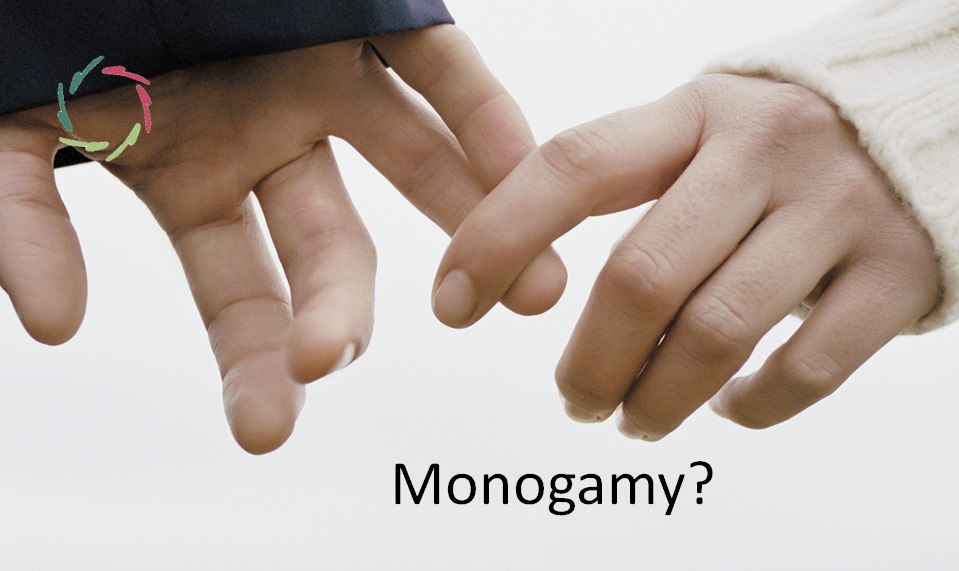
You might not like this. Please bear with me until the end. I will repeat that this idea is not unconditionally applicable.
About ‘mono’ in monogamy
Is it merely about a one-on-one relationship at a superficial level?
As in “Thy Shall not Covet Thy Neighbor’s Consort”?
Or is it primarily about a deeper level, as in a kind of deep attention that is oriented at the other (the ‘Other’) in such a way that there is an exclusivity in the ‘here and now’?
You might guess my answer. Still, it’s a bit more nuanced.
The deeper level is always very important. That deeper level includes the more superficial level, like: the depth of a pond is deep, including the surface. Take the surface out and the ‘deeper’ level becomes surface. Surface is needed for the deep to be deep. It’s an integral element.
But take surface out and put it somewhere else, then that is only surface. Gone is depth. In that sense, surface is opposed to depth.
Are you following?
A merely superficial relationship is a merely superficial relationship.
In a deep relationship, the surface is important from that depth.
If ‘monogamy’ is seen purely as one of many commandments, there is little depth involved, at least not in that individual case.
Being present for each other is much more important, though this is indeed easier with support from, for instance, a setting, a specific situation, a landscape, a mindscape, a mature culture…
Anything that may act as an (auto)suggestion.
And empathy?
Empathy and love are close neighbors. Empathy is somewhat more free-floating, thus it’s also possible in a professional relationship such as coach-coachee. Its driving force may be love.
As in monogamy or -andry or in any other kind of relationship. If the ‘mono’ is merely ‘I-driven’, there is no real love involved, while the latter needs depth in order to exist. It’s 3-dimensional. It doesn’t exist in 2.
Worse: the ‘mono’ may be a defensive wall of ego itself.
Then we quickly come into the realm of jealousy. Any breach or even possible breach in the wall becomes in the appreciation of the jealous person an act of violence, indiscriminate of anything else. Not the other person is seen anymore, only the breach, an emptiness where one expects only stones.
An emptiness that hurts, that is frightening, that may provoke the worst a person can be. Look at Othello (or google him). The worst is murdering the beloved, murdering love itself, possibly followed by infinite remorse.
So, is ‘mono’ OK?
Of course, it is. In freedom, openness, depth…
Such kind of mono-relationship may not be the comfiest one, but it is to a mature person one in which love can live.
I agree: this is not as such unconditionally applicable in the present world.
Let’s then change this world.
Related Posts

Mass Psychology
Mass psychology is one of the most powerful forces in human history. It has built civilizations, shaped revolutions, and fueled some of humanity’s greatest achievements. Yet, at the same time, it has led to manipulation, oppression, and the loss of individual autonomy. This force is neither inherently good nor inherently bad. So, how can we Read the full article…
Why Do They Vote Differently?
The other side is always the other side, viewed from what is to them the other side. So, are they voting differently, or are you? ►►► WHY read this? To preserve democracy, we need to answer this question.◄◄◄ Seeing ‘the other side’ is primarily internal. As a human being, one doesn’t see one’s mind, but Read the full article…
Group Jealousy vs. Loyalty from the Inside Out
Loyalty is a beautiful word — but easily misused. Many groups, in families, companies, and nations alike, confuse loyalty with control. But true loyalty grows only where there is freedom. This blog reveals how group jealousy pretends to be loyalty, and how we can evolve beyond it. What happens when someone leaves the group? If Read the full article…