Silos of Babel
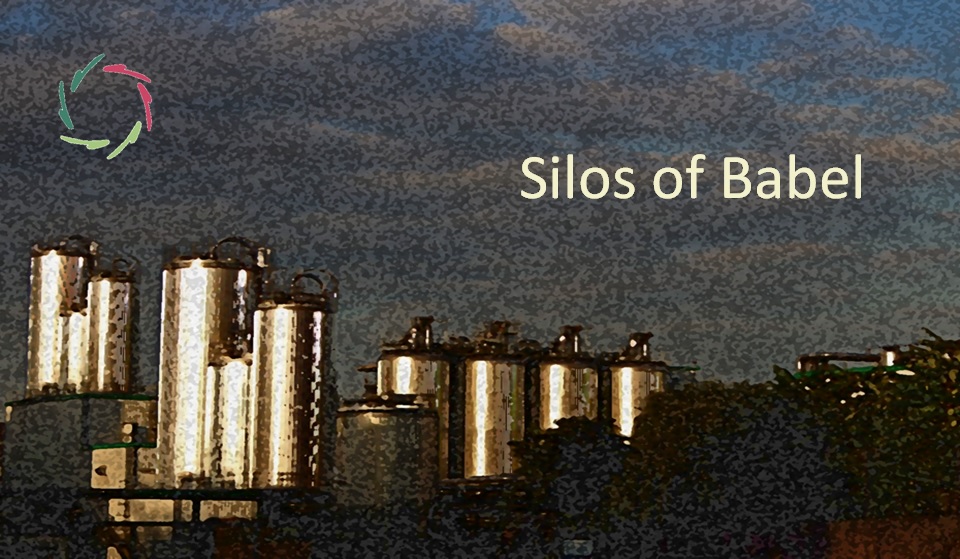
I see not one Tower of Babel to start with but many silos. I see not a dispersal at the end of the road but a coming together in worldwide Compassion.
At least, this is something to strive for.
It seems to me there are many towers of Babel at present.
We call these ‘silos’ nowadays. People live in such silos pretty much disjoint from what happens in other silos. We see this in social media, in professions, in scientific schools of thought, in special interest groups…
Much knowledge also resides and stays hidden in silos that could be crucially interesting for others. Relevant to me, cognitive neuroscience can be very relevant to psychosomatics, but alas!
In each of these silos, people apparently speak the same language.
In reality, they frequently think they do so much more than they actually do.
Part of this is instinctive, with the aim of group cohesion. In former times, this was helpful to survive in a competitive or otherwise adversarial environment.
Until Babel strikes
This way, they risk, as in biblical times, a dispersal into many directions — for instance, when group cohesion becomes less important by losing a common enemy. Paradoxically, as you can see in the example, this may happen more readily when everything is going well.
However, they don’t come to this dispersal by starting to speak strange tongues but by noticing they have already been doing so for a long time.
Would that dispersal necessarily be a bad thing?
Or can it be the first step toward the possibility of at least seeing the need to put more effort into trying to understand each other? Seeing this may help eventually to bring all people and all peoples together.
Even so, they won’t need a new Tower of Babel.
It will just be the world.
Moreover, there will be one language, indeed, called the language of Compassion. Many idioms will only make this more interesting. Compassion – in a good sense – doesn’t lead to boring stuff but a kaleidoscope of human flourishing.
From its side, Compassion will also make it more feasible to work with a multitude of idioms while enjoying the similarities and differences.
Is this the way to reach heaven?
I guess so.
Moreover, if one or the other vengeful godhead cannot stand it, we’ll teach him some Compassion so he can join the crowd.
Everybody is welcome.
Related Posts
Let People Be Meaningful
In a world full of noise, many people feel unseen, unheard, and unimportant. Meanwhile, people need to feel meaningful. They need to be heard, not just to exist, but to contribute and be recognized as valuable. Meaning doesn’t exist in isolation ― it requires someone to give it meaning. Without a meaning-giver, even the most Read the full article…
Wanted, the Truth!
Humans are truth-seekers in many different ways ― a worthy and challenging adventure. Paraphrasing Zhuangzi I don’t know whether I have been dreaming last night and am writing this after waking up, or whether I am still dreaming and writing this, hoping that you, dear reader, will read it in your dream. As far as Read the full article…
Zombification
Disclaimer: this text is not for overly sensitive readers. The term ‘zombie’ probably comes from the West African nzambi, which means: a dead person who is made alive again, but who has no own free will. In the Afro-Caribbean culture this is an essential part of voodoo (originally from West Africa). So, we are in Read the full article…