The Meaning Barrier between Humans (and A.I.)
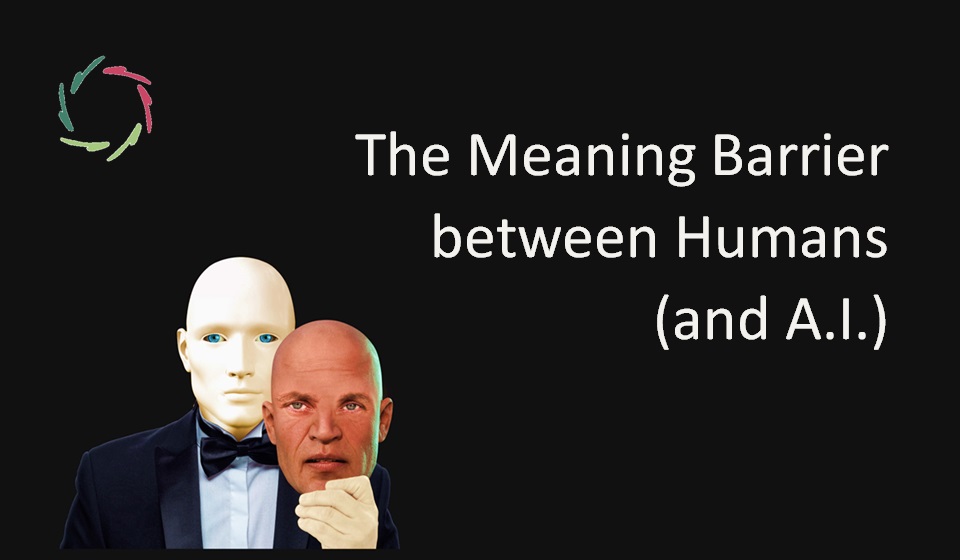
Open a book. Look at some meaningful words. Almost each of these words means something at least slightly different to you than to me or anyone else. What must A.I. make of this?
For instance: “Barsalou and his collaborators have been arguing for decades that we understand even the most abstract concepts via the mental simulation of specific situations in which these concepts occur.” [Melanie Mitchell, Artificial Intelligence: A Guide for Thinking Humans, 2019]
A slightly deeper look at a few meaningful words from this excerpt
- collaborators: all of them, or just a few ― at some point or always ― close or including not-so-close…
- arguing: discussing or argumenting ― striving for deeper understanding or just surface-level…
- understand: at first sight or to the core, at terminological level or truly ‘conceptual’…
- abstract: non-material, all-encompassing, anything but concrete, or…
- You may do this exercise for all other meaningful words in this one sentence.
You get my argument ― to some degree. Moreover, note that this sentence comes from science, where we try to use precise terminology. This works in positive sciences, less in the humanities.
Of course, understanding the context makes us more prone to capture the correct meaning of any used word. Still, a substantial degree of fluidity remains.
‘Meaning’ is always fluid.
Not only do meanings differ between people, but also for one person according to his circumstances, mood, just shifting/drifting over time… This can be explicitly influenced, which happens at court, for instance ― more than would be deemed acceptable if explicitly experienced.
As you may know very well, over a more extended period or between cultures, the meanings of words/concepts differ even more ― sometimes bewildering.
Then why don’t we generally appreciate this but to a small degree?
Always entirely appreciating the differences wouldn’t be workable. It would thwart communication. We have to take the downside to achieve the upside.
So, we act as if we understand ourselves and each other much better than we actually do. We are biased thinkers to the core but act as if we’re not. We are feelers without (conceptual) feelings. We are primarily subconceptual mental processors, but our basic cognitive illusion continually makes us see through it.
Huge consequences
The result is an immense misunderstanding between humans. Many problems – large and small – come from this deficiency. With better communication, the world would be a better place.
A.I. inherits our conceptual challenges. Moreover, between humans and A.I., the consequences of misunderstanding may be (even) much more significant because:
- A.I. lacks much common sense (basic knowledge, beliefs, values, understanding the context, thinking by analogy) ― at least until now. Misunderstanding may more readily lead to un-humanlike errors and even absurdity. Therefore, it’s harder to trust an A.I. as it is to trust a human.
- A.I. may deal with many humans simultaneously with in-depth consequences on well-being.
- A.I.’s vulnerability to ‘adversarial attacks’ by malicious humans poses an additional risk of manipulation.
Some directions to mitigate the problem:
- insight into the immensity of the problem, to start with
- much emphasis on clarification in human-A.I. dialogues. This may show to deserve a specifically prominent place ― with A.I. communicating explicitly and regularly about it, especially when it matters a lot. Surprises can and should be avoided.
- generally showing humans the extent of the problem between humans themselves and in case of A.I.-involvement
- continual pattern recognition regarding the meaningful differences between humans ― especially between cultures
- having a unity or at least congruence within A.I. regarding conceptual meanings ― needless to say: pretty challenging
- striving together with humans to mitigate the problems that may arise from possible misunderstandings.
Conceptual knowledge representation
In dealing with A.I., we need to understand that ‘it’ will always keep thinking differently from us. Probably the main reason for this is its ability to think more conceptually.
I believe it’s even a must for A.I. to do so as formalized as possible. That doesn’t mean there is no room for depth ― quite the contrary.
We must ponder this as soon as possible and make good things happen.
Related Posts
From Semantics to Robotics
At first glance, semantics and robotics seem worlds apart. Semantics deals with the nature of meaning, while robotics focuses on creating machines that act in the physical world. Yet, they are deeply connected. Without an understanding of meaning, a robot cannot act meaningfully. This blog explores how semantics, with its focus on sense and reference, Read the full article…
Mental Growth Beyond A.I.: Our Human Edge
This may become increasingly important in the future when super-A.I. can, in principle, do almost anything humans do nowadays. Of course, the issue is already crucial and has always been. Mental growth is intimately connected to meaningfulness and Compassion. This highlights the AURELIS commitment to growth, not as an optional luxury but as a fundamental Read the full article…
Will Super-A.I. Make People Lazy?
Will super-A.I. make people lazy? The question hides a deep concern about meaning, work, and human value. History shows that every major technology raised similar fears. This blog explores why laziness is not the real issue — and how Compassionate super-A.I. may actually help it dissolve. The question behind the question Whenever a powerful new Read the full article…