Secular Society
Secularism = the individual’s right to be free from the imposition of any religion by government, in a state declared to be neutral on matters of belief.
[This text goes further upon ‘Freedom of Religion’.]
Sustainability from the start
‘Secular society’ is about ‘freedom of religion.’ But not only that. In order to be sustainable, it needs to be about a society in which ‘re-ligiosity’ is present in a way that can in principle fulfill everybody. Logically, this is the only society that can continue to exist for the next, say, 1.000.000 years.
It’s a weird thought that there will then be a culture with 1.000.000 years of recorded history…
At least, without major catastrophe in between.
Guys of then: if you read this, I salute you
and hope you are doing fine. And by God I wish I would know more about you. Do you still have religion? How do you look upon us, most primitive of primitive beings?
One for all
We (now) are on our way to one religion. Of that, I’m sure. But the thing is: every believer is inclined, or at least incentivized to see his own religion be accepted for the job of ‘being the one’. You of the year 1-M, know better: “the winner takes it all’ is not an option. There is no winner in true religiosity. Thus, any religion that strives to ‘win’ makes no chance.
Re-ligion is about re-ligare: making connections, not divisions.
‘Connection’ inside the individual: between conceptual and subconceptual thinking. This is, more or less, between conscious and nonconscious mental processing.
‘Connection’, mainly through the former, also between individuals, groups, cultures.
Militant a-theism is in this sense just one of many possible dividers. This is a pity. Inasmuch as it lacks poetry, this makes present-day a-theism not sustainable. It’s correct that there is no need to make people believe in any weird stuff. But:
People do need poetry.
This is: deep meaning, deep respect, deep communication, deep ‘being’.
Many things are cultural: they have meaning to the individuals of a specific culture while they may not have the same meaning – or any meaning at all – to those of another culture. One should respect all meaning. That’s not the same as indulging in it, nor approving it.
The ideal secular society: a description in a few points, for now:
- Everything is allowed to everyone without imposition. This every one learns to deal with this freedom in a most humane way.
- There is no lack of re-ligiosity. So much so that there is no incentive to fill anything with any new ‘religion-of-things’.
- If there would be none of the present-day organized religions left, people would not need one.
- There is no religion because everything is re-ligion. People are free to show this because there is nothing that separates.
- Any sign/symbol is a unifier, also when different signs/symbols are used.
- People ‘believe’ as a pure action, objectless.
- There is no ‘enemy’ in religiosity.
In short, the ideal is a society of freedom of religion.
Related Posts
Neurons, Mental Depth, and Open Religion
Many people sense a connection between these three concepts, but how strong and in what ways? In reality, we know quite a lot about their interrelatedness. Patterns It all starts, more or less, with synapses, neurons, and the patterns they create — essentially mental patterns. These patterns underlie all mental activity, illustrating the profound connection Read the full article…
The Temporal Eye
In memory of a personal experience. Sitting at a bench looking over a field of grass and a pond. Trees in the distance. Sunshine. Late afternoon. Very relaxed. Becoming the trees. You may see this as a mystical experience. I do, if ever there is one. Being the trees. No difference between them there and Read the full article…
Rituals
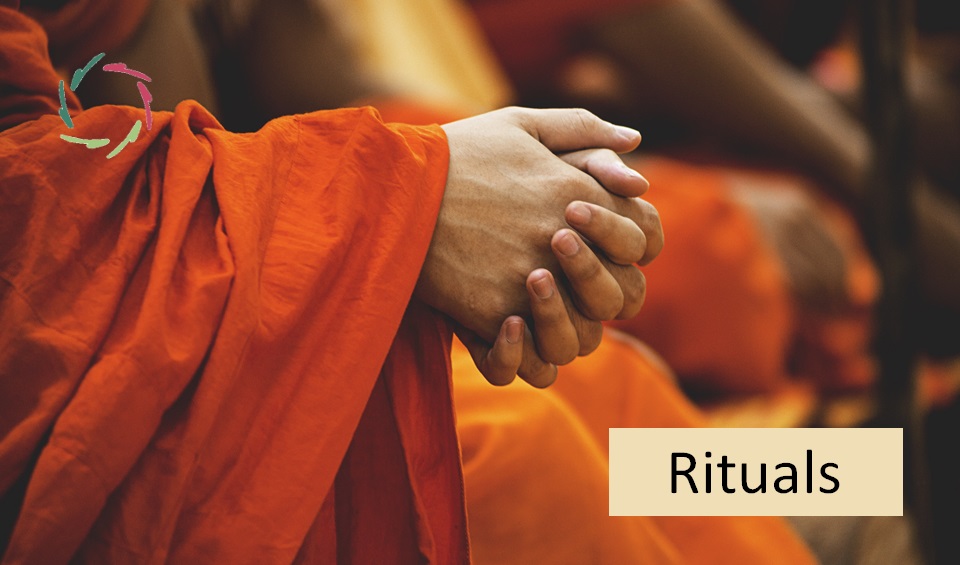
An action becomes a ritual when it is repeated and when it is deeply meaningful. For this, one needs to be open to it. ‘Open’ as in ‘Open Religion.’ A ritual is a repetitive action to which one attaches ‘deeper meaning’. Without ‘deeper meaning’, a ritual has no, well, meaning. It’s like an empty box, Read the full article…