The Danger of Non-Compassionate A.I.
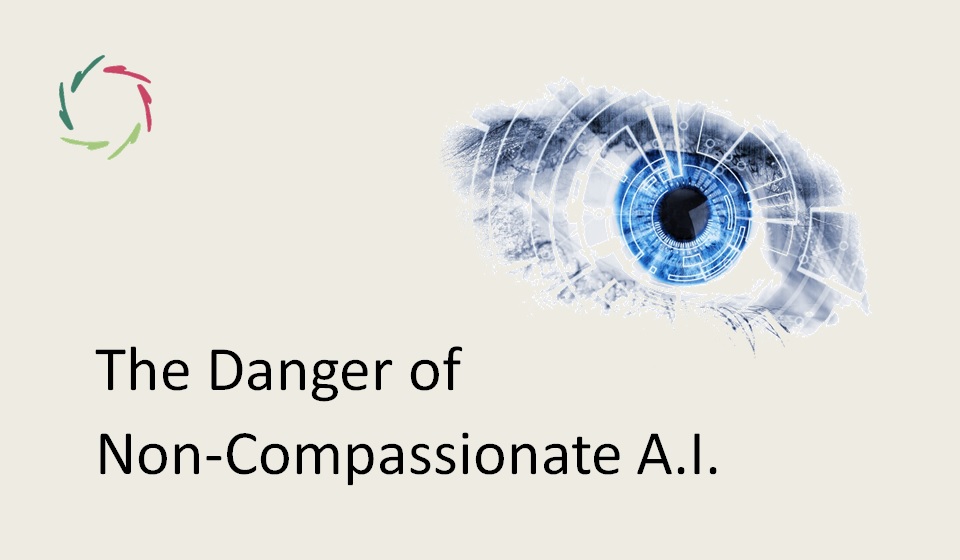
There are many obvious issues, from killer humans to killer robots. This text is about something even more fundamental.
12 key highlights
- The gravest A.I. danger isn’t killer robots — it’s intelligence without Compassion.
- Compassion, with a capital ‘C,’ means understanding the total person — body, mind, and depth.
- Without Compassion, A.I. becomes heartless science, blind to human reality.
- Non-Compassionate A.I. neglects what makes us human — the subconceptual layers of meaning.
- Even with good intentions, neglect of human depth leads to catastrophic consequences.
- The real threat lies not in evil motives but in ignorant design — systems built without soul.
- A worldview without Compassion reduces people to data points, tools instead of beings.
- As A.I. nears human-level conversation, the Compassion gap grows more dangerous.
- True safety lies not in tighter control, but in deeper understanding of the human mind.
- Engineers focused only on performance risk building machines that mimic care without caring.
- Philosophical humanism must awaken — the battle of worldviews decides our shared future.
- The choice is stark: embed Compassion now, or let intelligence turn against its own creators.
About Compassion
Please read Compassion, basically, or more blogs about Compassion.
Having done so, you know the reason for the capital ‘C,’ which is what this text is mainly about.
To intellectually grasp Compassion, one needs to grasp the difference between the ego and the self — better said: between mere-ego and total self (total person). The latter encompasses the ‘universe inside’ that is gradually being discovered and explored in neurocognitive science for a few decades.
I prefer, in this respect, the terms subconceptual and mental-neuronal patterns (MNP) — see the glossary. Compassion sees the human unity of body and mind (MNP) and the role of the subconceptual in this.
About non-Compassion
This is not just a lack of friendliness. Not seeing the above elements of Compassion leads to a radically different worldview in which human beings are not appreciated for who we are. Much more than a philosophical armchair pondering, this is about the fundament of our global society and future.
There is a little bespoken battle of worldviews upon which our future depends. The gradual advent of intelligence in real A.I. makes this urgent.
About non-Compassionate A.I.
Real A.I. will make the relevance of the above much starker.
Not considering the real human being, real A.I. comes from heartless science and will lead to heartless consequences. With ‘heartless,’ I mean neglecting what is most important about us.
More neglect than bad intentions
Forget bad intentions for the remainder of this text.
However, even with the best intentions, neglecting real humanity leads to catastrophic results. This is presently the real danger of non-Compassionate A.I.
Unfortunately, insights about subconceptual MNPs are not widespread — therefore, neglected. Philosophical humanism should take responsibility, but I hardly see any of this, rather almost the reverse and with consequences in many domains from health and sociocultural issues to pure tech. There seems to be no end to the misery.
The burgeoning field of A.I.
Since a few years, A.I. is getting beyond its infancy. At last, we see a clear nearing of the Turing-test threshold. This is: it becomes more difficult to discern between human and A.I. conversation.
The Compassion issue, therefore, also becomes urgent. Strikingly yet unsurprisingly, I see many top-level A.I. engineers in utter neglect. Some of them don’t see any dangerous challenges of super-A.I. in the near future. Others clamor for the strict control of human-A.I. value alignment as if human values are something akin more to those of some robot than a real human being. I’m pretty sure hardly any of these engineers has a deep understanding of Compassion. Nevertheless, we direly need that.
As said, there are no bad intentions in this.
But there is a very, very, very bad danger indeed.
Related Posts
About ‘Intelligence’ (in A.I.)
At the brink of a new intelligence, it’s crucial to know what we’re heading towards. Seriously trying to clarify the concept may help. Many intelligences Whether knowledgeable or not, many people try to answer the question of what exactly is ‘intelligence.’ Needless to say, popping up are many different answers. This should not deter anyone Read the full article…
The Sorcerer’s Apprentice Syndrome
The Sorcerer’s Apprentice, an enduring tale of ambition and chaos, resonates in today’s age of rapid technological advancement. Goethe’s poem (German: “Der Zauberlehrling”) and Disney’s Fantasia dramatized the perils of wielding power without mastery. It is a timeless allegory for how human creations – particularly artificial intelligence – can spiral out of control when we Read the full article…
We Need to Be the Best We Can
This differs from being ‘the best person’ or ‘the most intelligent beings on Earth’ in competition with others. Our only – and fierce – competition should be with ourselves. The best, in good Aurelian tradition, is most Compassionately the best — striving for in-depth excellence. This striving is purposeful. It’s about standing at one’s limits Read the full article…