Shall we Put A.I. on Hold?
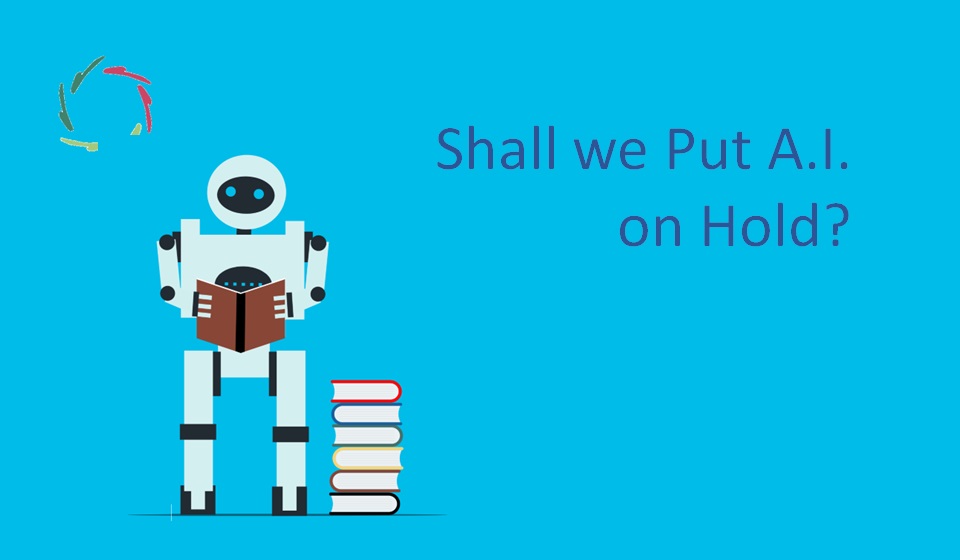
Now and then, the admonition arises to put A.I. – or part of it – on hold to take some breath and think about possible dangers. There are pros and cons to this pause button.
Doubtlessly, A.I. is challenging, as is any disruptive technology.
A.I. can disrupt on steroids. It’s not just about automation ― doing something with less effort. It’s also about autonomization ― deciding based on a self-made strategy. [Note that this differs from autonomation or ‘intelligent automation’ ― automation with a human touch.]
Due to the autonomization, A.I. can evolve toward performing larger sequential tasks with many different elements. In other words: it can not only let people do their jobs better. It can, to some degree, also do their jobs better.
No science fiction, soon science fact to a huge degree
We can be confident of many considerable advancements in the near future, even if only based on today’s core technologies, with cognitive overhang drizzling down soon. Moreover, there surely will be more core advancements.
Therefore, we need to think about many questions. The answers are urgently needed.
So, pause the whole thing for a while?
For instance, as has recently been asked by the Future of Life Institute. Note that they don’t request a stop on the whole A.I. endeavor but mainly on the giant black box technologies (*) that are newsworthy nowadays. Who hasn’t heard of Chat-GPT?
I admire the institute. I’m an early endorser of their ASILOMAR A.I. Principles for safe A.I. Their present concern is understandable. Also, I’m not against this pausing. It is a correct attitude and speaks of profound responsibility.
There are pros and cons.
Since the pro (I see only one) is obvious, let’s concentrate on a few cons which need to be taken into account, especially since it’s such a crucial matter:
If the call succeeds, not the whole world will pause in this respect.
Rogue developers will see it as an opportunity to take advantage (or to lessen a disadvantage) in time. Think of dictatorial regimes, power-hungry individuals, or organizations. The winners will not be the open A.I. labs.
Also, even the researchers in the open labs will not stop thinking about new technological developments. More and more, the thinking itself is the crucial part. More and more, the near future of A.I. is technological and philosophical at the same time. Unfortunately, philosophy is not humankind’s strongest asset. Arguably, moral philosophy is lacking behind even more ― say, some 2400 years, despite several turnarounds. Many engineers tend to be happily oblivious of Socrates’ warning (the wise man knowing how little he knows) and think the issue can be solved with some tweaks in the software. It is preferable if they do so in public.
Moreover, will we now suddenly close the gap?
I doubt that much thinking will be done in six months.
Therefore, a short time out to think might be somewhat misleading. Anyway, much more should have been done in the last six or sixty years ― since that is the timeframe for the first A.I. huge promises to rise and fall.
Will there be some regulations in place after six months? Maybe. Will they be relevant a year later? Probably not. Then, we have made many researchers’ lives uneasy for little to nothing, possibly disappointing – or even losing – the brightest ones. It may lead to losing the expertise needed to tackle the most challenging problems.
Still, a strong sense of urgency is needed.
This can accompany a pause, but the uncertainty may also scare people away from thinking about it. Anxiety is never a good adviser. Frequently, it leads to bad decisions.
With so much at stake, we must be careful without provoking anxiety.
Therefore, my humble opinion is that pauses – now or in the future – should be handled cautiously.
―
(*) ‘Black’ since nobody knows what happens inside, and it also cannot be explained meaningfully in human-understandable terms. Note that we ourselves are also ‘black box’ for the most part, even if many people think otherwise or don’t care.
Related Posts
Super-A.I. and the Meaning Crisis
I don’t know how things will evolve, especially with those unpredictable humans. But it is clear that we are in a meaning crisis at present, globally. With the advent of super-A.I., soon enough, what shall we do? Please read about the meaning crisis. We use(d) to get meaning from fairy tales. No lack of them. Read the full article…
Human-A.I. Safety Net
As A.I. grows more capable, the meaning of safety changes. Rules and guardrails remain important, but they cannot always recognize the larger purpose behind what’s apparently innocent. A deeper safety therefore calls for coherent and Compassionate A.I. working openly with humans. The result is not a perfect guarantee, but something more realistic: a Human-A.I. Safety Read the full article…
Human Symbols vs. Symbolic A.I.
A symbol can seem simple. We use the word easily, almost casually. Yet beneath it lies a deep ambiguity. What a symbol is in human experience and what it is in symbolic A.I. differ so deeply that using the same word for both can be misleading. This difference is not merely technical. It touches how Read the full article…