Are You a Trekkie?
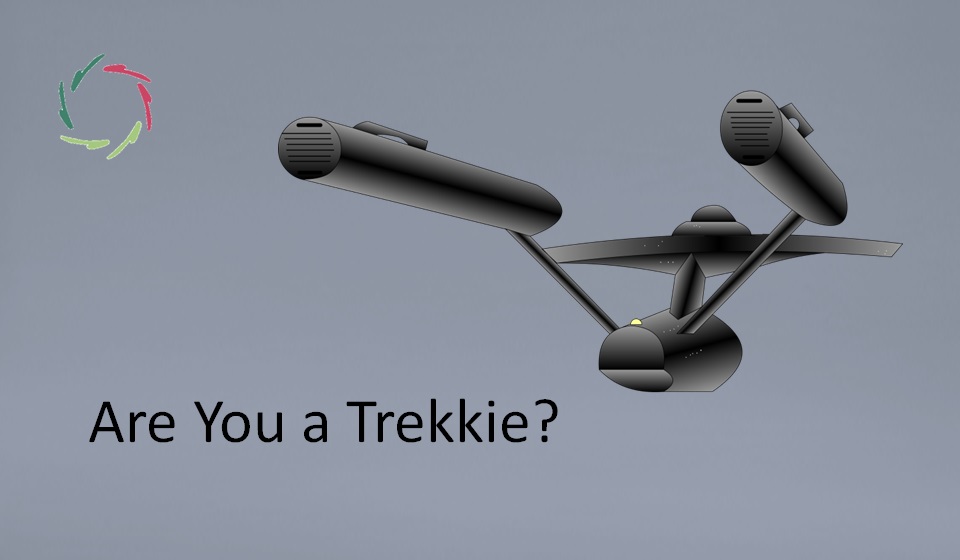
Star Trek (popular TV series) is about a future in which a specific economic-moral worldview has been realized ― also shedding light on today’s capitalism.
No money
In the Star Trek world, there seems to be no need for money anymore. Not just the physical money, credit cards or anything. Also the very concept of money has gone. For instance, if you need food, you press a few buttons, and food appears ― no payment.
Nobody owns anything as a mere summation of assets. Of course, emotions are still involved, even for Vulcans if push comes to shove. [Vulcans just like to appear purely rational.] The only property is directly emotional ― more precisely, ‘subconceptual,’ but that would lead us too far for now.
In one episode, some deep-frozen capitalists from the late 20th century are unfrozen. They wonder what drives the people in that brave new world since there is no monetary motivation. The answer is quickly given: “human growth.”
I’m sold already. You may call me a Trekkie.
The Star Trek universe is purely post-capitalist. The only primitives who still care about to-the-core ownership are members of strange civilizations where no human has gone before.
Note that nobody gets bored.
If you like that worldview, you might think about how we can evolve toward it.
Is it even possible, a world without money?
“Then who pays for all the stuff?” ― is a self-defeating question. Nobody pays.
“Then where does all the stuff come from?” ― From an entirely autonomized production process, where everything is taken care of by super-A.I. and robots.
“Then who pays for these?” ― Again. Nobody pays.
You see: In the complete autonomization lies a perpetuum mobile where money has lost meaning. Anything that could cost something is being take care of for free ― including the process of taking care of it all. Energy and other resources are taken from outside the bubble of life ― for free if that would still be unclear.
The Star Trek universe has managed to turn this into human-centeredness to the core.
In comparison to Star Wars
This shows an entirely different future. There is continually a lot of violence.
The ultimate violator – Darth Vader – tries to control everything out of anxiety, anger, resentment, and a sheer lust for power. Thus, he uses the ‘power of the dark side’ in a zero-sum contest with the rest of everything. Anyone who wants to control (command) something must do so under control (command) of Darth Vader. Any ownership falls under his ownership ― unbridled super-capitalism gone completely haywire.
Of course, Star Wars also has good people. The ‘Force Inside’ looks like Inner Strength ― in principle, at least. Even the dark force’s energy eventually comes from the same source, only entirely usurped. Until the end, hope remains that everything will turn out well for another eon.
Strict capitalism has capital at its economic-moral center, therefore, not the human being.
In a stark form, capitalism is not a kind of humanism if it does not explicitly put the human being at the center. Even Adam Smith, the alleged godfather of capitalism, did so to a considerable degree. Unfortunately, we frequently see capitalism with little humanism. We also frequently see A.I. developments with little Compassion. We should be weary for a Star Wars future.
On the other hand, the Star Trek future puts the human (and humanoids, broadly speaking) at the center so much that capital has evaporated. We might think of this as a reasonable option.
In any way, economic directions are taken from moral inclinations.
Putting the total human being at the center is a profoundly moral choice. This will also determine the economic-moral direction of the future ― which, of course, will not look like any present-day science fiction fairy tale, but, nevertheless.
One thing is clear: Capitalism as we know it today cannot be the basis for any viable future. In a gentle slope, it should be replaced by an economic-moral system based much more – if not entirely – on deep meaningfulness and Compassion. Moreover, the Compassionate choice may inevitably lead to the evaporation of money in a super-A.I. future.
Why would our descendants then still do anything? The answer: “human growth.”
They will not get bored.
Related Posts
Sleepwalking from World Crisis to World Crisis
The global crises that we are experiencing one after another – or even simultaneously – do not happen by coincidence. In-depth, their common cause is a fundamentally wrong view of the deep-mental side of the human being. Ancient wisdom and cutting-edge science have been trying to wake up humanity ― until now, in vain. Even Read the full article…

Wanted, the Truth!
Humans are truth-seekers in many different ways ― a worthy and challenging adventure. Paraphrasing Zhuangzi I don’t know whether I have been dreaming last night and am writing this after waking up, or whether I am still dreaming and writing this, hoping that you, dear reader, will read it in your dream. As far as Read the full article…
The Psychology of Nationalism and SID
Nationalism is increasingly prominent in many parts of the world. While it can fulfill a deep-seated need for identity and belonging, it can also be a symptom of Societal Inner Dissociation (SID). It then risks becoming a force of division, exclusion, and conflict The present blog explores the psychological mechanisms that link SID with the Read the full article…