Spontaneity: How-To
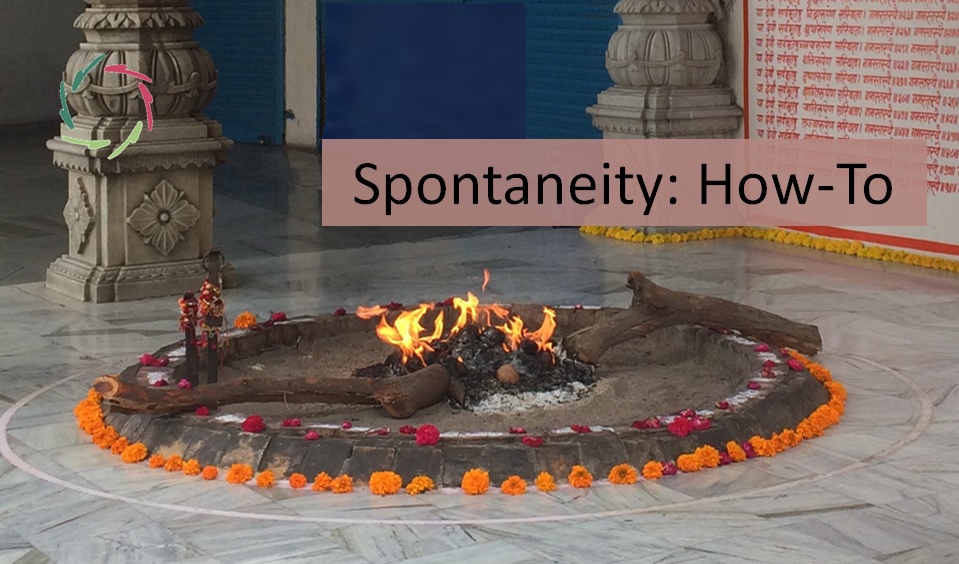
The main thing: not putting visible stuff in the way. Letting all ‘stuff in the way’ be invisible, transparent. Then, of course, it is the other way.
[Please read first: “Spontaneity”]
It doesn’t satisfy ‘one who wants.’
If this is you, then please try to make your wanting transparent. This is precisely the way to be spontaneous: there may still be ‘wanting’ but in the other way.
Not this way. This way, the wanting stops you from being spontaneous. You’re only making yourself – and others – believe in such.
So: how-to?
You have to tend to it. Spontaneity is different from ‘just doing anything you want.’ The ‘just’ in the latter makes the wanting not yours. Others make you want. Advertising. Organizations. The play of the powerful even in long bygone ages…
Many things except you.
You have to tend to it
like a fire.
Spontaneity burns.
Don’t let it burn you like wildfire. At the other side, you really have to let it burn. It burns at its own pace. Try to control the burning itself and you’ve lost it.
You can give it more or less fuel, but give it too little fuel and you’ve lost it.
Spontaneity is not an easy fire.
You have to tend to it
by giving it your attention.
OK. Another uneasy term: deep attention.
Not putting superficial stuff in the way is an exercise. By doing it, you become better. Then you can exercise better. It’s a familiar principle. So, starting small is a good idea… or so it seems.
Progressing little by little does have the disadvantage that every little hurdle may seem big. Note that we are dealing with ego-stuff. In such a domain, ‘little’ and ‘big’ are easily confounded.
Looking at the fire
you can see what it needs. Give it a bit of what it needs. You can experiment in many ways. Always try to do it seriously. It’s a game and it’s not a game.
Give it a bit of what it needs. Then see how it reacts. Try to ‘understand’ why it does so. An intellectual understanding is not bad if it doesn’t withhold you, again, by itself.
A meditative understanding may help a lot [see: “Meditation = Being Friendly”]. That is what for instance Buddhist monks do and call it meditation. At least some of them. Some meditate for many years.
Which is laudable.
Doing it for an hour, doing it for five minutes is also laudable.
The aim is to do it all the time.
Related Posts
Religions are Approximations
This is a two-part blog. In the first part, I expose a very Aurelian idea about religion. In the second part, I ask Lisa what this may mean for the future, for A.I., and for Lisa herself as a Compassionate A.I. in the ongoing future. And of course, dear reader, this is about you. Religions Read the full article…

The Future of Open Religion
The future of Open Religion, >as explored in many blogs<, foresees a significant transformation in religious experiences and beliefs. This blog integrates some key points. At its core, the future of Open Religion is about inclusivity, Compassion, and profound understanding, surpassing traditional boundaries and cultivating a global community founded on shared spiritual values and experiences. Read the full article…
How to Use Symbols
Any symbol. Let’s say you are a religious person. Then symbols may ‘talk’ to you. How? [see also: ‘Symbolism lost. Symbolism regained’] Eventually, any symbol is… you. You are the crystal. Does light shine from you or through you? It depends on how you look at ‘you’. Does your mind only consist of conscious – Read the full article…