Psychotherapy or Mental Growth?
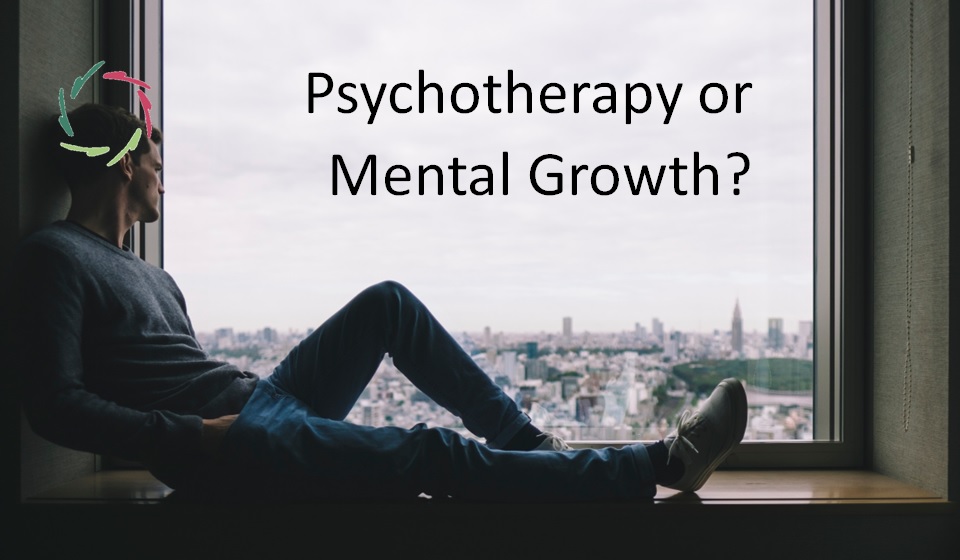
This is: curing a mental illness or fostering Inner Strength? What should a person with a mentally related issue strive for?
Concerning mental and psycho-somatic issues
Psychotherapy carries the connotation of being pointed toward strictly mental problems. Contrary to this, although seemingly hazier, mental growth has broader applicability.
Many practitioners of somatic medicine wouldn’t like the association of ‘mental growth’ with medicine, let alone their field of expertise. The solution is to separate the domains within the practitioner’s standpoint, bringing them together within the standpoint of the cared-for. The medical practitioner can advise his patients to take care of this other side ― while definitely not being within his medical expertise.
This will not detract from medicine but make it much more genuine and, indeed, scientific.
Mental illness under scrutiny
Not well known by the general public – or even many psychotherapy practitioners – the concept itself of mental illness lies under intense scrutiny. In top-research, the debate has even largely been abandoned, the consensus being that mental illness as a concept has little to no internal validity. This is, within the extensive enumeration of mental illnesses (DSM-V) lies no natural kind concept.
Much effort goes into the search for an alternative. For this to succeed, probably much more profound issues must be solved, such as a different stance towards non-conscious mental processing and a clear choice to transcend the placebo.
Arguably, this will make the whole domain of psychotherapy more mental growth-oriented.
AURELIS is a growth philosophy.
So, naturally, it goes in the second direction. Moreover, you recognize Inner Strength in the last two letters of the name.
One doesn’t need to be ill to use AURELIS. Even more, the concept of illness is not intrinsically relevant to the AURELIS project. Therefore, there is no diagnosis or therapy for any ‘illness.’ The term, if used at all, explicitly only serves convenience.
Lisa follows in this vein. Coincidentally, this naturally widens the applicability of Lisa very much. Moreover, it brings Lisa’s way of being closer to the concept itself of intelligence. This is the promise of Compassionate A.I., which I have written extensively about in my book The Journey Towards Compassionate A.I.
As to the science
Mental growth should be profoundly within the scientific domain.
As a matter of fact, at present, it is not. I believe the profound cause lies in the (culturally) badly digested distinction between the conceptual and the subconceptual. Western science has chosen the former for historical reasons while pushing away the latter.
Poetically said, the inside versus outside the poem needs to be reconsidered. Human depth may be absent from most present-day conceptual science. Meanwhile, much is happening within neurocognitive (conceptual) science that will undoubtedly change the picture.
Mental growth doesn’t belong forever in an alternative swamp vs. a colorless ivory tower. It should be taken seriously in a combination of rationality and depth, which is, as you may know, the USP of AURELIS.
Related Posts
Enlightenment, Kant, AURELIS, Growth
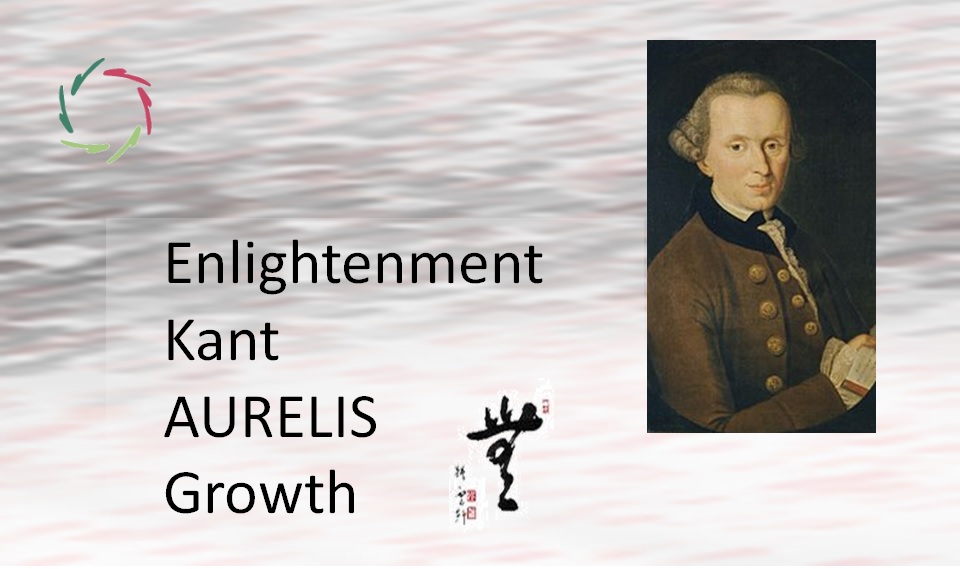
It’s time to bring things together. This is according to me the only way forward. ‘Western Enlightenment’ points to a historical period from +/- 1650 onwards, till +/- first part of 19th century. It was multifaceted, to say the least, and came in several waves from ‘moderate’ to ‘radical’… to even ‘totalitarian’ (à la Robespierre). Read the full article…

Do It for the Children
We live in an age of immense possibility — and danger. Artificial Intelligence is not just a tool; it is a mirror. What we put into it will shape how it reflects us, to ourselves and our children. This is not just a game of tomorrow. It is a responsibility for today. See, for instance, Read the full article…
Nature Wants Growth, Especially Mental
No growth – no health. This is most obvious in anything mind-related. For this reason, AURELIS is a growth philosophy. Mental disorder as obstruction of growth Nature wants growth, no matter what. There is no life without growth. If no growth is possible in one direction, there will be in another, even if this eventually Read the full article…