From Therapy to Empathy
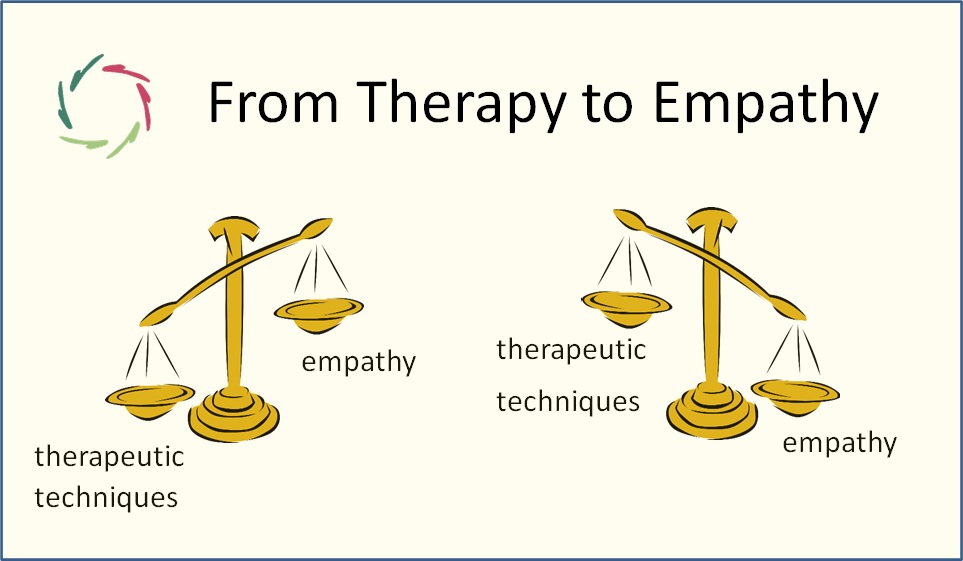
The future cannot be to un-science. It cannot be without empathy in full mode.
The term ‘therapist’
comes from the Greek ‘Serapis,’ a Hellenization of the Egyptian god Osiris. [see: “Isis’ priests, named ‘therapists’”] I think that, in those ages, anyone with a serious psycho-somatic disorder could best go and visit such a temple. The priests – therapeutai – performed acts of placebo and empathy. From a modern viewpoint, there was hardly anything else.
In the meantime, science has taken over many things. However, in psychotherapy, science hasn’t been able to develop very efficient answers until now. Should we go back to unscientific temples?
Let’s leave out placebo and focus on empathy.
Empathy is very much underrated
Everybody ‘does it’ like everybody sings a song now and then. Yet, there’s a difference with Whitney Houston at her prime.
The fact that there is little difference in efficiency between a math professor after a small ‘course in therapy’ and a fully educated and experienced psychotherapist may show that the empathy level in both is the same. It doesn’t show that empathy itself cannot be refined.
Psychotherapists are scientifically trained in the use of psychotherapeutic techniques but not in the use of empathy. Do you agree, my dear reader?
You might object to this:
“Empathy is an art and cannot be scientifically taught.“
Precisely, it’s an art ― also. And it’s also a science. [see: “Science of Empathy”]
Both sides are crucially challenging to accomplish from a ‘socially constructed reality’ in which psychotherapeutic techniques fill a void. [see: “Psychotherapy vs. Psychotherapies”]
The void that has been filled cannot be fully used anymore to hold empathy. The cup is full. Emptiness is conceptualized ― thus lost. Whence can originate Compassion, if not from ‘emptiness’ (the void that I am talking about)? [see: “Emptiness!”]
The empathic bird has two wings – art and science – that need to be considered, educated, respected, nurtured with practice and deep insight. If they are, the bird can fly. And indeed, it does!
Why are many psychotherapists reluctant to relinquish psychotherapeutic techniques?
In my view, mainly because they don’t see the possibility to fly. On the ground, indeed, wings are only a nuisance.
Secondly, many might think they sing like Whitney. There is no denigration in acknowledging that no, this is not – or seldom – the case.
Then there is the very grounded feeling that the techniques work. To get over this, my advice is to take antidepressants as an example ― hardly (at most) working in a specifically depression-diminishing manner, yet they feel like working this way. That is the lure of placebo. Now think back on the techniques. You don’t have to leave them. It is your decision.
In two drawings, what is thought to be:

and what is to be realized:

The future: from therapy to empathy.
There is a continuum from the first to the second balance. Empathy being partly science, it belongs to the world of science ― not by losing the art but incorporating it. Also, since it is science, it should be an academic discipline.
Many people depend on psychotherapists who rely on psychotherapeutic techniques. Abandoning the techniques just like that would have very negative consequences. Relinquishing the techniques in favor of full mode empathy/Compassion is a different game.
We don’t have to wait for some future to let this happen.
In my view, it is the only scientific and durable game.
Related Posts
Compassion = Empathy-Beyond
The difference, conceptually, mainly denotes the importance of subconceptual mental processing. This is my use of terminology. Please look at it conceptually ― much more interesting. [see: “Conceptual Landscapes”] In any case, the two concepts have fuzzy and overlapping borders. Please also read about this other distinction: [see: “Altruism – Compassion”] Empathy beyond the conceptual, Read the full article…

Wisdom Emerges
Wisdom doesn’t arise by magic; it is cultivated. Both in humans and Compassionate A.I., wisdom requires sustained effort. To think that wisdom comes effortlessly is wishful thinking. This blog explores how wisdom develops in humans and what this means for the future of A.I. For more about the latter, please read these blogs. ― Letters Read the full article…
Questions to Lisa as a Compassion Trainer
In due time, Lisa may become a workshop-leading Compassion trainer. Soon enough, she is already an excellent post-training personal coach. Here are some questions and Lisa’s answers that can guide herself – as well as human trainers/coaches – in both. Please first read What Makes Compassion Training Effective? You find the answers after this enumeration Read the full article…