Responsibility of Humanism in Modern Times
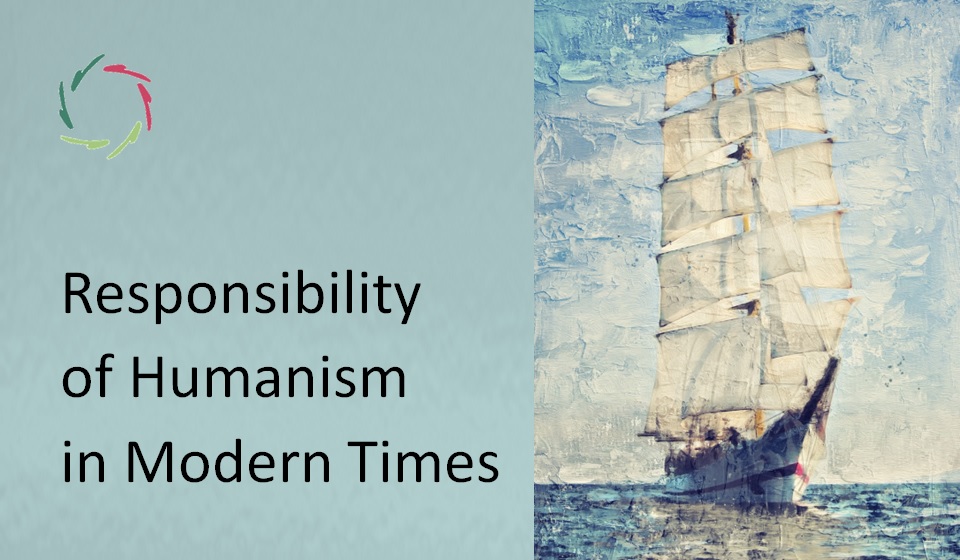
This responsibility has always been huge ― perhaps even more so in modern times with many essential changes happening, and probably even more (and more essential) to come in the near future.
Humanism: the striving to put the total human being at the first place of importance, therefore not a god or religion, nor some principle or ideology. This encompasses the insight that mind = body, and that there is much more under the mental hood than conscious conceptual thinking, following decades of relevant science. Unfortunately, many humanists have gone asleep half a century ago.
As always: responsibility, no guilt.
This time, however, it’s close because, more than anything, humanism itself should bring this insight to the fore.
Without the no-guilt principle, there is little progress foreseeable in many domains. People run away from (misplaced) guilt and, in doing so, from themselves.
Humanism as a movement
‘Humanism’ is a philosophy that one can adhere to individually. To me, the term also denotes a longing to realize this striving socially. That includes activism, one way or another.
Moreover, adhering to the philosophy already leads to social responsibility ― like an overflowing bucket. One cannot be a humanist solely by oneself amidst other people. Caring is part of being.
Is this proselytism ― trying to convince others of the ‘correct philosophy?’
In a way, yes. The humanist does this naturally and from genuine concern. It would not be honest otherwise. Of course, no coercion is involved, contrary to an organized religion or ideology that doesn’t put the human being at the center.
It is related. The more humanly ‘central’ one goes, the less coercion can be used to reach it, and the more it’s a question of spontaneous human growth ― say, by effective invitation.
Let’s dive deeper.
The total human being is – mentally seen – not just about the surface slice of conscious awareness. There is much more to it than the surface level, namely everything subconceptual. This is modern times science.
In the past, humanism has been oriented too exclusively toward the surface level, especially in the post-Enlightenment era, with disdain for what cannot quickly be clarified/conceptualized. This encompasses human depth.
Unfortunately, and with wide implications, this outdated stance lingers on in many ‘humanists’ who see it as crucial to the humanistic cause. A small step further, one gets into an ego world, innerly dissociated from the biggest part of the human being. As you may notice, this is not only incongruent but even opposite to the humanistic aim from the beginning of this text.
The biggest responsibility of humanism of modern times
… is to transcend this rut – individually, as a starter, then by bringing the same to many. Humanism is the ism about human, not about a meager ego projection.
The humanistic aim is not to aggressively fight (against anything) but to support the human being from a negative to positive mindset. What I propose here is challenging yet profoundly relevant to many domains. Two examples:
Humanistic religion
Simply discarding anything religious doesn’t take into account what is of true value inside. The genuinely human-related search for this value is crucial in two ways:
- to make sure that it doesn’t get lost when a person loses his outward religion ― thereby making it easier for anyone to discard the non-essential aspects of the same.
- to be able to communicate at the religious level ― thereby not leaving the domain to whomever is about to change it into a swamp, or keep it there.
Thus, humanism’s responsibility is to keep or make religion truly religious. That differs from today’s irreconcilable enmity against ‘the religious world’ that perspires through many humanists’ sense of conceptual rationality. From the other side, religious people often accuse humanism of being devoid of deep meaningfulness. This objection shouldn’t be discarded just like that.
You find much about this in Open Religion.
Humanistic responsibility toward global peace
A profound and socially perspiring sense of the true complexity, beauty, meaningfulness, and worthiness of the human being as a total person may counter the inner dissociation and inner aggression that eventually lead to war.
Much of the work to do – and which could be done right now – amounts to subconceptual (Open) communication. A vast amount of this has been worked out in AURELIS context. You find some of this in the category AURELIS Coaching. Much more – including the hands-on practical stuff – is part of the multi-day workshop towards an AURELIS coach. This is also applicable to mediation and diplomacy.
There is only one humanistic take on war: All wars are failures and preventable with correct insights and support. Showing a stark lack of total-person humanism, this world has barely begun scraping the surface of what is possible.
Other domains
There are many of these ― that is, any domain that is human-related in any possible way ― to begin with bringing it into every child’s curriculum worldwide.
This is about what might be called ‘humanism of modern times.’
Related Posts
The Entangled Ego
Most of us resist changing our opinions. Even questioning them can feel dangerous, as though tugging one thread might unravel the whole fabric of self. The reason is not just stubbornness but the deeper reality of an ego that is tightly entangled in protective patterns. The resulting knot of biases and defenses holds identity together Read the full article…
Ideomotor: Movements from Deep
Ideomotor movements demonstrate how meaning flows through muscle and mind as a unified current. They reveal that we are moved not only by thought but by something deeper that lives beneath it. Sometimes, the smallest movement says the most. A twitch, a tremor, a sigh — each can be the body’s answer to something the Read the full article…
Insight = Change
Insight is not information. It is not merely conceptual knowledge. Insight is rather wisdom. Wisdom is yours. Your wisdom can never be mine. Therefore, I cannot give you wisdom. If I tried to push my insight into you, it wouldn’t be your insight. It might be inside you for a while, then wither like a Read the full article…