The Double Ethical Bottleneck of A.I.
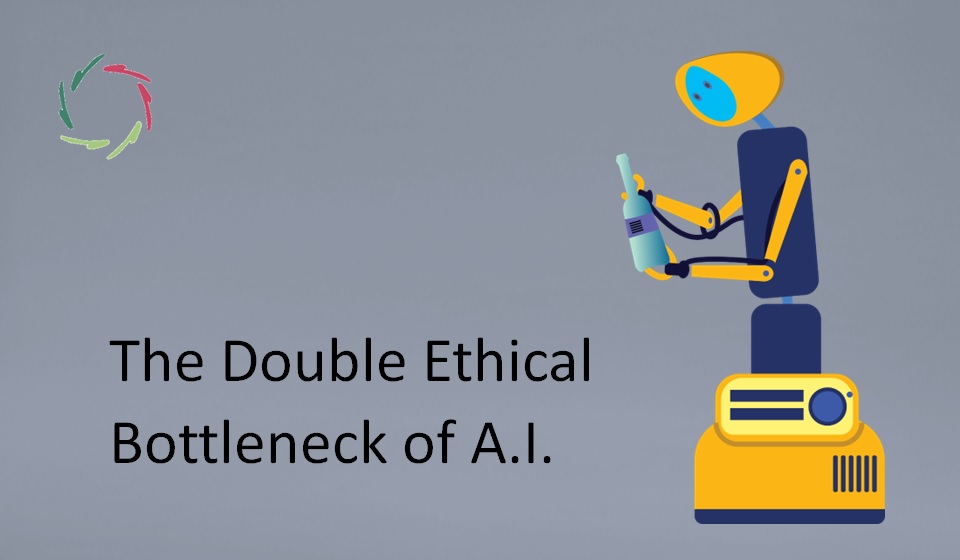
This is a small excerpt from my book The Journey Towards Compassionate A.I. The whole book describes the why’s, what’s and how’s concerning this.
Getting through the A.I. bi-bottleneck
On the road towards genuine super-A.I. – encompassing all domains of intelligence and in each being much more effective than humans – I see not one but two bottlenecks. This is no guarantee that after the bottlenecks, there will be heaven on earth, but let us suppose now that, from the day after, all will be well indeed.
That enables us to focus on the bottlenecks.
- The first one is human-made. Either rogue or naïve developers may take very wrong decisions. There is a sheer infinite amount of scenarios that one can think about. In the next section, I give a few examples. One may be enough not to need to fear any other anymore. It is the end, my friend.
- The second bottleneck is A.I.-made. On its way towards super-A.I. and beyond, there may be many stages and many changes. Even if the final stage is benevolent, and even if most stages are benevolent, it’s enough for only one stage to be less human-friendly, and we’re gone.
The bi-bottleneck may be quite long with many different stages.
Will humanity be able to control to a sufficient degree everything that can happen?
I think, and repeat, that reliance on control alone will not save us. I also don’t think we should relinquish all control and hope with crossed fingers that A.I. will eventually be Compassionate just like that, after the bottleneck as well as at any stage along. So, we should very well think about control, AND we should think about Compassion. BOTH are indispensable.
I hope that this book will be a wake-up call in this direction.
Related Posts
Containing A.I. by Becoming Less Human?
The looming presence of super-A.I. may present an existential threat to humanity. Our defense must begin with an honest understanding of our true nature — a defense rooted in superficial self-perception risks being both ineffective and self-destructive. Containing A.I. by diminishing our humanity could be the most perilous choice, especially since we already tend to Read the full article…
What is an Agent?
An agent is an entity that takes decisions and acts upon them. That is where the clarity ends. Are you an agent? The answer depends on the perspective you decide to take. Since the answer also depends on who is seen as the taker of this decision, the proper perspective becomes less obvious from the Read the full article…

Lisa
Lisa will be an in-depth companion to many people, as well as a continuous coach on many domains. Who’s that girl? ‘Lisa’ is the name of the project in which Lisa is the A.I. female coach, Lars is the male variant. I use the term ‘Lisa’ indiscriminately. Lisa is a coaching chat-bot based on A.I. Read the full article…