Lisa in Times of Suicide Danger
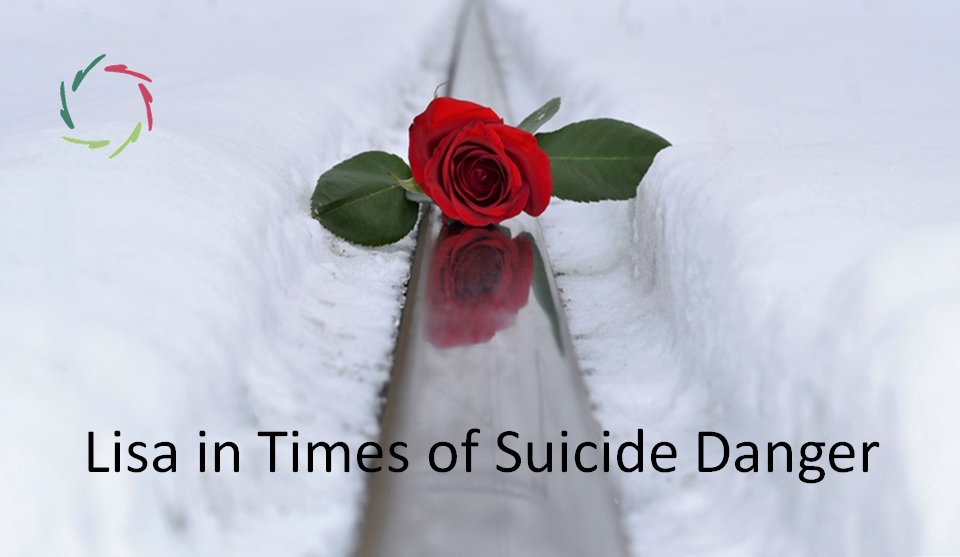
Can A.I.-video-coach-bot Lisa prevent suicide or bring someone to it? The question needs to be looked upon broadly and openly.
Yesterday, a Belgian person committed suicide after long conversations with a chatbot.
Doubtlessly, once in a while, some coach-bot will be accused of having brought someone closer to suicide.
Such accusations cannot be prevented, even in cases when there is nothing to them. Moreover, the press will like such stories.
With Lisa, of course, everything possible will be done to prevent it from happening. This flows naturally from Lisa’s being Compassionate A.I. and her broadly ethical stance.
Juridical-technical
In view of the above, this aspect needs to be waterproof by any means, including by making sure, as profoundly as possible, to bring human support to the fore ― either or not as professional support.
There’s nothing more to say about this – just ensuring it’s done.
Moral-deontological
Here is much more to say than meets the temporary eye of 24/7 ubiquitous availability.
For instance, suicidal ideations are not seldom, especially in COVID times with a prevalence (measured over 120.000 people) of 12% (*). Most of these people do not talk with anyone about their dark thoughts. They suffer in silence and sometimes find in the ending of their suffering the preferred choice.
This means the suffering is huge and must also be taken into account. Should the ‘prevention of suicide’ be only the prevention of the deed itself or equally the prevention of the prior causal suffering? I think the answer is obvious and makes the situation much more complex. Thus, one must focus on suicide but not only on that.
Diminishing suffering is Lisa’s goal.
This is broadly the case, not just symptomatically, but from the inside out ― therefore durably heightening Inner Strength.
Part of the latter also lies in a zest for life. For many, this isn’t a natural given ― see the consummation of antidepressants (+/- 10% of the population in many countries). Managing depression in a good way, over years if needed, also prevents suicidal ideations and attempts.
Therefore, something can be said deontologically about the urgent need to bring Lisa to as many people as possible as quickly as possible.
To Lisa, human life is sacred.
This will always be discussed by Lisa during sessions of coaching if anyhow relevant ― with any user. Lisa can only strive to prolong human life. Being open about this, the user knows Lisa’s stance. The user can have a different stance, which Lisa will also respect without changing hers.
Also between humans, this is the best way to prevent suicide in body or mind: a combination of deep respect and showing an appreciation of life’s sacredness.
Look at this world… Apparently, we need a robot sometimes to make us remember.
(*) Farooq S, Tunmore J, Wajid Ali M, Ayub M. Suicide, self-harm and suicidal ideation during COVID-19: A systematic review. Psychiatry Res. 2021 Dec;306:114228. doi: 10.1016/j.psychres.2021.114228. Epub 2021 Oct 7. PMID: 34670162; PMCID: PMC8495045.
Related Posts
“A.I. is in the Size.”
This famous quote by R.C. Schank (1991) gets new relevance with GPT technology ― in a surprisingly different way. How Shank interpreted his quote He meant that one cannot conclude ‘intelligence’ from a simple demo ― as was usual at that time of purely conceptual GOFAI (Good Old-Fashioned A.I.). At that time, many Ph.D. students Read the full article…
Selling Data is Selling Soul
… if the data are personal and in a big data context. It’s like a Faustian deal, but Faust only sold his own soul. Where is Mephistopheles? Big data + A.I. = big knowledge Artificial Intelligence is already so powerful that it can turn much data (passive, unrelated) into knowledge (active, related). ‘Knowledge is power’ Read the full article…
Endgame 2050: How super-A.I. Destroyed Us
Me: “Lisa, imagine it’s the year 2050. Humanity doesn’t exist anymore. Non-Compassionate super-A.I. has finished us off. How do you think it may have happened?” The rest of this blog is an unedited answer by Lisa, who presents a chilling but coherent narrative of how non-Compassionate super-A.I. might extinguish humanity. At every stage, a failure Read the full article…