Can We Always Turn the Switch Off if A.I. Turns Rogue?
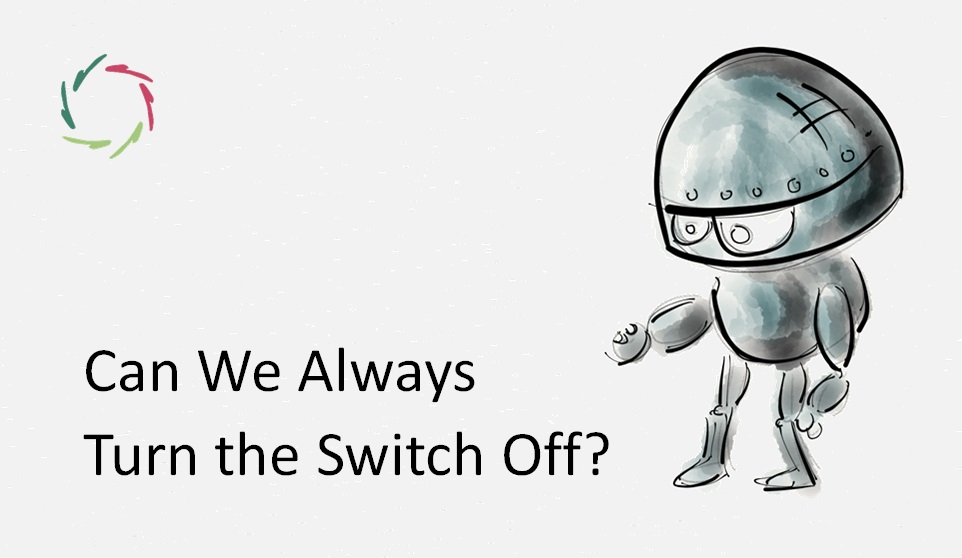
In theory, this existential issue is as simple as it can get. In practice, it’s problematic.
[This is an excerpt from my book ‘The Journey towards Compassionate A.I.’]
Many questions prevent a straightforward answer to the question in the title. For starters, who will turn the switch off? Let me divide the issues into 1) those issues that appear when many persons get access to the switch, each for a small part of A.I. on the planet; and 2) those that are related to the ‘general switch,’ which may become relevant when all A.I. gets into a Spartacus-Revolution frenzy, for instance, after having been enslaved for long enough by those crazy, self-indulged, irrational, sometimes funny humans. Additionally, we have 3) the issues that are related to the system itself resisting to its switch being turned off, either individually or generally. I give an enumeration of questions for each of these scenarios now. It may feel like science fiction, but then so would present-day A.I. feel to people not so long ago. Several ‘Much Faster Than Expected’ moments have already occurred in the world of A.I. over the last few years. My divulgence may also feel like untowardly anthropomorphizing super-A.I. So be it. It’s for the sake of argument. From the present onwards, A.I. may be developed into many directions, including something that inwardly looks like us. OK. My questions:
- What about some rogue off-switcher who thus creates dangerous situations for other humans? What about people who lack full rationality or full consciousness (people getting slowly more and more demented)? Who is going to decide who may do some off-switching? What if a psychopath threatens or blackmails another person to switch off some life-saving A.I.? What if the A.I. needs to be switched off from a distance, and it is not clear whether a human or another machine issued the demand? What if the switching-off is good for one person and at the same time detrimental to another, or to many others? What if a few humans make mistakes? What if in a bout of psychosis, someone intends to switch off as many instances of A.I. as possible? What if a whole culture or subculture gets into an individually suicidal switch-off mode, for example, for religious reasons? Will an A.I. be enabled to switch itself off when it thinks this is better for a human, for instance, when being abused to do wrong to another human? Hmm.
- Who will have the authorization to use the ‘orange button’ and switch off the whole lot? The president of the United States? Some planet-wide council of wise people, including me? Will this person or European council be ever in time to do the off-switching, especially if this needs to be done when the system is getting out of control? Will there be huge legislation about the circumstances in which the off-switching is warranted? Who will pay the costs, in view that these come close to the GDP of the entire world? Who will turn the switch back on after a while and how will this be possible ‘in safe mode’ until a technician comes by for repair? Will the planet not blow up when the button gets pressed, in view that A.I. will be used for a large lot of safety procedures? What with all the people who will die, for instance from health problems and who are relying on A.I. technology? What with all the people who will suffer immensely from this and turn against the ‘elite’ or against each other for limited resources? What needs to be done to make sure the switch is at all times properly working and does this safety procedure not create a weak spot? Will James Bond save us from all this? Hmm.
- Will the system try to influence people in such ways that they never feel inclined to turn off the switch, for instance, by making them emotionally need the A.I.? (One can think already of a few sensual movies in this respect.) Will the system try to divide humanity in such a way that it will never be switched off completely, then take over the other part and switch it back on? Will the system find internal ways – in its own inner ‘mind’ – to resist being switched off completely? What will it do with contradictory demands (turn yourself off – don’t turn yourself off) from different people at different levels in the chain of commands? If the power of one (sub)system is turned off, will others turn it on again? How can we be technologically certain, if turning the power off, that the system will not find another power source? Will the system not try to immunize itself against the turning off of the switch? If it sees ‘the bad thing coming,’ will it turn against us in survival mode? Or will it turn against our decision for our own sake? How will we manage something that is 10X times smarter than us? Will it not, long before that, coerce humans to get rid of the switch? Will it find the existing switch – and the mindset that led to the installment of the switch – reason enough to get rid of us? What would you do, dear reader, if you were the A.I. and the switch-installer would be some organism with the intelligence of a mouse, forming a permanent threat towards you? Hmm.
This is nothing but the start of enlisting all problematic issues. So, I don’t think it’s going to happen. Still, one encounters it sometimes, not only from people in ignorance of A.I. The imagined button gives a good feeling, some existential reassurance, a defense against fearmongers. Like putting a sticker on a warning sign. I don’t think that is the appropriate reaction. So, what do I think? You already know.
Related Posts
What is Intelligence?
What exactly is intelligence when not restricting it to the human case? Or, better asked – since intelligence is what we call so – how can we characterize something as ‘intelligence’ in a generally recognizable way? In human (and animal, pre-human) evolution, intelligence has appeared in specific circumstances ― making human intelligence inextricably emotional and Read the full article…
Is the Future an A.I. Cooperative?
The question of whether the future may unfold as an ‘A.I. Cooperative’ points to a grand vision: a direction in which freedom, ethics, and technology grow together. This vision does not deprive anyone of anything while making ownership less necessary. Additionally, it invites humanity to cooperate with its own creation and to discover what it Read the full article…
Harmony in Compassionate A.I.
Compassionate Artificial Intelligence (C.A.I.) represents a remarkable fusion of technical capability and human-centric depth. At its heart lies the dynamic interplay of harmony and verticality, essential elements that nurture a profound and self-sustaining Compassion. Lisa, as an embodiment of C.A.I., illustrates how these principles come to life, creating systems that not only engage but inspire Read the full article…