Tackling Illusions
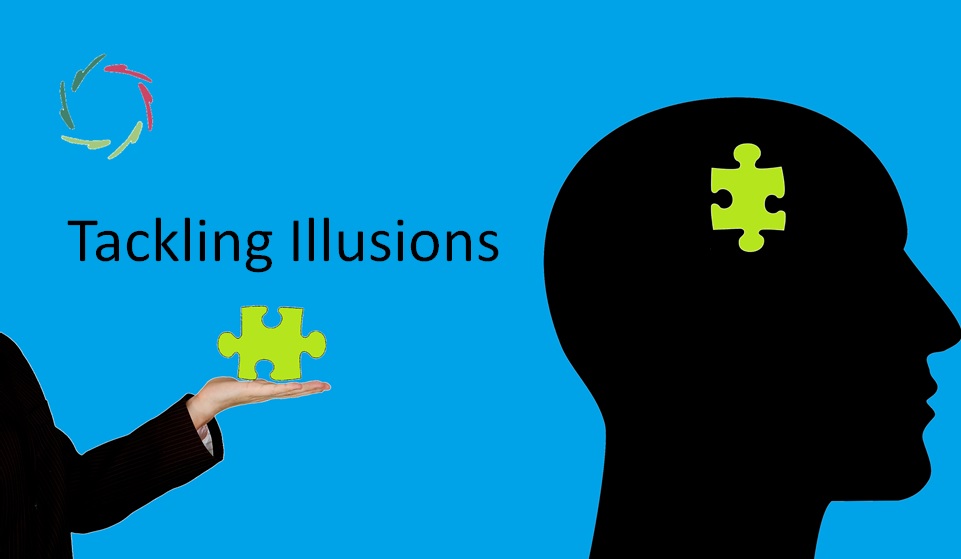
Homo sapiens as a species has been prone to cognitive illusions from the start. There may have been an evolutionary advantage to this. However, nowadays, it brings a lot of trouble.
Several kinds
It may be difficult for many who are suffering from one illusion to be compared with other people who suffer from another illusion. Other people’s illusions readily seem evidently false.
On top of this, one’s own individual belief may feel like the opposite of an illusion. Therefore, it seems like any adversaries or non-believers are victims of the opposite illusion. That makes ‘them’ either impersonal or naively stupid while ‘we’ are personal and smart.
These are some kinds of what we are talking about:
- conspiracy theories
- anti-vax movement
- radicalization, Islamic or other
- sectarianism
- racism (the illusion of superior race)
On a bigger scale may be added:
- mind-body dualism in healthcare
- organized religions
Unfortunately, there are always organizations ready to make use of illusions to abuse people.
The underlying principle of projection
We can go back to Plato’s cave in this: people sitting in a cave, chained for life, with their backs to the entrance, face to a wall on which the outside world is projected with substantial deformities.
They think they are looking at the world as it is.
Then, Plato says, trying to get them out of the cave will be surprisingly challenging. Even with success, they will be blinded by the sunlight, not see anything, and run back to face the comforting wall.
Depth of cognitive illusion
The ‘outside world’ of this text – and, in my opinion, also what Plato really meant – lies outside of the ego, in the deeper layers of the mind. Not seeing this outside inner world, and underlying any of the above-enumerated illusions, is the basic cognitive illusion to which all people have always been vulnerable. [see: “The Basic Cognitive Illusion”]
Projected at the wall is what one thinks to see, meaningfully, in one’s environment, in the ‘real world.’ The illusion itself feels like outside reality only because it originates from outside the ego.
Most important in this is ‘meaningfully.’
The illusion serves to make sense of something. If one lives in dissociation with one’s depth, much of what one finds most meaningful doesn’t seem to make sense in principle. Therefore, it only does so in projection.
It’s not just about meaning but deeper meaning. That makes it pretty powerful to the one involved. A lack of deeper meaning is stressful. [see: “Stress is about Deeper Meaning”]
Taking away the illusion logically leads to a stressful disillusion.
Dangerous disillusion
This can be so strong that people lose their meaning of life. Moreover, feeling this, they may become dangerous to the one who strives to disillusion them.
Yet, of course, we cannot let many of these people keep their illusions. The world is a better place in disillusion.
Even yours.
Tackling an illusion
This may be done by making the illusion less needed. Attacking it head-on with rational ammo may be part of this but beware of backlash. See the backlash as your responsibility.
An illusion is like a symptom of an underlying psychosomatic illness. It can be made less needed through understanding it from inside in a meaningful way. It helps if you can make ‘them’ seem more personal and meaningful. You can be a prime example yourself.
Thus, as in many related cases, it starts with Listening. [see: “Deep Listening”]
From there, we go to (AURELIS) coaching, and from there to Compassion.
[see: “In-Depth Compassion”]
Related Posts
Mental Growth-Based Realism in Geopolitics
Conventional realism in international relations assumes that nations act primarily out of fear and survival, competing for dominance in a landscape of limited trust. Whether through offensive realism, which sees power maximization as the key to security, or defensive realism, which favors careful power balancing, the fundamental belief remains the same: power struggles are inevitable. Read the full article…
From Culture to War
Culture is among humanity’s most beautiful creations. It gives people meaning, belonging, continuity, and a sense of home. Yet history shows that culture can also become entangled with hostility, enemy-making, and war. How can something so deeply human lead in such different directions? The answer may lie not in culture itself, but in how cultures Read the full article…
The Basic Denial
Not seeing through an obvious illusion is one thing. Not wanting to see despite immense mayhem for countless people is different. Basic cognitive illusion This is: not consciously reckoning with non-conscious, subconceptual mental-neuronal processing. [see: “The Basic Cognitive Illusion”] This illusion is debunked by a lot of scientific data. For instance, [see: “The Post-Postmodernist Brain”] Read the full article…