From Group to Team
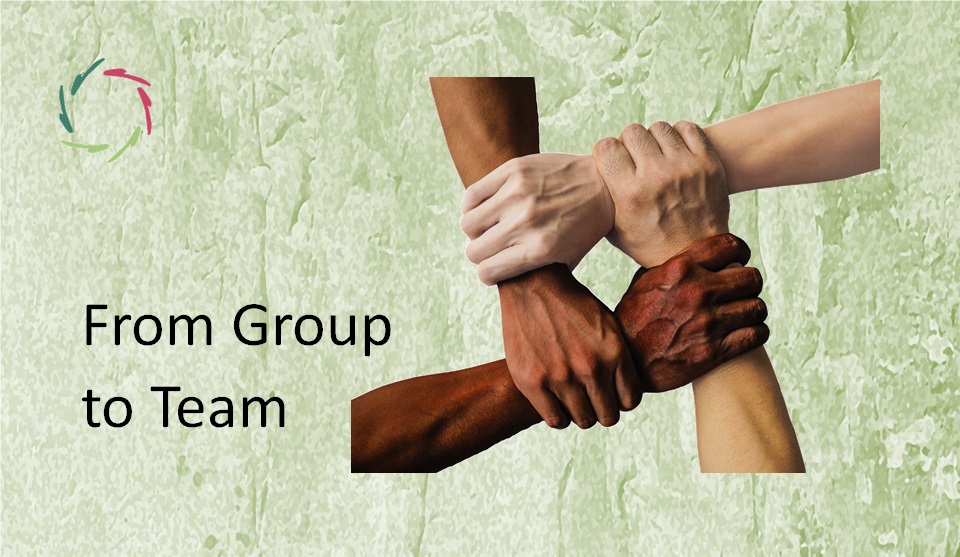
A group transforms into a team from the inside out.
The common goal
There is no group or team without a common goal, even if it’s only the goal of being a group.
Naturally, a group exists to heighten the fitness of an organism. This may be the group itself or its members, or both. In competition, this leads to the survival of the fittest. With Compassion, it leads to thriving through growth.
In the common goal, one may recognize one or the other.
If the common goal is naturally the members’ goal, then you have a team. Even so, as you may note, not only the commonality of the goal is important, but also the goal itself. Clarity in this is an ethical issue.
AURELIS teambuilding
With Compassion as a goal, this is naturally bent towards inspiration and ‘spirituality.’ The spirit is the depth of deeper self, by itself independent of the presence or absence of any Outside Other.
The members of the team inspire themselves and each other. Thus, also, they feel the others inspired and inspiring. It is a self-enhancing happening, at the same time impersonal – objective – and very personal.
Each member feels valued in his unique personality, lending inner strength, generosity, Compassion.
The team’s main task is to help members and other people alike towards transcending mere-ego, deepening it towards the total self, striving for unity at any scale.
Team leadership
Leadership makes the team. [see: “Transforming a Group into a Team through Open Leadership“] The ‘leader’ is nothing more (or less) than the symbol of this leadership which is a characteristic of the whole team.
Eventually, this leadership is always oriented toward the broadest team ― My people is everybody.
Bits of advice
‘Team’ is not a magical solution. There is continual effort involved, a never-ending challenge.
Each member’s energy (deep human motivation) is needed, like a bucket that overflows towards a common good.
Parting members can be ‘mentally retained’ in that their spirit keeps nourishing the team. This way, the team transcends itself.
Welcome new members by making them immediately part of the team. This is also a profound communication of inclusion to all other members.
Try to make everyone proud of being part of the team.
Anything that happens in the team – especially any broad change – is an occasion for personal growth.
Empowerment happens through giving well-supported responsibility.
Conceptual control within-team is necessary but should not stand in the way of depth.
What happens naturally and with little effort may be most valuable.
A team is a team of brains and passions and a lot of human potential.
Take care of ‘team destroyers.’
Consensus = everyone feels heard, understood, and integrated.
A team is an organic unity.
Related Posts

Anxiety
People who apparently feel little anxiety, quite often turn out to harbor a lot, arguably more so in Western cultures. The latter may seem so because it strikes me more. [See in AurelisOnLine: Anxiety] Anxiety, not fear Fear is conceptual. The object of fear is mostly well delineated. One can say: It is mechanical, directly Read the full article…

How to Dis-Illusion
How can one get people out of a clear and certain state of illusion? For instance, flat-earthers. My earth is not flat. If yours is, then my task – including with this text – is to invite-guide-bring you toward a different opinion. How should I do that? Not by telling you to look to the Read the full article…
Why Do People Polarize?
Increasing polarization is going on in many parts of the world. We are seemingly not at the end of this trend. Needed is a growing awakening to who we are: total human beings. Different opinions Different opinions may see each other more clearly in the differences as well as in the similarities. They can inspire, Read the full article…