Apollonian – Dionysian – Odyssean
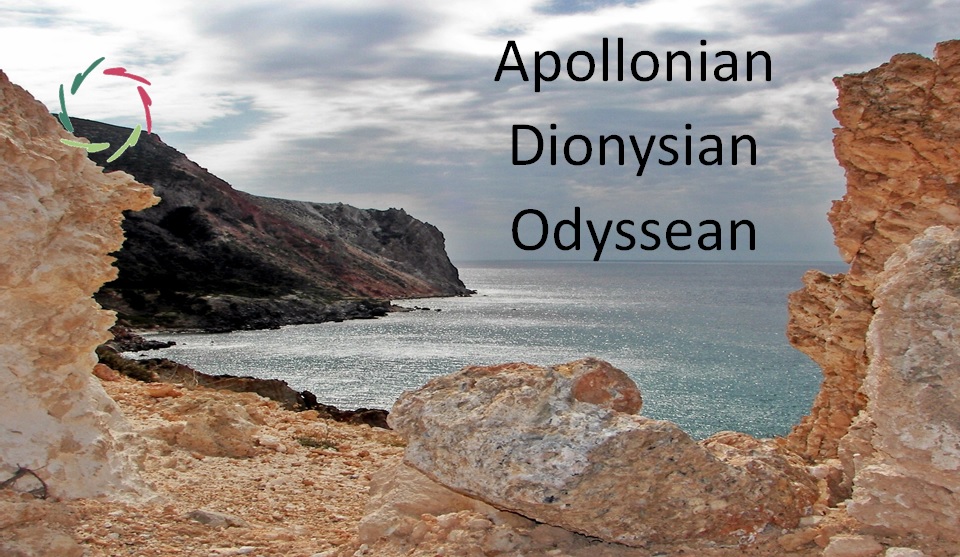
In therapy/coaching and in everyday life, one may be more Apollonian oriented or more Dionysian, or see it all as an adventurous journey.
Nietzschean dichotomy
Nietzsche used ancient Greek mythology to characterize two different mindsets in culture, art, and individual:
- Apollonian: more orderly, yet illusory and socially constructed
- Dionysian: more passionate, at the same time closer to chaos and intoxication
We can relate the Apollonian to conceptual, the Dionysian to subconceptual.
I add to this the Odyssean. In this mindset, everything is an adventurous journey. As long as the journey lasts, it’s a never-ending one. An Odyssean person or culture can be Apollonian or Dionysian as the circumstances unfold.
Ulysses
Homer’s ancient Greek epic poem ‘The Odyssey’ (24 books, 7th century BC) is one of the oldest works of literature, being still read ― and well readable.
On his ten-year journey back home from the Trojan War, Ulysses (Odysseus), king of Ithaca, had many heroic adventures for which he needed his wits and intelligence, deeper wisdom and willingness to enter transcending situations. It was a continuous blend of Apollonian and Dionysian.
In coaching
AURELIS coaching is a journey with unforeseen insights and occasions for growth. The enfolding can be rather more Apollonian or Dionysian.
The primary goal may be the relief of a symptom or condition. However, the path towards it is as important as the relief itself. Travelling the path is not a chore but an occasion with many positive aspects, deeper wisdom and growth.
The journey mostly starts with a search for the real goal of the specific coaching. This can be the straightforward goal as first put forward by the client. Further coaching (and self-coaching) can become a journey that lasts a while ― not necessarily ten years. With five-session tracks, the client is admonished to find his Inner Strength.
Excellent coaching is a journey with two in a universe that exists temporarily.
In everyday life
Life can be seen as a journey full of interesting adventures if one cares to look for them, or at least not close oneself down. This journey has outward aspects but even more inner ones ― a journey towards self-discovery in an ever-evolving change of scenery.
If you’re bored by life, then maybe you are not looking well enough. Are you daring to see how exciting you are in-depth? Everybody can hear the song of sirens inside. Everybody can feel the dread of Scylla and Charybdis when daring to sail towards a new horizon.
May it be to you mainly a journey of growth towards wisdom and Compassion.
This brings coaching and everyday life closer together. For instance, any person in a leadership position – as was Odysseus – can also be a coach to those who see him as a leader on a common path ― yes, even in politics.
Cultural journey
At present, ‘culture’ is becoming more and more a global happening. We are all on a ship sailing towards Ithaca, getting adrift now and then, encountering monsters and super interesting new possibilities.
Without any doubt, there are many adventures ahead of us.
This is my view, as a modern Ulysses.
Related Posts
Bias is Our Thinking
Human thinking is based on being drawn to some bias. Bias is part and parcel of human thinking. There is not only bias IN our thinking. Bias IS our thinking. This needs some explanation. The rabbit and the duck In this well-known illusion, you can see a rabbit (looking to the left) or a duck Read the full article…
Growing Metaphors
Metaphors are not just linguistic tricks. They live, breathe, and unfold. A metaphor can appear like a small seed, yet once spoken, it continues to grow — in the one who uses it and in the one who receives it. This blog explores how metaphors grow in theory, in practice, and in their poetic resonance. Read the full article…
Seeing = Creating?
Seeing is not passive observation but an active creation. The mind completes what it perceives through natural, lawful processes — Pattern Recognition and Completion, autosuggestion, and embodied movement. This blog explores how perception, humility, and Compassion merge into one act of reality-making, from the brain to the body to the shared world ― of course, Read the full article…