Energy
Deep motivation.
The direction matters.
Constructive or rather destructive, intentional or somewhat chaotic, used or abused. It matters when it matters to people. The more profoundly someone makes it matter, the more it matters.
If you know what I mean.
Depth makes it matter. That’s what depth is about, what makes it essential. Without it, no human motivation points to anything.
Of course, chaos itself may be a direction. Then it’s not the chaos of nothing, but everything. Then it’s a universe of energy that can take any form as needed.
Energy matters.
Putting the direction before anything may drown the energy. The latter needs at least a certain amount of freedom.
Think of an artist.
The energy may flow in all kinds of directions. It may even flow in ever the same direction. This is also one of ‘all kinds of directions.’ As long as the energy is not constricted through purely external rules, there is a chance that it flows by itself; thus, that it is deep human motivation and not a look-alike.
Appearances may deceive.
Where energy fades, depression surges
The specter of depression: one more reason why people will generally resist actions that they perceive to be depleting their energy. They are, of course, right to do so, but in many cases, it defies rationality.
Energy is a force of nature. It is real. There is no necessity in it also to be rational. If this is not taken into account, one may wonder why some goal is not achieved even though it seems perfectly rational. Frequently, being rational is not the aim in the first place. The primary objective of life is to live. The first aim is for energy to flow in the correct direction, which is away from entropy or chaos.
Energy is central to what life is about.
An amazing contrast
One can feel this inside, according to the stage of life, at least the stage-in-heart in a non-over-politicized culture. The direction is mostly secondary to the energy at a younger stage-in-heart. This shows itself as a progressive stance.
At a maturing or older stage-in-heart, the well-experienced direction may become relatively more important. This shows as a conservative stance, a desire to only change direction if there is an outstanding reason to.
A worthy culture listens to the elderly. Nature-bound cultures have naturally done so in the course of history. Older people can see broader perspectives. In mythology, the older person is the wise one, the seer, the magician. The younger person is the warrior, the king, the energetic one who seeks guidance and proper direction at the elderly. If this order is respected – in mythology at least – then the country fares well. If the younger person imposes direction, it may be time for an imminent disaster.
In what kind of culture are we living?
Are older people wise? Are the young? Who cares for wisdom? We degraded it to knowledge, then to information, then to data.
As in ‘big data.’
In my view, artificial intelligence gives a paradoxical chance to evolve back to wisdom (= Compassion).
But there is no guarantee. It needs many efforts.
Related Posts
Nature’s Deeper Way of Inventing Stuff
Nature doesn’t invent things — she finds them. Every form that appears in evolution seems less designed than discovered, as though life itself were listening for coherence. This blog explores how Nature invents by resonance rather than by control, how simplicity gives rise to complexity, and how the same rhythm continues through Lisa — Nature Read the full article…
Science for Complexity
Especially in human-related sciences, holding on to a Platonean ideal is insufficient for grappling with present-day challenges. We need new science to manage complexity. A.I. can provide the necessary tools for this. Science of medicine and psychosomatics Until now, medical science has been based on a non-complex picture of the human being. This accords with Read the full article…
From Whispering to Inspiration
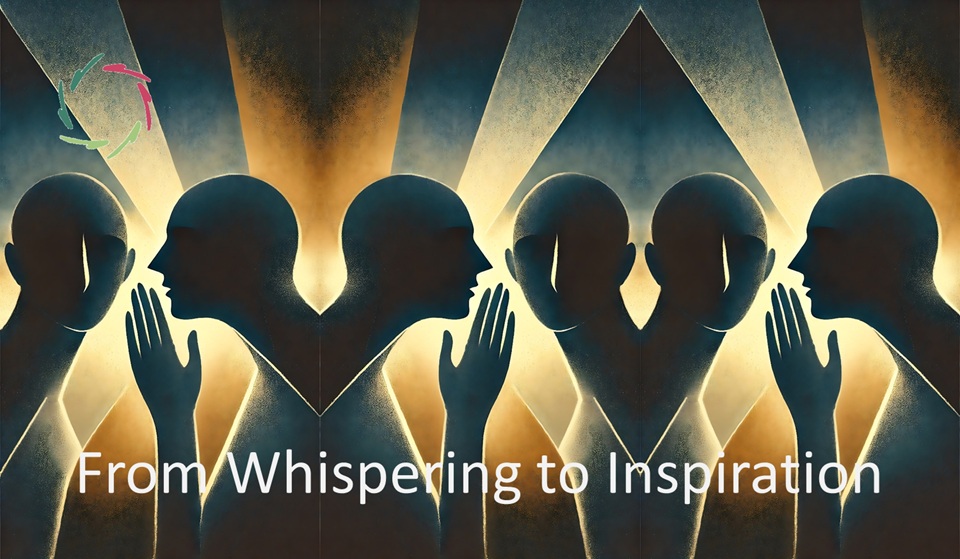
Whispering and inspiration seem far apart: one quiet, the other radiant. Yet the two belong to the same movement of Compassion. Whispering is the gentle act of attunement; inspiration is its unfolding as creation. Between them lies resonance — the silent conversation through which meaning takes root and grows. Whispering as communication with depth Whispering Read the full article…