Rituals
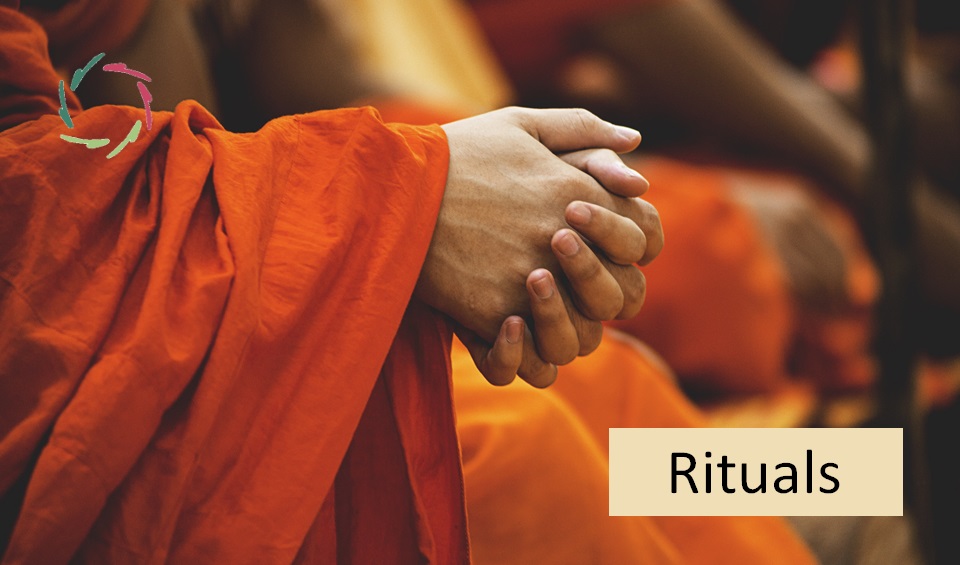
An action becomes a ritual when it is repeated and when it is deeply meaningful. For this, one needs to be open to it. ‘Open’ as in ‘Open Religion.’
A ritual is a repetitive action to which one attaches ‘deeper meaning’.
Without ‘deeper meaning’, a ritual has no, well, meaning. It’s like an empty box, a ‘vase without water’.
At the other side, without concrete recipient (object, action…), ‘deeper meaning’ is formless. It’s – in the same metaphor – like ‘water without a vase’. It cannot even ‘exist’ in a normal sense of the word.
Rituals in religion
A ritual, performed individually or collectively, is frequently part of a religion.
The ‘re’ in re-ligion denotes repetition as well as intensity. The ‘ligion’ denotes ‘to connect’. So, ‘religion’ as a term is about repetitively and intensely making a connection… with what? Let’s say: with a highly meaningful entity.
Interesting, because a ritual is also about repetitively and intensely doing something: an action in which one may see the bodily performance of ‘making this connection’. This puts ritual at the core of religion even more than the mental act of believing, as is described by several authors such as Karen Armstrong (*).
At the same time, a ritual within a rather artificial context (like a temple, for instance) while being deeply meaningful, also carries the – important – potential to become part of a person’s life in a broader-than-religion sense. Rituals are not confined to religion (unless you see ‘religion’ really very broadly) and even within religion, they are not confined to that specific context.
The quality of a formal ritual
lies, according to my understanding, in the way it’s inviting to individuals to attach ‘deeper meaning’ to the ritual.
This ‘deeper meaning’ is of course not coming forth from the ritual itself, but from the totality in which the ‘deeper self’ (subconceptual) of the individual plays a major role [see: ‘About ‘Subconceptual’]. Without it, there is no ritual. There are only motions.
Genuinely open
Performing a ritual in a good way, is to each time again genuinely open oneself to it and to its meaning, its ‘symbolic function’. Indeed, a ritual can be seen as a ‘symbol’ that one performs on oneself. It is a symbolic action, thus: ‘vertical’, a communication from conceptual to subconceptual [see: ‘Symbolism lost. Symbolism regained.’].
Which makes it to me very interesting.
It’s poetry.
And it’s also – if done properly – completely compatible with rationality.
Of course, the ‘properly’ is not guaranteed. It can be used or misused. In this sense, the following is necessary.
Rituals in total freedom
To me, in order to enjoy a ritual – as I do in Zen meditation for instance – it’s important to feel it as completely ‘free’. This is not to say that it cannot be part of something done together. The ‘free’ (actually, as is always the case) lies in how I personally experience it. If someone would come towards me and put my hands in a certain position, I would readily have a little problem.
Not a big one, of course.
But still.
Rituals and freedom are close friends. However, not just any kind of ‘freedom’:
There needs to be an aspect of depth
as I pointed to already at the beginning of this text.
Indeed, nobody would see a superficially performed ritual as really valid.
Openness, freedom, depth… this begins to sound like AURELIS [see: ‘Five Aurelian Values’]. I guess this is not a coincidence. It brings me to the following:
Rituals are much like autosuggestions
[If you don’t already know, you may recognize autosuggestion in AURELIS.]
And thus, like autosuggestions, they can be quite powerful. However, not if one closes oneself to them. In such case, they can have no effect whatsoever.
As with autosuggestions, one can also be very open to the meaning of rituals and still they ‘work’. Indeed, it’s what I like to do towards meditation. I use a ritual as an invitation to open my mind in this special way.
Then I flow and before I know, I get inspired.
(*) Karen Armstrong: “The Case for God – What religion really means.” – 2009
Related Posts
Spontaneity
is the most important characteristic of life. It is very deeply falling within, then coming all the way out again and ‘meeting the world.’ Religion, Eastern enlightenment… Big words, emphasizing that, seemingly, very important stuff is going on. That is correct. It’s important stuff with huge consequences. Think of the misery that has been brought Read the full article…
Humanism with a Vengeance
Humanism: ‘man is the measure of all things.’ Vengeance: this is about the total human being – partly conscious, mostly nonconscious. Many faces of humanism, yesterday and today Among them, I see ‘humanism’ as what puts human being at the forefront, thus not – apart from human being – any organization: no religion, no politics, Read the full article…
75. Religion with no object
What’s in a name? Nothing. In some cases, even much less than nothing. ◊◊◊ In this world, many things are called ‘religion’ that clearly have nothing to do with what it can mean. Obvious: religion is not about believing that it will rain tomorrow (Is there a 20% chance? 60%?). Likewise, religion is not about Read the full article…