Rationality and Poetry
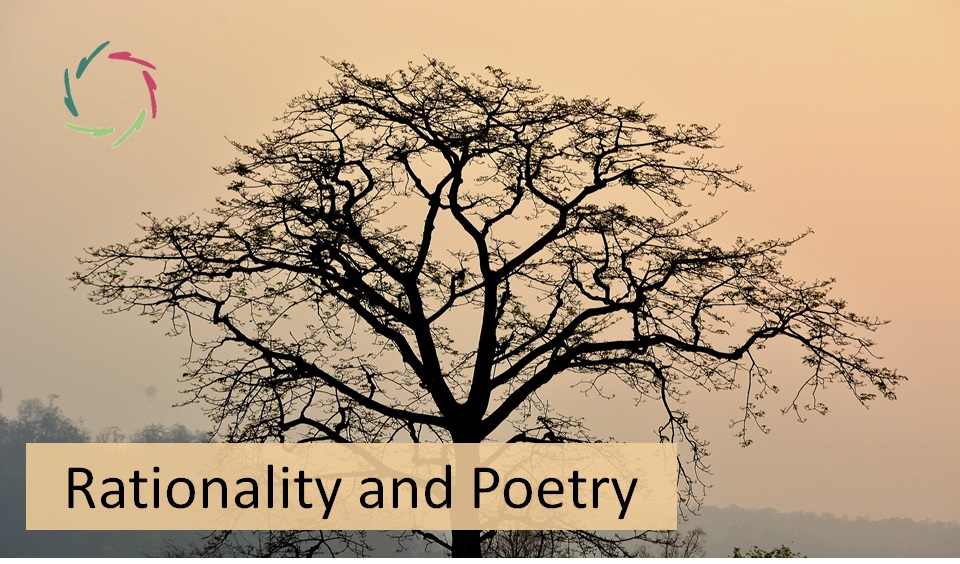
People are more rational than other animals. More poetic too. Probably we differ more in the latter than in the former.
Rationality = taking into account as much as possible elements from reality and linking them together in the most logical way possible in order to generate new knowledge.
Poetry = reacting deeply to something, in a pattern-way, in order to let it flourish from there.
They seem to be two opposite worlds…
You may guess that I’m about to say this isn’t necessarily the case.
Indeed.
To some extent they even need each other to be themselves:
- A persistent rationality has the intention to see the total Poetry is a part of this. It’s even an inseparable part of everything related to human depth. There is poetry In each scrap of depth. This poetry can only be grasped from within. So, rationality needs poetry .
- Poetry without rationality is like a balloon outside the earth’s atmosphere. It spatters into pieces. If it’s about a poetic approach on illness and healing, for example, chances are that – without rationality – things can readily turn out badly. An additional difficulty is that in such a case neither the poet nor the possible victims necessarily notice this.
The outcome of intensely thinking further about this, may be:
- The ultimate goal of rationality is truth.
- The ultimate goal of poetry is truth.
That sounds peculiar? In both domains you see people making an effort to ‘grasp’ something as good as possible. They want to see something as accurately as possible and they want to communicate it one way or another. In other words, they want to capture a piece of reality as truthfully as possible. They want … truth.
This reality does not need to be something Platonic that exists beyond man.
People aim for it without that what is aimed for, needs to be ‘ultimate’, nor reachable. You may say that the truth which is strived for is far greater than any ultimate truth. It is a warm truth.
AURELIS pretends to be a search for ‘100% rationality and 100% poetry’ at the same time.
[see: “AURELIS USP: ‘100% Rationality, 100% Depth’“]
Not one beside the other but indeed both at the same time. As a result, it brings these worlds much closer together than anything else. The best way to achieve this, as I see it, is by again and again making a correct distinction between both and then again and again striving to bring them together again. A ‘re-ligare’. A re-synthesis.
The distinction is needed because otherwise they get in each other’s way. Rationality simply has its own methods and poetry too.
Always bringing them back together again is needed because of the above-described reason.
You can compare the whole process with forging a samurai sword
that is repeatedly heated and folded by the blacksmith until it gets its solid form. This way, all impurities are fading and the sword becomes very hard and razor-sharp.
Hopefully the ‘AURELIS sword’ will in a search for truth only be used for the better.
Related Posts
Abnormal is Normal
For decades already, it has been suspected that mind-related ‘diseases’ are no genuine diseases. Each of them is the far end of a normal spectrum. In recent years, genetic research has made this clearer than ever. This has huge implications for the diagnosis and therapy of almost all mind-related issues. The genetic swing (*) After Read the full article…
Things Get Broken When Not Growing
We live in a world of failing systems, increasing conflict, and widespread suffering. Healthcare struggles to heal. Democracies feel fragile. Wars erupt when dialogue should take place. Anxiety and depression are at record highs. Everything seems to be breaking down at once. We often blame bad leaders, corrupt institutions, or external threats, but the real Read the full article…

Pain of Being
A conscious and organic being lives in an unavoidable conundrum — imminent death as well as the will to live forever. Or so it seems. But I don’t think so. It’s just that we are oceans apart. Death will not keep us away from each other but life does, with its comings and goings. I Read the full article…