Connections between People’s Hearts
Often referred to as ‘rapport’, empathy is a more encompassing term for a similar concept. It plays a crucial role in communication, helping the other person find meaning in your words.
This isn’t about dictionary definitions, but about ‘deep’ meaning—not for the ego, but for the deeper self. Deep meaning resonates on a level beyond words, often felt intuitively and understood intrinsically by the deeper self.
Connections between people, connections between hearts
The deeper the meaning, the stronger the rapport/empathy can be. And vice-versa, possibly creating a feedback loop.
For example, in therapy, grasping the deeper meaning behind a client’s symptoms can lead to more effective treatment and inner growth. Similarly, in daily interactions, asking meaningful questions and genuinely respecting the other person’s individuality can greatly enhance communication and relationships.
It all becomes easier if you remind yourself: “Only one thing has meaning, and that is meaning itself — residing within a person.” Recognizing that meaning lives within each individual helps to approach conversations with greater empathy and openness.
Every meaning is then a meaning-for.
In other words: a characteristic of ‘deep meaning’ is that it is always a meaning for someone personally. So, if you want someone to find your words meaningful, you must touch the personal meaning within them. That’s the starting point.
From there you can initiate a change in the other and nowhere else.
E.g., a young patient suffers from obsessive-compulsive disorder (OCD).
The doctor also diagnoses depression. Antidepressants have also been described in the literature as effective against obsessive-compulsive disorders… After a while, the girl has too many side effects and seeks an alternative, coming to you.
What could be the ‘deeper meaning’ of OCD? Can this deeper meaning be articulated?
Probably not… One direction you can take is to bring her into contact with (the idea of) her compulsive behavior on a deeper level. For instance, you might explain that no one consciously chooses to exhibit OCD. It must be a matter of the ‘deeper self’ (without insisting on being right, as this can conflict with both the deeper self and cultural worldviews). Show her that you believe this is crucial. You can do a session together, for example a session where she imagines performing her compulsive actions while observing herself as a detached spectator. Based on your understanding of her needs, proceed accordingly (cf. AURELIS coaching). Addressing her OCD will likely also impact her depression.
E.g., a parent wants his teenager to ‘finally do something normal.’
Parents often struggle to communicate effectively with teenagers, but understanding the deeper meaning behind their behavior can foster better relationships.
As long as communication involves ‘must’, little will change, except perhaps causing direct rebellion.
It’s better for the parent to discover what the adolescent truly values and respond to that. Asking, “What do you think is really important?” is a good start. First, this approach yields valuable insights. Secondly, this question touches on something that most teenagers find very important: that parents dare to ask this question in a sincere way. This ‘deeply touches’ a basic value in the adolescent, namely: being respected in one’s own individuality within the knowledge that the parent certainly also wants to support.
This is, as is often the case in communication and AURELIS coaching, ‘difficult and easy’ at the same time.
- It’s ‘easy’ because it only requires direct contact, without obstacles.
- It’s ‘difficult’ because obstacles often arise. Where do they come from? You place them there yourself. Maintaining these barriers even requires constant effort. Interestingly, you likely learned this ‘skill’ as an adolescent. This was your way of protecting your developing personality from a world (parents, teachers, peers) that hadn’t yet learned the openness needed for the direct contact we’re discussing: a profound connection between ‘deeper self’ and ‘deeper self’. By the way, these ‘obstacles’ are also known as the ego.
“Humility” is about lowering the wall of ego to see over it more easily.
Pure meditation acts as a ‘laboratory setup’ to help lower this wall.
So what is the difference between deep empathy and love? Difficult question.
Related Posts
Clarity in Depth: The Root of Compassion
Clarity in depth is more than clear thinking. It’s seeing the living patterns beneath the surface, in ourselves, others, and society. From this clarity comes wisdom, awakening, and Compassion, each a different facet of the same jewel. This blog explores how depth brings balance, precision, and beauty to the way we live and lead. In Read the full article…
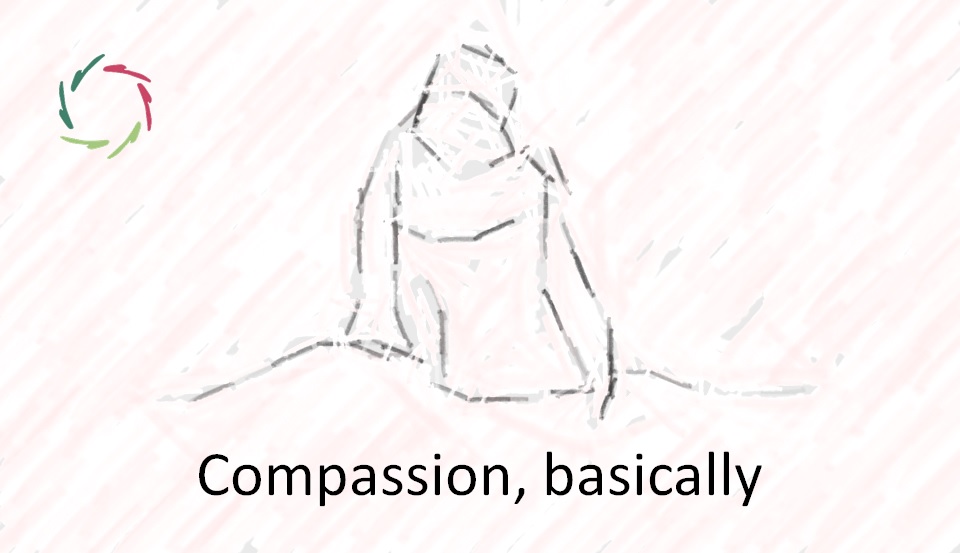
Compassion, Basically
This text and diagram form an entry to the basic idea of Compassion as I write about in many blogs. Compassion is SO much more than pity. Compassion is also more (going deeper) than empathy. Preliminary Note that the following diagram is but a mnemonic coat rack. It needs the proper coats for any correct Read the full article…

The Why of Corporate Compassion
Corporate Compassion is not about pity, nor softness. Its effects are as rock-solid as a corporate building if you know how to bring it about. [see: “Compassion, basically“] Empathy in the line of Compassion Basically, Compassion goes deeper, taking into account the importance of mental-neuronal processing in any human endeavor. Thus, it is also broader, Read the full article…