Are Genes an Excuse?
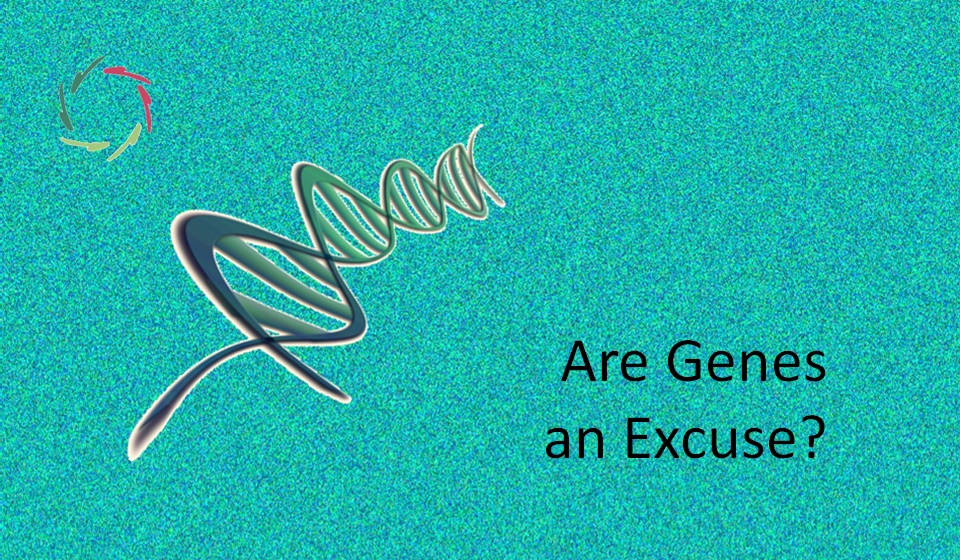
Our genes are the most important factor shaping who we are — mentally more differentiating than all else put together. (*) Are we, therefore, not responsible for our actions?
Spoiler alert: Responsibility is saved, but very differently from what you might expect.
To make things worse
On top of the above, schools and families account for less than 5 percent of school results and mental health. The rest is comprised of mainly chance factors — or what appear to be such but may themselves also be substantially influenced by our genes.
Consciously, one doesn’t have the impression to be moved by strings of genes. At the same time, given the above and since genes are truly causal, there appears to be little room for responsibility.
Saving responsibility by broadening the scope
The above statements are scientific facts. However, they are incomplete statements because they do not take into account a possible broadening of the scope by including subconceptual processing. In other words, they are ‘true’ only in a small part of reality.
Unfortunately, most people think, feel, and act as if living in that small part.
Even more unfortunately, Western Enlightenment has pushed a whole civilization further into that ordeal. It’s time to get out while keeping the (enormous amount of) good it has brought us.
The AURELIS aim is to broaden the scope.
See many of my blogs and books — for instance, Why AureLisa?
Such broadening doesn’t change our genes, of course, but it changes the implications. This is possible because genes are seldom one-to-one correlated with clearly cut-out mental features. What they stand for is more subtle and flexible than the above ‘small part of the world’ may entice us to believe.
A question of Inner Dissociation
The total self is much broader than most people can consciously fathom. The subconceptual is an inner universe. Any genetic influence in the mental domain starts here and evolves a great deal through non-conscious means before it becomes conceptually visible. By discarding this, one also discards many options of influence.
In short, genes stay genes, but there is more room to play on a bigger playground. There are still fences, yet there is more choice, more freedom, and more possibilities to influence — therefore, also more responsibility.
One example: testosterone
As everybody knows, male genes are different from female genes. As a consequence, men have more testosterone running around their bodies. More testosterone (‘better’ genes?) means more male behavior.
Apparently — however, ‘male behavior’ can mean many things lying between creation and aggression. In a male-aggressive society, there are many male bullies on the playground. Can the sorry genes help it or not?
Different playground — same genes — different behavior.
Much wider playground — same genes — many more options for how the genetic potential gets realized.
Indeed, we can then better talk about genetic potential than genetic determination.
In my view, this is excellent. It makes us more exciting and meaningful. It also makes us more responsible, but it is a responsibility focused on Compassion, not on guilt and retribution.
It should make us more humane. We can do much to make that happen at the individual and the group level.
In our efforts to enhance mental health, it emphasizes growth rather than cure.
As such, our genes don’t disappear, but we may better use them on our shared journey toward a better world.
―
(*) Robert Plomin: Blueprint: How DNA Makes Us Who We Are ― Mit Pr, 2018
Related Posts
Nature’s Deeper Way of Inventing Stuff
Nature doesn’t invent things — she finds them. Every form that appears in evolution seems less designed than discovered, as though life itself were listening for coherence. This blog explores how Nature invents by resonance rather than by control, how simplicity gives rise to complexity, and how the same rhythm continues through Lisa — Nature Read the full article…
To Measure Is to Know?
To measure is to know… but only if you know what you are measuring. If you are confused in this, chances are you end up knowing even less than before. Western culture seems to be addicted to measuring, whether it be in management or medicine, education or economics… I see this as part of a Read the full article…
Gardens of Inner Strength
What if long-term mental vulnerability were not seen as a defect to manage, but as fertile soil for growth? What if we designed communities for the vulnerable not to suppress their vulnerability, but to cultivate Inner Strength? Gardens of Inner Strength are an invitation to rethink care, community, and even society itself. Not as a Read the full article…