Darwin and the Brain
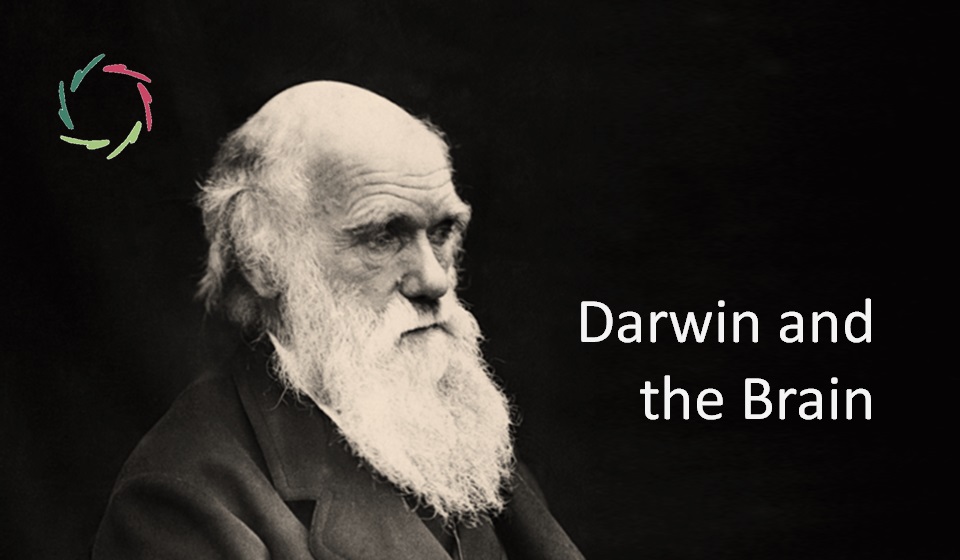
Darwin had it right to the core. We (natural evolution) stumbled into a niche of intelligence/knowledge that brought heaven and hell to earth.
We might choose for heaven, but that’s another blog.
Brain stuff
It happens that the human brain has pretty much the same kinds of neurons and the same kinds of brain parts as our animal cousins — in the first place, the big apes.
The starkest difference is that we have bigger brains. Clearly bigger brains.
Size matters, especially in intelligence, whether natural or artificial.
Something missing?
This difference sets us clearly apart as a species. In that sense, we may be excused to temporarily have had the idea of not being animals at all.
But not anymore, as uplifting as the idea may still be to some.
Why not anymore? The missing has been found.
It has been found even multiple times over several years, and increasingly more with the use of DNA analysis.
The difference between us and other animals has also been exaggerated because many ‘missing links’ are not around anymore. ‘We’ (our ancestors) either murdered/competed them out or sexed them in. Otherwise, there would be a bunch of hominids running around.
I wonder what we would do with them now.
Some animals have bigger brains.
Namely, elephants, whales, and some dolphins.
Our advantage to these is naturally having some additional tools that we (evolution) have further developed in brainy interplay.
Masters of exaptation
This way, we got excellent grabbing tools — hands and fingers. We got excellent communication tools — facial expressions and vocal cords. We got a handy upright position.
On top of it all, we got complex social interactions.
None of these have evolved from the beginning to foster intelligence or intelligent behavior. They have been co-opted by emerging intelligence and made into its practical tools. This general process is called ‘exaptation,’ and is no evolutionary exception. We happily used it in our niche.
The lesson of the brain
If nothing else already does, the human brain clearly shows that we are animals. One might see this insight as reductive — the more so if it is (mis)used as such by boiling down each human trait to a simplistic, surface-level explanation. Many resist darwinism not because of the science but the sorry misuse.
Such reductionism does not only denigrate us but the whole animal kingdom. We, animals, are more complex, profound, and interesting than that. At the dawn of super-A.I., it’s about time we recognize this.
Thus, we have to find our dignity elsewhere.
We need to be humble to see how valuable we are. That may take more work than simply assuming we’re so special ‘because,’ but eventually, it’s so much more gratifying.
As a result, we might find our true dignity in Compassion, basically.
Related Posts

What’s Your Legacy?
Everyone wonders, at least once, how they will be remembered. Some wish to leave a visible mark; others hope simply to be cherished by those they love. Yet behind all this lies a deeper question: what truly endures of a human life? Legacy may begin as a personal dream, but it points toward something far Read the full article…

The Importance of ‘Certainty’
With ‘certainty’ I mean something that you can see as a kind of open surrogate for the belief in a placebo. This is to say: the action of believing in it (so the power, without the lie of it). It is a ‘certainty’ that you can basically take up yourself and that makes many things Read the full article…

The Whirlpool of Economics
“Good institutions create individual trust, which creates rich economies.” This is the short summary as given by some of 2024’s Economics Nobel Prize-winning insight, countering the contention that rich economies just create good institutions. As in the whole field of psychosomatic health, such linearities may be only part of excellent causal thinking. Reality is more Read the full article…