How to Touch the Heart and Soul
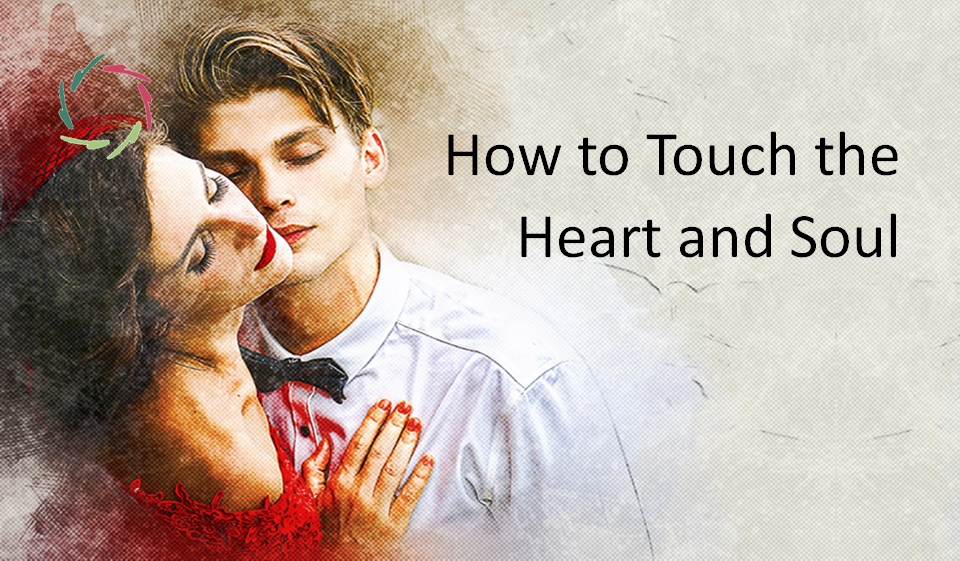
This is symbolic. Also, it is crucial in many human situations. People try to do this touching for diverse reasons.
With ‘soul,’ I mean a direction that possibly goes deeper than the ‘heart,’ without denoting where it ends.
For diverse reasons
Some of these are not readily respectful: selling stuff, surface-level populism, seducing someone to take advantage of that same person.
It seems to work also in these situations — more or less, although far less is clear than is generally thought (and sold, for instance, as marketing or HR expertise).
Between lovers
Many genuine lovers are experts in touching each other’s heart and soul — love being the most natural way to accomplish the touching.
The expertise may fade when the love diminishes, again showing love itself is the active factor. Love is the ‘how.’
Any other reason may be faking love.
It’s a pity as such and quickly leads to dismal consequences. For instance, people are led through marketing to overconsumption, seeking depth they will never find this way and, meanwhile, destroying the planet.
For instance, abusive populists may lead people into hating other peoples or even each other for being the so-called cause of their own misfortunes or lack of depth.
For instance, someone may be seduced into heartache and never fully recover.
In coaching
Compassion, love, and excellent coaching are closely related. There is no fake involved, even when coaching is brought in a professional setting. Of course, the relevant agreement between coach and coachee should be crystal clear. On the one hand, this closeness is needed for the coaching’s effectiveness. On the other hand, this leads to situations in which abuse by the coach is more readily within reach ― seducing to take advantage.
Coaching can be seen very broadly. AURELIS coaching might well be especially effective, more than any other, in my view. Therefore, the caution is also especially pertinent.
In storytelling
There is nothing magical about a story, nor is it principally fake, even when brought as fiction. The agreement between the teller and listener is overt. What the story is about and how it is told can, therefore, touch the heart and soul.
A good story is like an easily flowing river through your mental landscape. You can put your boat on the river and let yourself drift along. The river then – you can say – lets you discover a part of the landscape (your mind) that you would otherwise miss for lack of time, patience, motivation, or preliminary insight.
From the boat, you can symbolically touch the environment. You might even take a halt and disembark. An excellent story invites you to do so ― as an act of love. If it doesn’t, then it’s a mere pastime. There’s generally no harm in this, but you might prefer the real thing.
Because
the real thing is what we are living for.
Related Posts
Rewards or Value?
Are people driven more by direct rewards or broader value? Should A.I. be driven rather by one or the other? What about end values? Zero-sum values These are nothing but the sum of individual rewards. For instance, one earns tokens on several timesteps. The eventual zero-sum value is the sum of all tokens earned ― Read the full article…
Insight is a Path
The way one reaches an insight is at least as important as the insight itself, viewed as an accomplished piece of knowledge. This is highly important in many situations. Please read [see: “Insight is Not a Supermarket“] Close to wisdom As I use the term, insight is more than just an intellectual idea. It always Read the full article…
What’s in It for Me?
At least half the world turns around this — no circumventing it. Therefore, it may be easier to change the ‘me.’ However, of course, the ‘me’ doesn’t readily want to be changed from the outside. Therefore, supporting the ‘me’ in changing from the inside out is recommended. Which is mental growth — coaching, everywhere. Also Read the full article…