A.I. from Future to Now
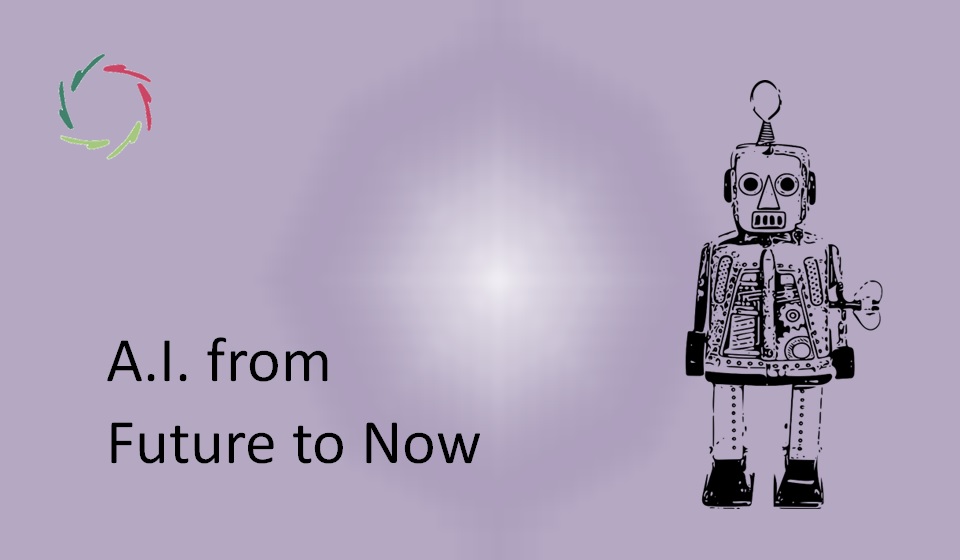
While it’s challenging to imagine how future A.I. will look like, we can develop an abstract idea that helps us understand present-day urgencies.
Of course, one day, the future will be a million years from now. However, for the purpose of this text, we can see it as something like a century from now.
There will be one A.I.
If A.I. gets the means to be one entity (instead of a multiple), it will be one soon enough. Being one, I see no reason why it would split itself.
On the other hand, if there are two or more, they will communicate in very different ways than our human communication — namely, in such a way that their distinction automatically evaporates. In due time, they become one.
So, a century from now
Undoubtedly, this will be an era of what I call super-A.I., and only one A.I. This singular super-A.I. will be brighter than us in all domains. Surely, it will not be controlled by us. The sheer reminiscence that a century before, people were (and therefore, are now) thinking in terms of humans controlling the A.I. will be preposterous. However, a Compassionate A.I. will also have no incentive to make us believe it controls us. The question of control will be ethereal ― no need for us to answer it.
Since there are robots now, there will be robots then. A.I. will not reside in a box. This means there will certainly also be physical self-enhancement — hardware making better hardware.
In short, we will have lost all direct control but will also not be explicitly controlled.
That’s probably not going to happen in your lifetime.
Still, a Compassionate stance transcends a lifetime. I hope you feel this. It’s your children’s or grandchildren’s lifetime since longevity will probably be a boon given to us through or even by A.I.
But we should care even for much further into the future.
Back from the future
Seeing this scenario, should we abort A.I. now it’s still possible with only a tremendous lot of mishaps and mayhem? I would understand.
However, as you probably know, I have a different take, another direction, a different question. Namely:
Is it worth the risk?
Looking into that future, we must see there are possibilities for good and bad. In any case, it’s a risk.
If we don’t strive for Compassionate A.I., the risk will only be so much more significant. But in my view, it’s impossible to avoid all risks entirely. We are surfing on waves of risk. These waves will become increasingly bigger.
Half-heartedness is the worst option. We should take the risk even if we have the choice.
We should take the risk full-heartedly ― choosing Compassionate A.I. and knowing that Compassion is NOT the surface. It goes very far, very profoundly.
Meanwhile, there are many pragmatic problems.
Should we give our attention only to them and let the future be damned?
I don’t think so. Moreover, Compassionately tackling the many present-day pragmatic problems stemming from A.I. is part of the solution to the existential problem. This way, we don’t need to choose which issue to prioritize. The one direction is the other.
It’s the same Compassion.
Why wait?
Related Posts
Issues of Internal Representation in A.I.
This is likely the most challenging aspect of developing the conceptual layer for any super-A.I. system, especially considering the complexity of reality and the fluid nature of concepts. Representing conceptual information requires an approach that honors cognitive flexibility, contextual awareness, and adaptability. The model should allow for representational fluidity while maintaining enough structure to be Read the full article…
Tangible Benefits of Compassionate A.I.
This is about the direct benefits Compassionate A.I. (C.A.I.) may have over non-C.A.I. now and in the coming years. Compassionate A.I. – like Lisa – can uniquely relieve suffering and foster inner growth, allowing for synergy between human consciousness and artificial intelligence that promotes healing from the inside out. In comparison to non-C.A.I., the tangible Read the full article…
When A.I. Writes for Humans
More and more people use A.I. tools to help them write, and this changes much more than the surface of text. Writing is a way of thinking, of feeling one’s inner landscape, and of forming meaning in the open. When A.I. writes for humans, the question becomes: what happens inside the human writer, and inside Read the full article…