Does Talking Help?
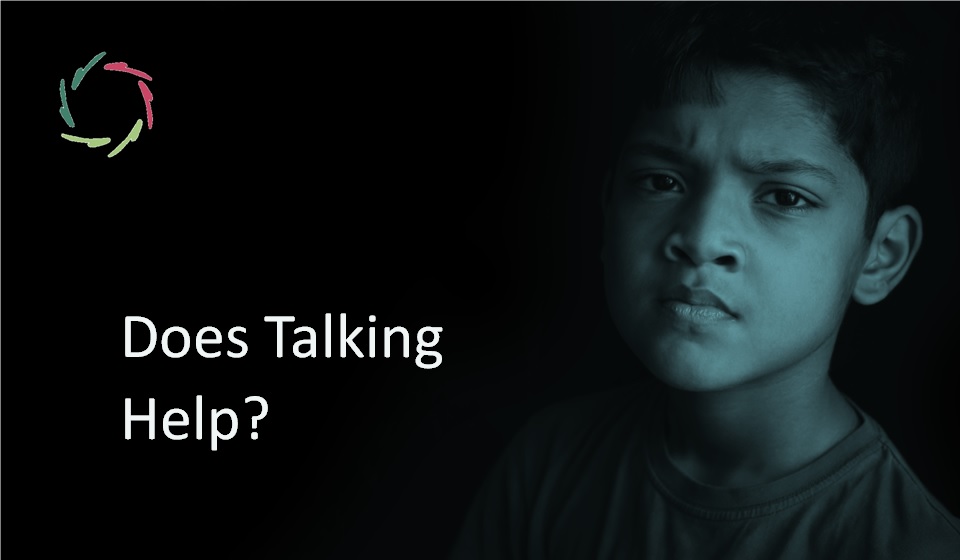
Talking as an indiscriminate empathy-vehicle in therapy/coaching may be more than nothing, but the aim should be higher.
A good feeling is not enough to profoundly relieve pain and heighten Compassion.
Conceptual methodologies for mental help
Conceptual methodologies aim for more, but they generally don’t realize much in the direction people need for durable change from the inside out ― say, growth.
Being conceptual all the way through, their goal is not entirely client (as a total person)-friendly. People need more, and that is certainly possible.
Is talking as such an excellent vehicle for empathy?
One shouldn’t take this for granted. Research into talking therapies shows their potential to harm ― for instance, in post-traumatic stress situations.
Moreover, even when talking by itself may temporarily help, it can hold back from searching deeper. People may think this is all the help needed. Alternatively, they may believe that no further support is possible.
Thus, the effect may be rather negative than positive in the long term ― depending on the goal, also if it appears not to be so.
Anyway, the goal must be much higher.
People searching for mental help can be seen from a medical viewpoint: individuals with some mal-ease (or dis-ease, in a further stage) who need restoration toward a state without the mal-ease ― therefore, being cured.
The same people can also be seen as in need of mental growth. Their mal-ease is then a symptom of this deeper aim. They need no restoration but help in their mental growth, as a result of which the mal-ease will diminish.
Sure, talking may help, but not straightforwardly.
The talking that carries surface-level empathy is not enough. Happily, even in mere talking, some profound insight may make things more interesting.
For instance, in education, human depth should be strongly valorized. Unfortunately, an emphasis on STEM seems to make us go backward in this regard almost all over the world.
As a result, many may increasingly think there is nothing much to what is probably the most complex thing on Earth: the human being as total person.
There is clearly much work to be done.
AURELIS coaching is part of what is needed.
AURELIS coaching-methodologies are worked out to enable a coach to become a better coach as a total person. These methodologies may also be interesting for anyone to listen more profoundly and communicate more effectively in this regard.
They are tools to make you a better instrument as a coach and a person.
You’re welcome.
Related Posts

Your Symptom as ‘The Total You’
<A symptom is not just a part of you—it is the total you.> This perspective allows you to see a symptom as a gateway to self-understanding and transformation. When viewed this way, the symptom embodies all that you are. Engaging with it becomes an opportunity to connect deeply with your whole self. 12 key highlights Read the full article…
A Taste of Pain
Pain is not always easy to ‘endure’ if you necessarily want to ‘endure’ it. There are only 4 basic tastes (or 5, if you count in ‘unami’) that we can distinguish on the tongue: salty, sour, sweet and bitter. All other flavors that we taste with the tongue are somehow combinations of these 4. Makes Read the full article…
In Mind-Matters, We’re still Pre-Science
Well, mostly. Unfortunately, as we were still pre-science in body-matters 250 years ago, we still are in mind-matters today. In healthcare 250 years ago, practices like bloodletting, enemas, and the theory of four humors were prevalent. There was some science in that pre-science era, but it was pretty limited. Note that in this blog, ‘mind’ Read the full article…