Am I a Conscious Being?
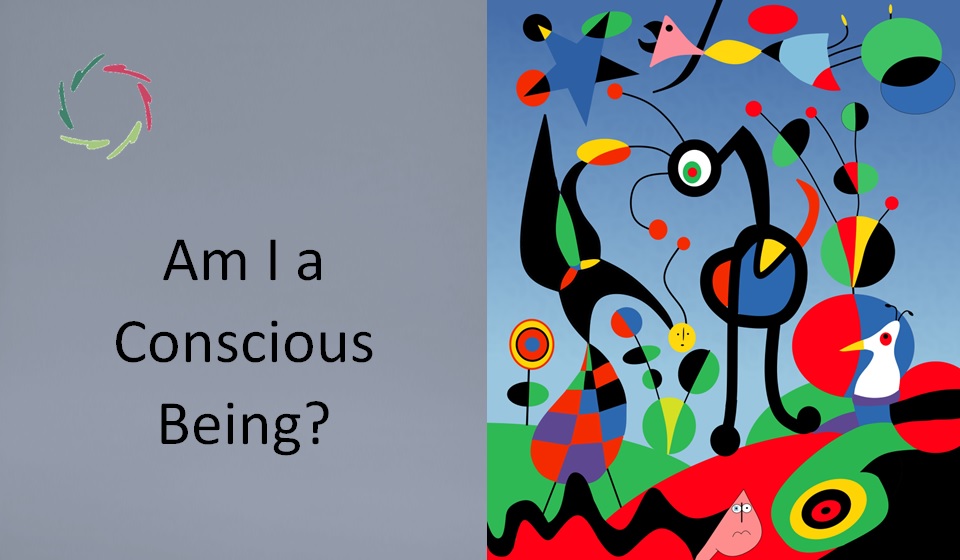
It depends on the meaning of the term ‘conscious.’ Surely, I feel conscious, but that eventually proves nothing.
See Qualia
Philosophically
“I am conscious; therefore, I am.”
Not necessarily. There is a ‘me-being-conscious’ as a feeling, an experience. Thus, better said, there is a ‘me-feeling-conscious.’
Can one, from within this me-feeling-conscious, speak of a me and of consciousness? Yes, but me-feeling-conscious can also merely be an illusion. The only certainty is the feeling itself, which doesn’t prove that my consciousness exists or that I exist even within the potential illusion. There may be just something floating somewhere as me-feeling-conscious.
Also, me-feeling-conscious certainly doesn’t prove that my consciousness exists apart from a body. It may be just another name for the activity of my body ― no reduction unless if I wanted my consciousness to be something exquisitely magical.
I’m fine without magic ― no spooky consciousness.
That means that, indeed, it’s just another name for the activity of my body ― another name stemming from another viewpoint. This way, my body is not the cause of my consciousness.
As an analogy, you may now flex your forearm by contracting your biceps muscle (in the upper arm). When you do so, thousands of little fibers in your biceps shrink in size. Does the fibers’ shrinking cause the biceps’ contraction?
Think about it one moment before proceeding.
The answer is: No, there is no causation from the fibers’ action to the muscle’s action. The bicep’s flexing is just another viewpoint’s term (looking from the outside) for what happens when the fibers contract (looking from the inside). Meanwhile, it is the same thing ― two views, one action. This action causes your forearm’s flexing.
Another example of this principle lies in thermodynamics. As you may know, there is continual movement of molecules within any substance. The scientific term for this is molecular kinetic energy. At any moment, the mean molecular kinetic energy correlates with the large-scale property of temperature. The faster the movement, the higher the temperature. Yet, the movement doesn’t cause the temperature. This movement is what temperature is. Only the way of describing the phenomenon differs.
The same with consciousness as an experience and the movement of neurons/synapses in your brain. In the biceps case from above, they are both – with some abstraction – the conscious decision to move your forearm. This decision causes the contraction, which causes the flexing. No conscious awareness of fibers is needed for this, nor even of bicepses. One just ‘flexes one’s forearm,’ which can be done consciously or automatically.
Let’s agree that I and my consciousness exist.
Even if it’s by way of speaking, for the argument, then let’s talk this way.
That still doesn’t say what we are. It still doesn’t say what it is that exists. More to the point, is there a fundamental difference between me and a non-conscious table? Otherwise asked: Am I, even in the potential illusion, just a machine that thinks to be conscious?
May consciousness be a thought like any other ― from the brainy view, an active mental-neuronal pattern (MNP)?
If a table could have this thought, would it be a conscious table?
What about a super-A.I.?
Please, don’t get too confused about this. Because now comes the following question.
Am I only the conscious part of my being?
The real me is the total me. The ‘total human being’ – the real me – is conscious and non-conscious taken together. The conscious, self-perceived me is a tiny part of that.
Yet, when saying “I am aware,” people usually mean that they are totally aware. Thus, the ‘aware me’ is apparently totally conscious. It seems like the total me is thus confined to the conscious part. Yet, the ‘aware me’ is only part of the real me. This contradicts itself in a few sentences.
So, I have a non-conscious.
Who has a non-conscious? My consciousness? My total human being?
Or may it be the other way around: my non-conscious having me? As far as I see, most scientific data point to this being the preferred stance to comprehend who we are and why we do what we do ― including me. My ‘total human being’ may be partly conscious, but even this acts as the emergence of non-conscious processing. There is no fundamental divide between both.
So, am I a conscious being?
For the most part, at any discrete moment, no. “I am aware of something” means that only a part of me is consciously aware of it (if I call it so). Most of what happens in my mind happens non-consciously. I can even be non-consciously aware ― on automatic pilot. The fundamental difference in consciousness between me and a table is, in a certain way, small. We are both mostly non-conscious.
Still, a part can make a huge difference.
Then, what difference makes consciousness?
Does it make all the difference or almost none?
It’s a choice.
Related Posts
The Scientific Mind
What defines true science? Beyond methods and data, the scientific mind is a way of thinking that thrives on deep questioning, self-reflection, and expanding understanding. While methods evolve, the scientific mindset remains constant, pushing beyond rigid frameworks and questioning even its own foundations. This blog explores the difference between methods and mindset, the role of Read the full article…
Managing Inner Strength without Chaos or Coercion
The challenge of managing the Inner Strength of many individuals has persisted throughout human history. Cultures and societies have oscillated between chaos, where individuals’ freedoms overwhelm the collective, and coercion, where imposed control stifles growth and leads to stagnation or revolt. AURELIS introduces a third way: fostering shared depth and Compassion to align individuals naturally, Read the full article…
Depth is Always Present, Sometimes Invited
Depth is not something added to life from the outside. It is already present in ordinary moments, in silence, in beauty, in hesitation, in a sincere question, in the way meaning sometimes gathers before words are ready. Yet depth does not always appear to us. It asks for conditions: openness, space, patience, and a certain Read the full article…