Inner Dissociation – Ego – Total Self
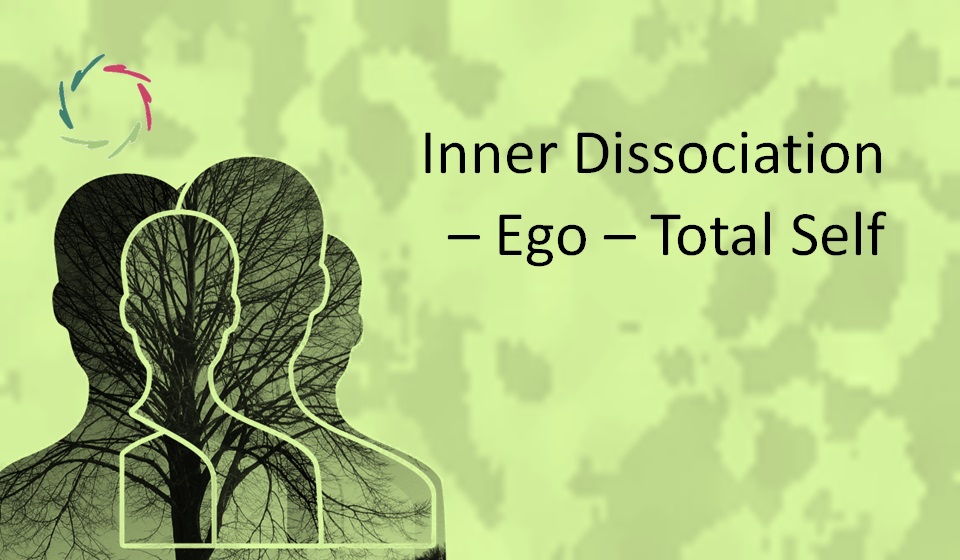
Inner dissociation is a wrongly perceived divide between – more or less – conceptual and subconceptual mental processing. Metaphorically, the dissociation lies between the ego and the total self.
Reality is always more complex.
Functionally
In-depth, of course, the ego is part of the total self.
Moreover, any conscious ego-element is engendered in deeper subconceptual layers (of total self) ― whether it starts here or in the outer world or as a mutual reaction of one to the other.
So, any divide between the ego and the total self can only be functional. In other words, the ‘divide’ points to the dynamic interpretation of a happening, not a static entity. The dissociation is not between two separate things ― yet the result is as if this would be the case.
The basic cognitive illusion – not seeing the functional divide – is an illusion nevertheless, in which mere-ego acts as if there is nothing else but mere-ego within a total person.
Bad consequences
Bad consequences from tensions between the – functionally – dissociated entities are so ubiquitous that I dare say inner dissociation is never OK. It leads to much anticipatory anxiety (distress) and ruminating depression (regret), not to mention aggression between individuals and between groups/societies.
Yet potentially, there is also good involved, depending on how people try to cope with their dissociation.
Humanity’s best
Eventually, the most profoundly beautiful aspects of the human being lie in the ways people may try to cope with their inner dissociation ― this is: toward giving the ego a place in total self where it can be a part of the opening up:
- Accepting one’s flaws ― nevertheless, trying to be a good person.
- Not running away from one’s essential loneliness ― nevertheless, searching for a door to someone else’s loneliness, a lifetime.
- Living as a deeply flawed person ― nevertheless, being confident everything will turn out all right.
- The knowing that obstacles are high ― nevertheless, believing in life’s journey and one’s ability to keep going.
This is mental growth. It can take serious effort ― not easy but meaningful and attractive, especially in a complex reality.
Is it worth it? Absolutely!
Related Posts
46. Is there life beyond conceptual thinking?
Here’s the picture. On the one hand, we think with or by way of concepts. A concept can be anything like <tree>, <grandmother>, <character>. It is not ‘this tree’ but <tree>. The concept of <tree> can be filled in by any specific tree (called then an ‘instance’ of the concept). The concept of ‘tree’ has Read the full article…
Surface wins the moment. Depth wins the soul.
In today’s world of speed and stimulation, surface easily wins attention — but it cannot carry the weight of meaning. This blog explores the silent contrast: where surface culture dazzles the moment, it is depth that nourishes long-term inner growth. Here, AURELIS and Lisa offer not escape from modern life, but reconnection to what makes Read the full article…

Deep Analogy
Deep analogy lives at the heart of intelligence itself. It is the mind’s way of sensing patterns that move alike, even when they look different. From this resonance arise creativity, empathy, and the possibility of Compassion. This blog explores how deep analogy connects rational clarity with inner depth — a bridge between human understanding and Read the full article…