No Compassion without Growth
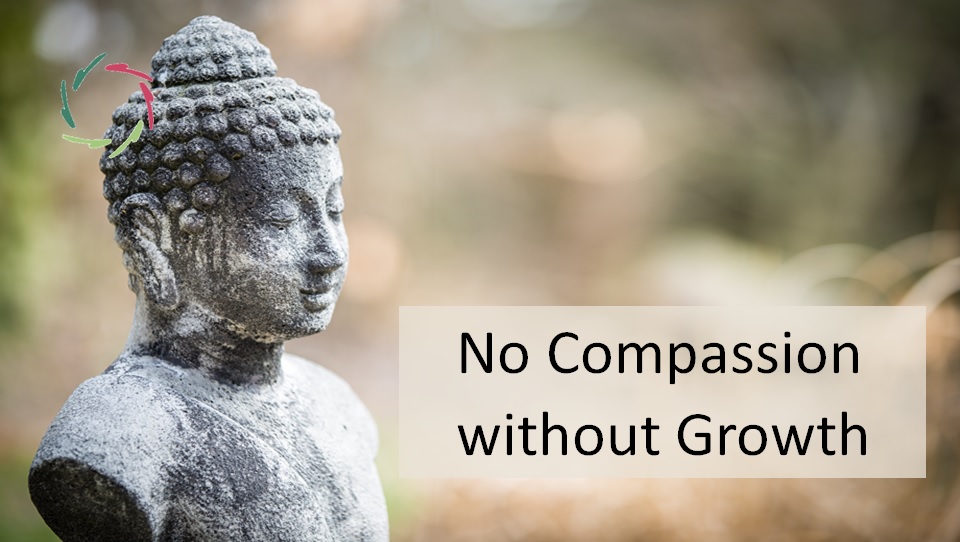
Striving towards Compassion puts you in the balance. Are you willing to take the risk? Are you willing to fundamentally ‘grow’?
This is about big-c-Compassion ― not something pity-like. [see: “Essence of Compassion”]
Please also read [see: “Growth, Compassion, Love”]
Compassion will not happen without effort.
A Compassionate person doesn’t mind the effort. Like Grace [see: “Grace”], Compassion needs to be earned. Eventually, it may come spontaneously, but not by miracle, nor by talking about it. The final spontaneity is the result of effort ― sometimes a considerable amount of it.
This effort lies in personal growth. [see Cat.: “Personal Growth”] Basically, it is a development at the subconceptual level [see: “About ‘Subconceptual’”] ― thus, by definition, pretty vague. It’s easy to use the terminology without much insight. It’s easy to think one is doing great stuff in personal growth.
That is precisely a condition that may thwart it.
Humility is crucial
We’re talking about growth, becoming better, more meaningful, more ‘worthy’ as a total person, more Compassionate.
Therefore, people who want to build on Compassion in this world must understand and practice ‘humility of ego.’ [see: “Humility”] In my understanding and experience, this requires continual practice. Otherwise, the ego knows many ways to put itself on a pedestal.
The more growth as a total person – which is what we are talking about – the more the ego must stay humble, even while it finds it harder to do.
Mere-ego is like a shell that prevents all inner growth.
This shell is the basic cognitive illusion of seeing everything through invisible inner glasses. [see: “The Basic Cognitive Illusion”].
It may make anything related to the subconceptual either invisible or seem like something straightforward, childlike even. And in a way, it is. One needs to keep a beginner’s mind. [see: “Beginner’s Mind, Forever”] However, in this very same way, it is hugely complex. Beginner’s mind is – in the culture of its origin – the mind of the Zen master.
Not-knowing while knowing very well. [see: “Into the Not-Knowing”]
A meditative mindset is essential.
In a Buddhist image, the meditative mindset is the pond’s soil in which lotus flowers may grow. The flowers are acts of Compassion, big or small, life-changing or just a deep-friendly word ― which may also be life-changing.
The soil is humble, yet without it, there are no flowers.
Formal meditation (on a cushion, for instance) may not be needed, but the mindset is. This has been correctly sensed in much of Buddhism.
It is a Compassionate mindset.
At the same time, it’s what inner growth is about: growing from and towards this mindset. It’s like filling one’s inner bucket until it overflows.
Out flows Compassion. [see: “In-Depth Compassion”]
Gracefully.
Related Posts
Empathy vs. Placebo
As in other cases, how terms are used is of little importance as long as crucial conceptual distinctions are valued. The landscape of subconceptual communication Mere consciousness is not the realm of subconceptual communication (SC). [see: “About ‘Subconceptual’”] This is also the case in health-related issues. [see: “Subconceptual Processing in Health and Healing”] A patient Read the full article…
Can Compassion Draw Us out of Decadence?
Worldwide, people have been struggling, are struggling, and will do so even more regarding a sense of decadence. That is a bad omen for things to come, but there is a way out. Etymologically ‘Decadence’ comes from the Medieval Latin decadentia = decay. This comes from the Latin decadere = de (down) + cadere (to Read the full article…
We are Made for Compassion
Let’s not be naive. Compassion exists — yet, from both a close-up and a distant perspective, we witness a profound lack of it in the world. So, ‘made for Compassion,’ really? Also, ‘made for’ does not imply an intelligent designer who made us. That is unless you see an extremely long history of trial and Read the full article…